Close
Back


From now on you can download videos from our website
If you would also like to subscribe to the newsletter and receive our latest updates, click on the button below.
Enter the email address you registered with and we will send you a code to reset your password.
The password must be at least 12 characters long, no spaces, include upper/lowercase letters, numbers and symbols.
Click the button to return to the page you were on and log in with your new password.
07 July 2026
1 MIN READ
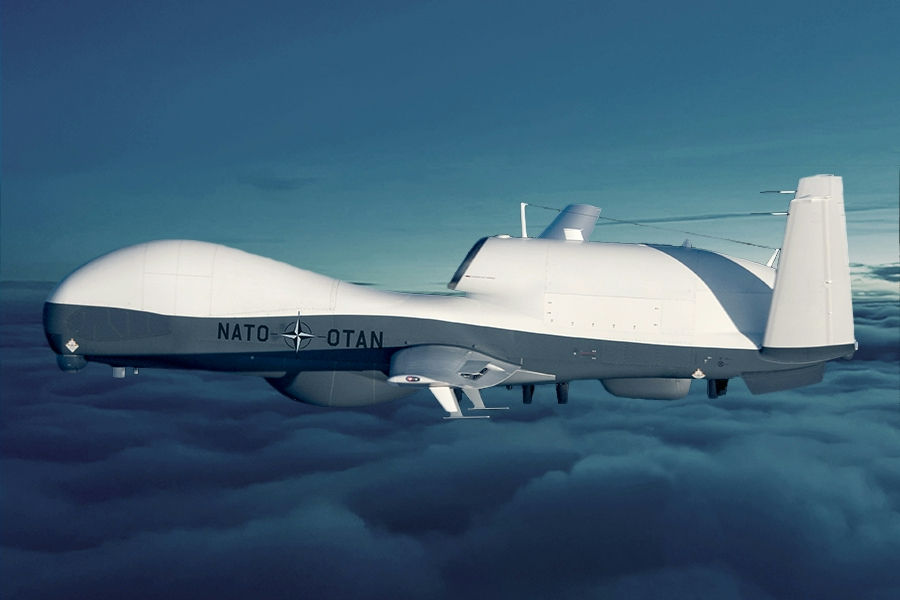
On Tuesday (7 July), Denmark, Finland, Germany and Norway announced the procurement of up to five Northrop Grumman’s MQ-4C Triton high-end, high-altitude and long-endurance uncrewed aircraft to enhance NATO’s owned Intelligence, Surveillance and Reconnaissance (ISR) Force.
The announcement was made at the NATO Summit Defence Industry Forum in Ankara, Türkiye. The new aircraft will complement NATO’s Alliance Ground Surveillance (AGS) Fleet that operates from Sigonella airbase in Italy.
Triton aircraft offer high-end technological capabilities. Specifically designed for maritime surveillance, the aircraft can sustain 24-hour flights at an altitude of more than 15 km.
Equipped with long-range sensors, Triton aircraft will increase Allies’ ability to detect threats early, protect our sea lines of communication, and support operations in demanding regions, such as the Arctic and the High North.
A transatlantic industrial consortium is being formed to deliver this capability. While Northrop Grumman will build the Triton aircraft, Airbus Defence and Space and other European companies will provide the ground segment, data management services, command and control, infrastructure and mission support. This leverages the work and transatlantic relationships built upon the last decade to enable a modern and capable NATO ISR Force.


NATO expands its Intelligence, Surveillance and Reconnaissance Fleet with the purchase of Triton aircraft Chief of Defence of Germany Carsten Breuer, Minister of Defence of Norway Tore O. Sandvik, NATO Secretary General Mark Rutte, Northrop Grumman Vice President International Frank Morley, Minister of Defence of Finland Antti Häkkänen and Minister of Defence of Denmark Jeppe Bruus Christensen
NATO’s new Airborne Warning and Control System is announced.
NATO’s new Airborne Warning and Control System is announced. NATO Secretary General Mark Rutte, CEO of Saab Group Micael Johansson and Prime Minister of Sweden Ulf Kristersson
NATO’s new Airborne Warning and Control System is announced.
NATO Allies expand strategic airlift capacity - Airbus A400M and the A330 MRTT
NATO Allies expand strategic airlift capacity - Airbus A400M and the A330 MRTT
NATO expands its Intelligence, Surveillance and Reconnaissance Fleet with the purchase of Triton aircraft
NATO Secretary General Mark Rutte reveials major capability announcements at the NATO Summit Defence Industry Forum. NATO Secretary General Mark Rutte and Minister of Defence of Türkiye Yaşar Güler
NATO Secretary General Mark Rutte reveials major capability announcements at the NATO Summit Defence Industry Forum. NATO Secretary General Mark Rutte with Executive Vice President Global Business at Airbus Defence and Space Ben Bridge, Northrop Grumman Vice President International Frank Morley and CEO of Saab Group Micael Johansson
NATO Allies expand strategic airlift capacity - Airbus A400M and the A330 MRTT
NATO Secretary General Mark Rutte reveials major capability announcements at the NATO Summit Defence Industry Forum
NATO’s new Airborne Warning and Control System is announced.
NATO’s new Airborne Warning and Control System is announced.
NATO expands its Intelligence, Surveillance and Reconnaissance Fleet with the purchase of Triton aircraft
NATO Secretary General Mark Rutte reveials major capability announcements at the NATO Summit Defence Industry Forum
NATO Secretary General Mark Rutte reveials major capability announcements at the NATO Summit Defence Industry Forum
“Big Reveal” Announcement