Close
Back


From now on you can download videos from our website
If you would also like to subscribe to the newsletter and receive our latest updates, click on the button below.
Enter the email address you registered with and we will send you a code to reset your password.
The password must be at least 12 characters long, no spaces, include upper/lowercase letters, numbers and symbols.
Click the button to return to the page you were on and log in with your new password.
07 July 2026
2 MIN READ
On Tuesday (7 July 2026), NATO Allies made progress on providing innovative and cost-effective solutions for munitions and deep strike systems, delivering them faster and at greater scale.
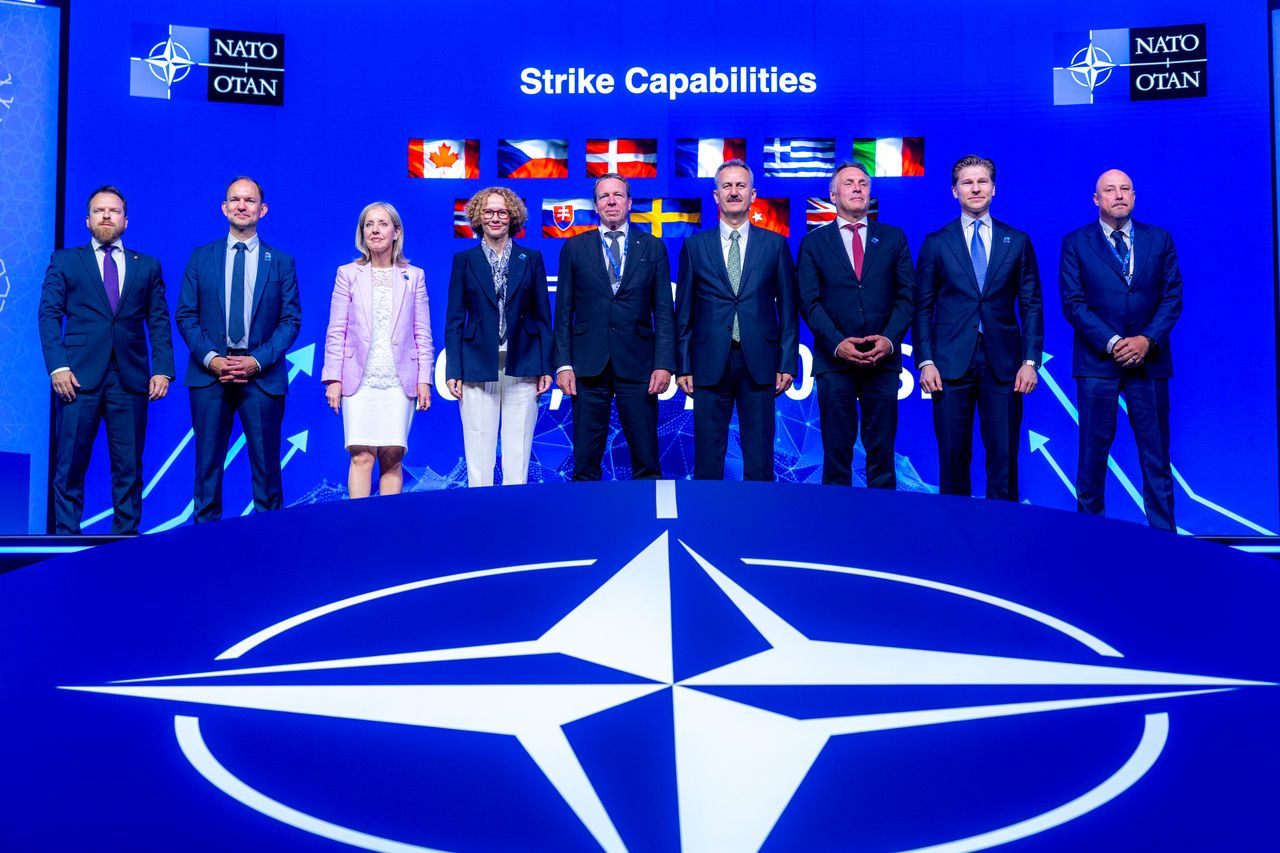
At the NATO Summit Defence Industry Forum in Ankara, Türkiye, nine Allies (Canada, Czechia, Denmark, Finland, Greece, Norway, Slovakia, Sweden and Türkiye) agreed to work together on the development of a prototype for a generic NATO 155mm munition. The Generic NATO Indirect Fire Round (GENIFR) multinational High Visibility Project (HVP) will set up the parameters for a future fully interchangeable, interoperable NATO 155mm munition. It will help streamline and accelerate production, while eliminating constraints that affect Allied artillery systems.
At the Forum, six Allies (Denmark, France, Italy, Norway, Türkiye and the United Kingdom) also launched NATO’s multinational Ground-Based Precision Strike Capabilities High Visibility Project to explore the multinational development of novel deep precision strike capabilities, including new launchers and missiles.
In addition, NATO’s Support and Procurement Agency (NSPA) helped deliver several framework contracts to procure additional 155mm ammunition and loitering munitions. Türkiye also announced a major national investment in ATMACA land-based, long-range cruise missiles.
Developing and producing advanced strike capabilities is complex and costly. Lack of compatibility and interoperability has been a recurring issue that effects production capacity. As shown during the war in Ukraine, the threat of long-range strikes is growing and evolving fast, requiring a more agile approach in the development and use of such capabilities. By leveraging multinational projects and joint procurement, Allies can share development costs, accelerate timelines, achieve economies of scale, and field capabilities more quickly than if done alone.


Launch of NATO’s multinational Ground-Based Precision Strike Capabilities High Visibility Project with representatives of Denmark, France, Italy, Norway, Türkiye and the United Kingdom with NATO Deputy Secretary General Radmila Shekerinska
Launch of NATO’s prototype for a generic NATO 155mm munition with representatives of Canada, Czechia, Denmark, Finland, Greece, Norway, Slovakia, Sweden and Türkiye with NATO Deputy Secretary General Radmila Shekerinska
Türkiye announces major national investment in ATMACA land-based, long-range cruise missiles
Strike Capabilities