Close
Back


From now on you can download videos from our website
If you would also like to subscribe to the newsletter and receive our latest updates, click on the button below.
Enter the email address you registered with and we will send you a code to reset your password.
The password must be at least 12 characters long, no spaces, include upper/lowercase letters, numbers and symbols.
Click the button to return to the page you were on and log in with your new password.
Defending against chemical, biological, radiological and nuclear (CBRN) threats
Updated: 22 June 2026
Weapons of mass destruction (WMD) – including chemical, biological, radiological and nuclear (CBRN) weapons – are some of the greatest threats that NATO faces. The Alliance is therefore committed to countering these threats in two key ways: (1) strengthening both its military capabilities and the resilience of its societies to defend against attacks, and (2) working to prevent the proliferation of WMD through an active political agenda of arms control, disarmament and non-proliferation.
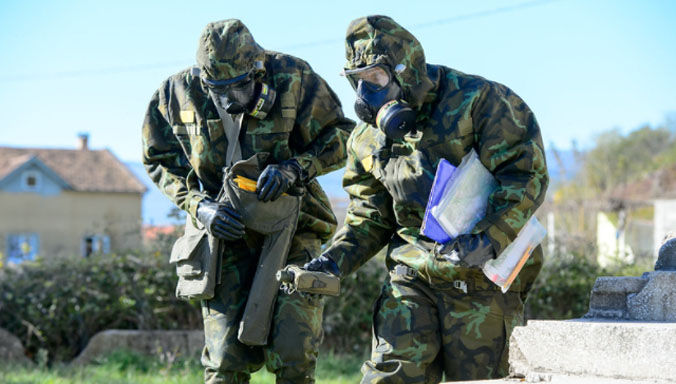
NATO defines a “weapon of mass destruction” as any weapon or weapons system employing CBRN materials that is able to cause widespread devastation and loss of life.
“CBRN materials” are chemical, biological, radiological or nuclear substances that may pose a hazard to NATO populations, territory and forces. This includes materials such as:
The difference between WMD and CBRN threats is one of intention: WMD refers to the intent to cause large-scale harm, while CBRN refers to the specific type of substance used, regardless of origin or whether the material was originally conceived as a weapon.
NATO’s WMD and CBRN defence capabilities are prepared to address any hazard, whether its origin is intentional or accidental. For example, during the COVID-19 pandemic, NATO Allies used CBRN defence equipment and used the experience gained from counter-CBRN training to help prevent the spread of the coronavirus.
The Alliance’s strategy to address WMD and CBRN threats is laid out in NATO’s Chemical, Biological, Radiological and Nuclear (CBRN) Defence Policy, agreed by Allies in June 2022. The policy stresses that NATO’s approach to WMD includes both military and civilian elements.
NATO is prepared for recovery efforts – should it suffer a WMD attack or CBRN event – through a comprehensive civil-military approach.
In addition to these measures to prepare for potential CBRN attacks, NATO Allies work with a wide network of international partners to prevent the proliferation of WMD, reducing the overall risk posed by these weapons.
NATO Allies maintain a wide range of national CBRN defence capabilities, ranging from CBRN reconnaissance and decontamination to warning and reporting, individual protection, and CBRN hazard management. NATO itself continues to significantly improve its CBRN defence posture with multinational capabilities, such as the Combined Joint CBRN Defence Task Force, the Joint CBRN Defence Centre of Excellence and other NATO bodies that support NATO's readiness to deal with any WMD threat.
The Combined Joint CBRN Defence Task Force is a deployable NATO asset designed to perform a wide range of CBRN defence missions. It is composed of the multinational CBRN Defence Battalion and the CBRN Joint Assessment Team. The Task Force is led by an individual Ally on a 12-month rotational basis. It operates under the authority of the Supreme Allied Commander Europe.
The Joint CBRN Defence Centre of Excellence (COE) in Vyškov, Czechia was activated in July 2007. It is an international military organisation sponsored and staffed by Canada, Czechia, France, Germany, Greece, Hungary, Italy, Poland, Romania, Slovakia, Slovenia, the United Kingdom and the United States. It is also open to partners that want to become contributing countries. Austria joined the Centre as the first such contributing country in 2016.
The COE offers recognised expertise and experience in the field of CBRN defence to the benefit of the Alliance. It provides opportunities to improve interoperability among national forces and capabilities by enhancing multinational education, training and exercises; assisting in concept, doctrine, procedures and standards development; and testing and validating concepts through experimentation. It has thus supported NATO's transformation process.
The COE integrates a CBRN Reachback Element (RBE), which reached full operational capability in January 2016. This Reachback capability provides timely and comprehensive scientific, technical and operational CBRN expertise, assessments and advice to NATO commanders, their staff and deployed forces during planning and execution of operations. The RBE, together with its secondary network (which comprises various civilian and military institutions), is able to operate 24/7, if needed.
NATO creates and improves necessary standardization documents, conducts training and exercises, and develops necessary capability improvements in the field of CBRN defence through the work of many groups, bodies and institutions, including:
The Alliance also continues to create and improve standard NATO agreements that govern Allied operations in a CBRN environment. These agreements guide all aspects of preparation, ranging from standards for disease surveillance to rules for restricting troop movements. In addition, the Alliance conducts training exercises and senior-level seminars that are designed to test interoperability and prepare NATO civilian and military staff and forces for operations in a CBRN environment.
The NATO Science for Peace and Security (SPS) Programme enables collaboration between NATO and partner countries on issues of common interest. This cooperation enhances mutual security by facilitating international research efforts to meet emerging security challenges, supporting NATO-led operations and missions, and advancing early warning and forecasting for the prevention of disasters and crises.
The central objective of SPS activities in WMD non-proliferation and CBRN defence is to improve the ability of NATO and its partners to protect their populations and forces from CBRN threats. The Programme supports research towards the development of CBRN defence capabilities, training activities and workshops in the following fields:
Many of NATO's activities under the SPS Programme focus on the civilian side of nuclear, chemical and biological technology. Scientists from NATO member and partner countries are cooperating in research that have tangible impacts in these areas.
National authorities are primarily responsible for protecting their populations and critical infrastructure against the consequences of terrorist attacks, CBRN incidents and natural disasters. Within NATO, Allies have agreed baseline requirements for national resilience. Together with a package of resilience guidelines, evaluation criteria, assessments and a tailored toolbox, the objective of the baseline requirements is to support Allies in enhancing their resilience and to provide benchmarks against which to assess their state of civil preparedness.
An extensive network of civil experts from across the Euro-Atlantic area exists to support these efforts. Their expertise covers all civil aspects relevant to NATO planning and operations, including crisis management, consequence management and critical infrastructure protection. Experts drawn from government and industry participate in training and exercises, and respond to requests for assistance.
NATO Allies work to prevent the proliferation of WMD by state and non-state actors through an active political agenda of arms control, disarmament and non-proliferation. Through cooperation with partners and relevant international organisations, NATO has historically provided strong support to the negotiation and implementation of a number of arms control and non-proliferation agreements.
While often used together, the terms arms control, disarmament and non-proliferation do not mean the same thing.
All NATO Allies are States Parties to the Nuclear Non-Proliferation Treaty (NPT), which is the cornerstone of international efforts to prevent the spread of nuclear weapons and weapons technology, and to achieve the goal of nuclear disarmament. As long as nuclear weapons exist, NATO will continue to be a nuclear alliance. However, since the height of the Cold War, NATO has reduced the number of nuclear weapons stationed in Europe by more than 90 per cent.
All NATO Allies are States Parties to the Chemical Weapons Convention (CWC), and to the Biological and Toxin Weapons Convention (BWC). No NATO member country has a chemical or biological weapons programme. Additionally, Allies are committed to destroying stockpiles of chemical agents and have supported a number of partners and other countries in this work.
Outreach to partners, including international and regional organisations, helps all parties develop a common understanding of WMD threats. It also encourages their participation in and implementation of international arms control, disarmament and non-proliferation efforts. Furthermore, international cooperation enhances global efforts to defend against CBRN threats and improve crisis management and recovery if WMD are employed against the Alliance or its interests.
Every year, NATO organises the NATO Conference on WMD Arms Control, Disarmament and Non-Proliferation. This unique event provides a venue for informal discussions among senior national officials about all types of WMD threats, as well as potential political and diplomatic responses. It regularly includes more than 150 attendees from around 50 countries. The Conference has been hosted by both Allies and partners since it first took place at the NATO Defense College in Rome in 2004.
The Alliance also participates in relevant conferences organised by other international institutions, including the United Nations Office for Disarmament Affairs (UNODA), the European Union (EU), the Organization for Security and Co-operation in Europe (OSCE), the Organisation for the Prohibition of Chemical Weapons (OPCW), the Biological and Toxin Weapons Convention (BWC), and others.
The North Atlantic Council (NAC), NATO’s principal political decision-making body, has overall authority on Alliance policy and activity in countering WMD proliferation and CBRN threats. The Council is supported by a number of NATO committees and groups, which provide strategic assessments and policy advice and recommendations.
The Nuclear Planning Group (NPG), the senior body responsible for NATO’s nuclear deterrence, provides a forum for consultation and decision-making on nuclear policy, doctrine, planning, force posture, capabilities and exercises.
The Resilience Committee coordinates national and collective resilience activities, ensuring that Allies are resilient against military and non-military threats and challenges to the Alliance’s security. The Defence Policy and Planning Committee coordinates overall defence matters, including against WMD and CBRN threats.
The Arms Control, Disarmament and Non-Proliferation Committee (ADNC) is the senior body for discussion of the Alliance’s political and defence efforts against WMD proliferation. It brings together national officials who are responsible for political and security issues related to non-proliferation with experts on military capabilities needed to counter WMD proliferation, to deter threats and the use of such weapons and to protect NATO populations, forces and territory. The ADNC is chaired by NATO International Staff from the Arms Control, Disarmament and WMD Non-Proliferation (ADN) Section of the Political Affairs and Security Policy (PASP) Division. It continues the work of the former Committee on Proliferation (CP), which was the previous senior advisory body to the NAC on WMD and CBRN defence.
The use or threatened use of WMD significantly influenced the security environment of the 20th and early 21st centuries, and will continue to impact international security in the foreseeable future. Strides in modern technology and scientific discoveries have opened the door to even more destructive weapons.
During the Cold War, the use of nuclear weapons was prevented by the prospect of Mutually Assured Destruction (MAD). The nuclear arms race slowed in the early 1970s following the negotiation of the first arms control treaties.
The improved security environment of the 1990s enabled nuclear-weapons states to dramatically reduce their nuclear stockpiles. However, the proliferation of knowledge and technology has enabled other countries to build their own nuclear weapons, extending the overall risks to new parts of the world.
At the 1999 Washington Summit, Allied Leaders launched a Weapons of Mass Destruction Initiative to address the risks posed by the proliferation of these weapons and their means of delivery. The initiative was designed to promote understanding of WMD issues, develop ways of responding to them, improve intelligence and information-sharing, enhance existing Allied military readiness to operate in a WMD environment and counter threats posed by these weapons. Under this initiative, the Alliance established a WMD Centre at NATO Headquarters in May 2000.
At the 2002 Prague Summit, Allies launched a modernisation process that aimed to ensure that the Alliance was able to effectively meet the new challenges of the 21st century. This included the creation of the NATO Response Force, the streamlining of the Alliance command structure and a series of measures to protect NATO populations, forces and territory from chemical, biological, radiological and nuclear (CBRN) threats.
In 2003, NATO created the Multinational CBRN Defence Battalion and Joint Assessment Team, which have been part of the Combined Joint CBRN Defence Task Force since 2007.
At the 2006 Riga Summit, Allied Leaders endorsed a Comprehensive Political Guidance (CPG) that provided an analysis of the future security environment and a fundamental vision for NATO's ongoing transformation. It explicitly mentions the proliferation of WMD and their means of delivery as major security threats, which are particularly dangerous when combined with the threats of terrorism or failed states.
In July 2007, NATO activated a Joint CBRN Defence Centre of Excellence in Vyškov, Czechia.
At the 2009 Strasbourg / Kehl Summit, Allied Heads of State and Government endorsed NATO's "Comprehensive Strategic-Level Policy for Preventing the Proliferation of WMD and Defending against CBRN Threats". On 31 August 2009, the North Atlantic Council decided to make this document public.
At the 2010 Lisbon Summit, Allied Leaders adopted a new Strategic Concept. They also agreed at Lisbon to establish a dedicated committee providing advice on arms control, disarmament and non-proliferation. This committee started work in March 2011.
At the 2012 Chicago Summit, NATO Leaders approved and made public the results of the Deterrence and Defence Posture Review. This document reiterates NATO's commitment "to maintaining an appropriate mix of nuclear, conventional and missile defence capabilities for deterrence and defence to fulfil its commitments as set out in the Strategic Concept".
In June 2022, the North Atlantic Council agreed NATO’s Chemical, Biological, Radiological and Nuclear (CBRN) Defence Policy. Under the policy, the Alliance commits to having the military capabilities necessary to counter WMD proliferation as well as to operate effectively and fight and prevail in any environment. Allies further committed to enhancing their national and collective defence and resilience against CBRN threats of all types.
In the 2022 Strategic Concept, agreed by Allied Leaders at the 2022 Madrid Summit, NATO committed to continue investing in CBRN defence; to enhance its relevant policies, plans, training and exercises; and to ensure that CBRN defence capabilities are integrated into the Alliance’s deterrence and defence posture.
Allies have continued to reiterate the importance of arms control, disarmament and non-proliferation at subsequent summits, reaffirming their commitment to protecting the Alliance and its populations, territory and forces against WMD and CBRN threats.


6 September 2021