Close
Back


From now on you can download videos from our website
If you would also like to subscribe to the newsletter and receive our latest updates, click on the button below.
Enter the email address you registered with and we will send you a code to reset your password.
The password must be at least 12 characters long, no spaces, include upper/lowercase letters, numbers and symbols.
Click the button to return to the page you were on and log in with your new password.
Updated: 29 September 2026
NATO Air Defence aims to preserve the security of Allied skies in peacetime, crisis and conflict. It is a collective task and involves the continuous presence – 24 hours a day, 365 days a year – of a wide range of assets and capabilities that provide 360-degree coverage. This includes quick-reaction fighter aircraft and crews, sea and surface-based air and missile defence systems, and counter-drone technologies.
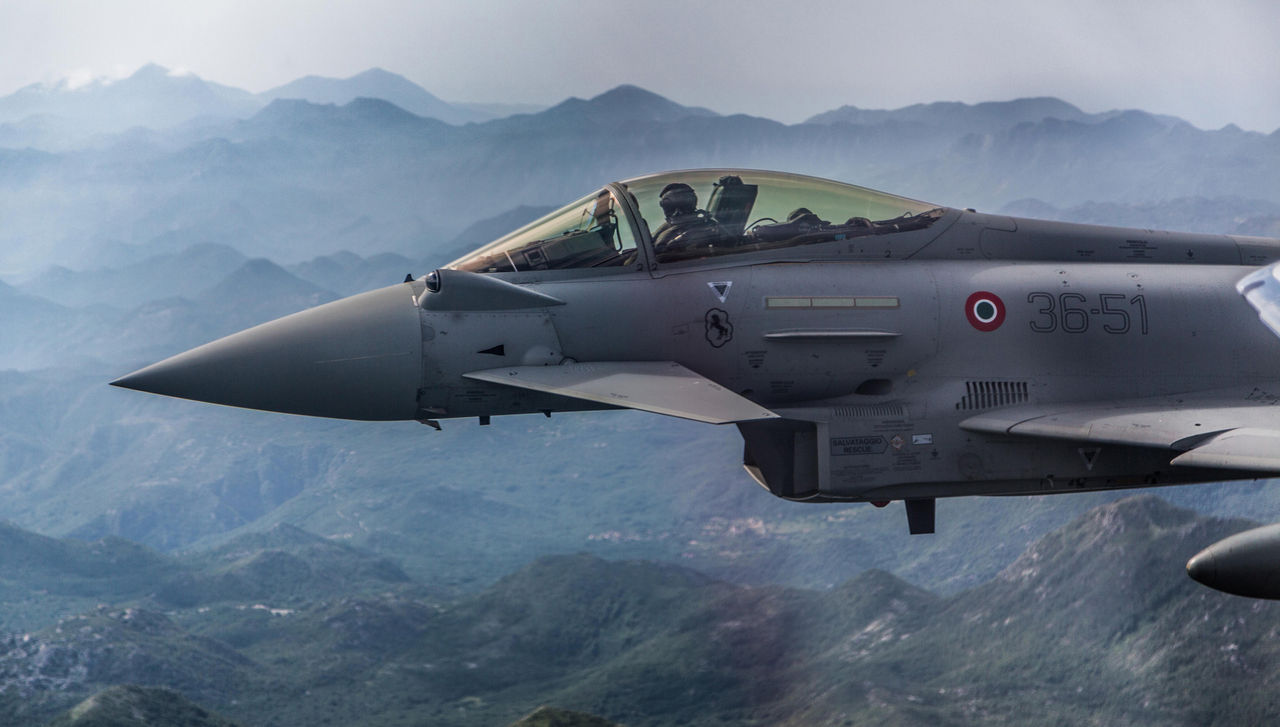
An Italian Eurofighter during a simulated interception exercise over Montenegro, part of NATO Air Defence in the country.
The primary purpose of NATO Air Defence is to safeguard the integrity and security of airspace. NATO and Allies achieve this by continuously monitoring all air traffic in and around Europe, enabling them to detect and respond to any unusual activity, including intercepting potentially hostile aircraft. Moreover, NATO Air Defence forces also provide support to civilian aircraft in distress – for example, when they have lost communication with air traffic control.
On duty 24/7/365, NATO Air Defence is a constant in a rapidly changing security environment, giving NATO the capability to protect its skies around the clock. It is a clear sign of cohesion, shared responsibility and solidarity across the Alliance.
NATO Air Defence and NATO Ballistic Missile Defence (BMD) are complementary systems, both strengthening the protection of NATO territory, populations and forces. The NATO BMD capability provides a range of assets to detect and intercept ballistic missiles.
NATO Air Policing was established in 1961 during the Cold War and served as an integral part of NATO Integrated Air and Missile Defence (IAMD) for decades.
Throughout 2026, the Alliance has upgraded NATO Air Policing and integrated it with other activities into its current NATO Air Defence posture.
NATO Air Policing was primarily oriented to protect against threats from aircraft through interception by Allied fighter jets. NATO Air Defence provides a broader range of capabilities to protect against a full spectrum of threats across all operational domains (air, land, maritime, space and cyberspace), including those posed by crewed and uncrewed aerial systems and cruise missiles. These defence capabilities include Quick Reaction Alert (QRA) aircraft, sea and surface-based air and missile defence (SBAMD) systems, and counter-uncrewed aerial systems (C-UAS). Using a multi-layered, 360-degree approach, NATO Air Defence provides greater flexibility and faster response to changes in the security environment.
NATO Air Defence is carried out using the NATO Integrated Air and Missile Defence System (NATINAMDS). The Supreme Allied Commander Europe (SACEUR) has the overall responsibility for the conduct of NATO Air Defence.
Allied Air Command (AIRCOM), headquartered in Ramstein, Germany, oversees NATO Air Defence with 24/7 command and control from three Combined Air Operations Centres (CAOCs):
The areas of responsibility of the three CAOCs overlap, providing critical redundancy that ensures continuous air command and control. Together, these CAOCs plan, direct and coordinate the activities of NATO Air Forces, monitoring up to 30,000 air movements across European NATO airspace each day. When an interception is required – in the case of airspace violations, suspicious air activity close to the Alliance’s borders or other kinds of unsafe air traffic that does not adhere to international air safety norms – the relevant CAOC decides from which air base the aircraft will be scrambled, according to the location of the incident.
NATO member countries provide the necessary aircraft and sea- and ground-based assets for air defence, either individually or in multinational teams, under SACEUR’s direction. Countries without the necessary air capabilities are assisted by other NATO members. Within NATO Air Defence, NATO currently oversees five regionally focussed activities.
NATO has been protecting the Baltic skies since 2004, when Estonia, Latvia and Lithuania joined the Alliance. Under NATO’s Baltic Air Policing mission, NATO member countries that possess the required capabilities sent crews and fighter aircraft to airbases in the Baltic States, rotating responsibility every four months. Following the move from Baltic Air Policing to a more comprehensive Air Defence posture in 2026, this rotational model continues, with additional assets deployed by Allies to the Baltic States on a four-month basis. Since the mission’s activation in 2004, participating NATO fighter aircraft have been based at Šiauliai Air Base in Lithuania. Since 2014, NATO aircraft have also been based at Ämari Air Base in Estonia. Since 2024, Lielvārde Air Base in Latvia is also capable of hosting NATO Air Defence aircraft.
As a part of the broad set of assurance measures introduced following Russia’s illegal annexation of Crimea in 2014, Allies started providing additional assets to enhance air defence along NATO’s eastern flank To that end, Allies have supplemented the existing NATO Air Defence forces in the Baltic States, deployed additional aircraft to Poland, and augmented the national capabilities of the Bulgarian and Romanian air forces. Originally deployed as part of the Eastern Sentry military activity launched in September 2025, Allies are operating additional assets – including more fighter jets, surveillance planes, refuelling and transport aircraft, and air defence systems – that have been integrated into NATO Air Defence along the eastern flank.
NATO Allies have protected the skies of their Allies in the Eastern Adriatic and Western Balkans since a number of countries in the region joined the Alliance – initially through Air Policing, and now through Air Defence. Hungary and Italy have covered Slovenia’s airspace since its accession to NATO in 2004. Greece and Italy have covered the airspace of Albania since 2009, Montenegro since 2017 and North Macedonia since 2020.
Since May 2008, Allies have periodically deployed fighter aircraft to Keflavík Air Base to provide protection for Icelandic airspace. Prior to this, the United States conducted air policing as part of its military presence in Iceland from 1951-2006. The Alliance’s air defence mission in Iceland is different from other regional assistance missions in that it does not permanently cover Iceland’s airspace. Instead, it typically involves a deployment of fighter aircraft from a NATO Ally for a period of three to four weeks, three times a year.
In 2015, Belgium, Luxembourg and the Netherlands (known collectively as the Benelux countries) signed an agreement to conduct joint air policing of their territories. Under this agreement, the Belgian and Dutch air forces provide fighter aircraft to cover the Benelux airspace on a rotational basis. The joint operations started on 1 January 2017. As part of the shift from Air Policing to Air Defence, Belgium and the Netherlands announced at the 2026 NATO Summit in Ankara that they will jointly acquire multi-layered air defence systems, including radars, surface-to-air missile launchers and other key assets.
12 August 2026