Close
Back


From now on you can download videos from our website
If you would also like to subscribe to the newsletter and receive our latest updates, click on the button below.
Enter the email address you registered with and we will send you a code to reset your password.
The password must be at least 12 characters long, no spaces, include upper/lowercase letters, numbers and symbols.
Click the button to return to the page you were on and log in with your new password.
Dear Chancellor, lieber Friedrich,
Thank you for the warm welcome. It is now twice in a few days, and always great to be back in Berlin. You hosted an excellent meeting last week of the Coalition of the Willing, and now Germany is also hosting the Annual Session of the NATO Parliamentary Assembly.
I think this demonstrates very clearly, in just five days, two of these big meetings, Germany’s commitment to NATO, to Europe, and Ukraine.
Germany is also driving efforts to build a stronger Europe in a stronger NATO, and showing great leadership in support of our collective security.
Your investments in defence are immense, and they are going up. And your industries are producing more and faster, which is very important. The German brigade in Lithuania plays a key role in helping to keep our eastern flank safe, and German aircraft help defend Allied skies, and German Navy helps protect critical infrastructure in the Baltic Sea.
So, Germany is really leading, and Germany is leading when it comes to Ukraine. Indeed, together we are working to ensure that Ukraine has what they need to defend themselves against Russian aggression and to be as strong as possible in the peace negotiations.
The threats we face – let’s be clear-eyed on this – the threats we face are significant. But we are doing what is needed to ensure that we remain ready and able to deter aggression and defend our free societies.
And this is also part of what I discussed this morning with the parliamentarians in the NATO Parliamentary Assembly. They play a crucial role in what… [that] we have the resources to stay strong, but also, they have the connection with their population, so they can explain why this is so important, they can bring the message to their countries.
And to be truly secure, we need governments and militaries to do their part. But it takes, in the end, the whole of society to remain resilient, our countries, and this is absolutely important, and something we debated extensively this morning.
So, working together, investing together, producing together, and standing together. This is what NATO is all about.
I am grateful again for Germany's continued commitment, for your personal leadership, Friedrich. Thank you so much for organising all of this, and hey, looking forward to work together. Thank you.
Again, thank you.
Question
Secretary General, Federal Chancellor, two questions to both of you. Today, there were reports about Russia planning to station nuclear weapons in space, and to do this this year, how concerned are you about this and about airspace violations in Poland? What do you think would be an appropriate reaction to that? And when is the threshold to Article 5 really triggered?
NATO Secretary General Mark Rutte
I’ll start with the second question on Poland because, of course, this is a dangerous incident, and, clearly, this comes from Russia. It has to do, of course, with the war in Ukraine, which has
got to end, and authorities are looking into what's exactly the details, what's behind it, etc.
When it comes to our deterrence and defence posture, our deterrence and defence, our Supreme Allied Commander, so the most senior military general in NATO, constantly assesses our deterrence and defence, and where necessary makes adjustments to the posture. So that's happening continuously.
We are in close contact with Poland. I was there myself in Warsaw – that was already pre-planned for an event on Saturday, but it gave me the opportunity to also address this serious situation. And I was in contact on Friday with both the Prime Minister, Donald Tusk, and with Karol Nawrocki, the President, but also our Supreme Allied Commander, being in contact with the Chief of Defence and with the Minister of Defence to make sure that we have the complete picture. And absolutely unacceptable, of course, what happened there.
To your first question, this is part, again, of what we are doing as NATO, which is constantly – be it on the ground, be it at sea, be it in the air, and in space – assessing our deterrence and defence situation. Where do we need to make adjustments? And we do this over the whole of NATO territory. So, this is not only Europe. This is also Canada. This is also the United States. Collectively, for example, now defending the Arctic against any Russian or Chinese influence there, but also when it comes to space, which is more to the point of what came out in the German media about what the Russians might be up to. But I can assure you, we will always make sure that we defend every inch of NATO territory, and that includes making sure that we are safe when it comes to the space element.
Question
Thank you. A question to both the Secretary General and the Federal Chancellor. How much are you concerned about the conflict spreading? You talked about the Baltic Sea, the attack on a Russian cargo ship. There is an attack carried out by Ukraine off the coast of Libya. And in the Black Sea,
Russia and Ukraine have been attacking each other. So, how concerned are you when we see that Russia is claiming Estonia to make its airspace available for Ukraine for attacks against Russia? And a question to both of you: the French President said last week that now was the time to speak about NATO accession of Ukraine. Do you share this assessment?
NATO Secretary General
Let's start with the first question. And can I point you to the fact that, as we speak, Ukraine is killing or seriously wounding up to between 40 and 50,000, so up to 50,000 Russian, primarily men, each month. When you compare that to the war in Vietnam, in 14 years, the United States lost tragically 56,000 people. Here, you are talking about up to 50,000 Russians dead or seriously wounded each month. The Ukrainians are rolling back, not massively, but they are rolling back the front line in the direction of Russia, and they are striking, of course, deep inside Russia. So… and of course, the fact that Putin is accepting this, that he is losing so many of his own people, tells you something about him and his intent, and that he is willing to sacrifice tragically so many of his own countrymen, so this is the context in which we have to address.
And when it then comes to hybrid, yes, of course this is serious. We have seen what happened in Leipzig, well, luckily did not happen in Leipzig. You were able to prevent it, but that was potentially a serious situation. We see situations in Poland, in Estonia, etc. As NATO, as I told you, when it comes to the military domain, we will always make assessments to our deterrence and defence and make updates where necessary. But more generally speaking, as societies, we have to be resilient. We work together closely in NATO. We consult. The European Union is very much involved, and we have our response options. You will not always see them. We cannot always be open about them. It will not always be tit-for-tat. But I would urge us all to sometimes take that step back and say “yes, this is serious. We have to deal with it”. But look, what is happening with our support – not that we are fighting there, but with our military support for Ukraine, what they are able to mount as a reaction to the Russian aggression, which is massive, and then a little bit of calm and carry on, and most importantly, keep that support for Ukraine going. So, for every incident in Europe, more support for Ukraine, not less support for Ukraine. It's the best reaction we can give.
And then, to your second question, this has to do, of course, with the wider debate of security concerns in Europe. We have seen this in the past when Germany entered NATO. We have seen it when Germany reunified on the 3rd October 1990, that as part of the acceptance by then the Soviet Union that a reunified Germany would be, as a whole country, part of NATO, there was also a discussion on security concerns from the Soviets, from the Europeans. That's not strange. That can happen. What cannot happen is that we are forced to roll back NATO to the 1997 borders, or that we should have others to decide on our posture, others than the Allies, than the Allies themselves. So, in that context, NATO came up and can come up.
But let's be honest: real peace negotiations with the Russians still have to start. I'm happy with what the Americans are doing, trying to get it done. It's a herculean effort, and now the Europeans are closely consulting with the U.S. and with Ukraine, and we have a unified position. But it is also to test now whether Putin is willing to play ball, and then these issues might come up again. But in the end, also when this comes up again, it is only the 32 Allies deciding on who is in NATO or who is not in NATO. So, in that context, here the French President made that remark, which I find fully understandable. And as you know, it is a long-standing NATO position that Ukraine should become part of NATO, and that is the position of NATO now for many years.


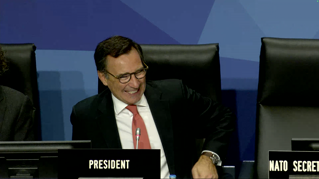
NATO Secretary General Mark Rutte meets with the President of the NATO Parliamentary Assembly (NPA), Marcos Perestrello
NATO Secretary General Mark Rutte meets with the President of the NATO Parliamentary Assembly (NPA), Marcos Perestrello
NATO Secretary General Mark Rutte meets with the President of the NATO Parliamentary Assembly (NPA), Marcos Perestrello
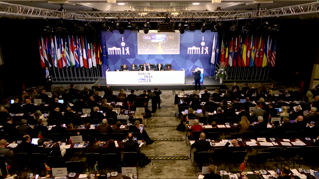
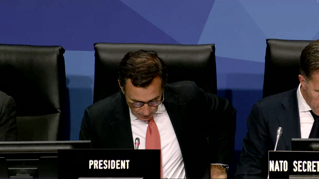
NATO Secretary General Mark Rutte attends the 72nd Annual Session of the NATO Parliamentary Assembly in Berlin
NATO Secretary General Mark Rutte attends the 72nd Annual Session of the NATO Parliamentary Assembly in Berlin
NATO Secretary General Mark Rutte attends the 72nd Annual Session of the NATO Parliamentary Assembly in Berlin
NATO Secretary General Mark Rutte attends the 72nd Annual Session of the NATO Parliamentary Assembly in Berlin
NATO Secretary General Mark Rutte attends the 72nd Annual Session of the NATO Parliamentary Assembly in Berlin
NATO Secretary General Mark Rutte attends the 72nd Annual Session of the NATO Parliamentary Assembly in Berlin
NATO Secretary General Mark Rutte meets with the President of Moldova, Maia Sandu
NATO Secretary General Mark Rutte meets with the President of Moldova, Maia Sandu
NATO Secretary General Mark Rutte meets with the Minister of Foreign Affairs of Germany, Johann Wadephul
NATO Secretary General Mark Rutte meets with the Minister of Foreign Affairs of Germany, Johann Wadephul
NATO Secretary General Mark Rutte meets with the Minister of Foreign Affairs of Germany, Johann Wadephul
NATO Secretary General Mark Rutte meets with the President of the German Bundestag, Julia Klöckner
NATO Secretary General Mark Rutte meets with the President of the German Bundestag, Julia Klöckner
NATO Secretary General Mark Rutte meets with the President of the German Bundestag, Julia Klöckner
NATO Secretary General Mark Rutte meets with the President of the German Bundestag, Julia Klöckner
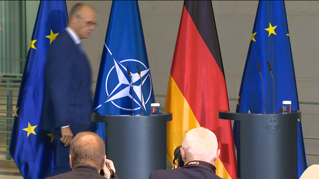
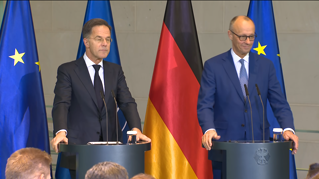
Joint press conference by the NATO Secretary General Mark Rutte with the Federal Chancellor of Germany, Friedrich Merz
Joint press conference by the NATO Secretary General Mark Rutte with the Federal Chancellor of Germany, Friedrich Merz
Joint press conference by the NATO Secretary General Mark Rutte with the Federal Chancellor of Germany, Friedrich Merz
Joint press conference by the NATO Secretary General Mark Rutte with the Federal Chancellor of Germany, Friedrich Merz
Joint press conference by the NATO Secretary General Mark Rutte with the Federal Chancellor of Germany, Friedrich Merz
Joint press conference by the NATO Secretary General Mark Rutte with the Federal Chancellor of Germany, Friedrich Merz
Joint press conference by the NATO Secretary General Mark Rutte with the Federal Chancellor of Germany, Friedrich Merz
Joint press conference by the NATO Secretary General Mark Rutte with the Federal Chancellor of Germany, Friedrich Merz
Joint press conference by the NATO Secretary General Mark Rutte with the Federal Chancellor of Germany, Friedrich Merz
NATO Secretary General attends the 72nd Annual Session of the NATO Parliamentary Assembly in Berlin