Close
Back


From now on you can download videos from our website
If you would also like to subscribe to the newsletter and receive our latest updates, click on the button below.
Enter the email address you registered with and we will send you a code to reset your password.
The password must be at least 12 characters long, no spaces, include upper/lowercase letters, numbers and symbols.
Click the button to return to the page you were on and log in with your new password.
Mr President of the NATO Parliamentary Assembly, dear Marcos,
Thank you so much for those introductory remarks. And let me start by thanking you for the friendship, for the close working relationship. I know I could always count on you. I hope you could always count on me. But from your words, I think I can hear that indeed it is mutual, and I hope we stay in touch. Your support is truly appreciated, and you are a great friend.
And thank you all here for the warm welcome. It is really quite daunting to see so many people in this room. It is great. This is NATO democracy working.
Then, is Julia Klöckner [President of the German Bundestag] still in the room? Not yet – she has left. But I think what she did this morning – wasn’t it this morning, when she handed out a prize to Maia Sandu [President of Moldova]? Maia, are you in the room? I will see Maia Sandu later – But she is… You've heard the speech, no doubt. I heard about it. I've not seen the speech. But she is a true leader of Moldova. I'm a big admirer of hers.
But again, through Julia Klöckner, I want to thank the Bundestag for hosting this year's Annual Session of the NATO Parliamentary Assembly here in Berlin. It's demonstrating that Germany is a big supporter, a valuable supporter, a continuous supporter of NATO in every sense. It is the biggest Ally in Europe, and again, hosting this Assembly is truly appreciated.
Talking about Germany, Germany is stepping up. It’s stepping up when it comes to our collective defence, when it comes to security in Europe, and these aren't just words. This is what is happening in reality, because Germany is powering ahead. Powering ahead on defence spending. Plans to invest 3.5% of GDP on core defence, not in 2035, but already in 2029, which means a doubling of the German defence spending in eight years. German industries are expanding; the factories and ramping up production. And Germany is a leader when it comes to the vital support to Ukraine in its fight for freedom. And I believe this morning you also had an address here through Zoom from President Volodymyr Zelenskyy, reminding us of the importance of this continued support for Ukraine.
So, when it comes to Germany and all of this money, industry, Ukraine, it's a real, yeah, let's say, action and real leadership, and it is exactly what we need.
Because – and you know this – we face great dangers coming from Russia, and the fact that Russia works so closely together with Iran, China, and North Korea.
We know that Russia’s war machine, at the moment, is running at full speed. Its war economy keeps growing. And it won't stand still when the war against Ukraine, hopefully, will end one day. That whole machine is there and will continue.
Meanwhile, China’s military mobilisation and technological advances are accelerating, with little transparency about its intentions.
And then Iran, that has launched an indiscriminate attack across the Middle East and continues to threaten the freedom of navigation in the Strait of Hormuz.
And then, of course, North Korea continuing to develop its nuclear programme while openly, and also materially, supporting Russia’s war against Ukraine. And we see evidence of this every other day, or even every day.
And of course, we have seen intensifying malign activities targeting our nations. And one day, it can be in the form of an arson attack against a factory or drones disrupting an airport. The next, it is sabotaged railways or cargo vessels targeted at sea, and cyber-attacks. These cyber-attacks, at the moment, are relentless. Not to mention the repeated airspace incursions and violations of our maritime space.
When it comes to all of this, we have seen evidence over the last couple of days, the dangerous incident in Poland on Friday, but also over the last couple of weeks, some serious stuff happening on the Black Sea, which we are working on as NATO with Romania and Bulgaria and Türkiye. All evidence of this, yeah, let's say, hybrid/cyber. But even, I still think hybrid is a bit too cuddly because it is too serious, and we maybe should find another word for this. And it's all happening now, and it won't go away anytime soon.
So basically, the conclusion of all of this is that we are all targeted, that we are all affected when it comes to our pipelines, our cables, our energy grids, and our economies. They are all interconnected, and that means that we are all in this for the long term. And therefore, we must step up to the plate to ensure that we stay ahead of danger.
Here, let me mention the NATO Summit in Ankara, because there we demonstrated real progress. The Hague was great. We had all the commitments. But in Ankara we saw, almost physically, the billions flowing in, when it comes into major defence, major new contracts to procure capabilities, and also a pledge of €70 billion in military equipment, assistance, and training for Ukraine in 2026, and again when it comes to 2027. However – because otherwise you knew all this already – there is more work ahead, and I think this is in four areas.
First, we need to stay focused on this issue of defence spending and defence investments. Several Allies are now projected to meet or exceed the 5% core defence spending target already this year, and that is really remarkable.
But if we’re serious about keeping our Alliance strong and secure, then all Allies must pull their weight. Not only in 2035, but starting now. At least everybody needs to have the credible path to get there, and ideally, they get there sooner than 2035. And to be effective, the investment must be sustained, and that means year after year – again, the credible path to get to the 3.5% or more.
The power of the purse is the purview of parliaments. So, therefore, I count on each of you and every one of you to build the political and public support for accelerating defence investment and for sustaining it over the longer term. The threat is real, and together in NATO, we are well placed to address it – if all Allies invest, if all Allies invest.
And the benefits we all stand to gain go well beyond securing our freedom and stability; these investments are also a boon to prosperity. There are dividends to be gained from investing more in defence. This is about real jobs for real people, so there is also that argument.
Second, our industries: they need to deliver the capabilities we need for our defence. Because, right now, demand still far exceeds the supply, and this is not only true in Europe, also in the U.S. and in Canada. We are making good progress on ammunition. According to our projections, by next year the Alliance will have the capacity to produce around 4 million artillery shells annually, and that is almost twice as many as in 2025. So there, we are doing fine. But we have to do the same for other investments, so air defence, drones, counter drone systems, the deep precision strike capabilities we need, and much more. And that means that our industries – and they can be big, they can be small, they can be established, they can be emerging – they need to have the technology and the know-how, and that means they have to be innovating and evolving. But we have to make it easier for them to work together and to work with us here at NATO, and the governments, and all our Allies.
Now NATO has a role to play here, so we are doing our part, and it has to do with expanding our connections with industry, but also bringing our Allies together to make sure that we pull resources, and therefore we pull the demand to generate more effective, efficient solutions to our shared challenges, and that helps the industry.
And here, as members of Parliament, again, you can play a crucial role here. So, I count on you to continue to help to cut at the national level red tape, remove the barriers, and make defence industrial cooperation easier. And this is between governments and industry and across borders. So please help here.
Then third, Ukraine – and, of course, there is no logical order to this, I could have started with Ukraine, so nothing intended here – third, we must keep Ukraine strong.
We had a meeting last week here in Berlin of the Ukraine Defence Contact Group. Sorry, that was in Brussels, and then we had a meeting here in Berlin with the Coalition of the Willing, chaired by Chancellor Merz. And what we have seen both on Tuesday in Brussels and here on Thursday in Berlin, so at the UDCG and at the Coalition of the Willing, is several Allies announcing new contributions. This is about air defence. This is about ammunition. And this is about crucial supplies Ukraine needs to defend today and tomorrow. And this is essential. But Ukraine simply needs more, and it is vital that all Allies undergird their messages of support with real contributions.
The military equipment flowing into Ukraine, including through the PURL Initiative, is indispensable. It helps Ukraine to defend itself today, but it also strengthens Ukraine's hands in any future negotiations with Russia, as do contributions made to the CAP – the Comprehensive Assistance Package – to the NSATU Trust Fund, and also all the support you can give to Ukraine bilaterally and beyond. But support needs to be concrete. We have to show Putin that his attempts to weaken our support will fail.
So also here, I have to count on you to help sustain the support for as long as it takes.
And then my fourth point and final point: we must strengthen beyond the money and the industry and the support for Ukraine. We must strengthen the resilience of our societies. And that means that our citizens need to know that the lights will stay on, that their homes will stay warm, that hospitals, transport, and communications will keep working, and this is why it is necessary. And this is also part of the 1.5 [%] defence-related investments that we keep on investing billions in resilience and in civil preparedness.
This is why we launched Baltic Sentry to protect a vital undersea infrastructure in the Baltic Sea. This was after the cutting of the sea cable late 2024 between Finland and Estonia.
It is also why we just launched a critical energy infrastructure network. This is bringing together our Allies, our energy providers, to share threat warnings and to exercise collectively when it comes to our critical energy infrastructure.
And it is also why we are deploying advanced cyber technologies to help all Allies find the vulnerabilities they have in their cyber defences. Just a few examples – there's much more – but resilience is, in the end, something that NATO can work on, and governments can work on, but not NATO and governments alone. This really takes the whole of society. That means we have to get the businesses involved. We have to get the institutions involved. We have to get communities involved. We have to get the citizens involved. And we can learn from the best in class in NATO, and that’s, in the end, I think, still Norway and Sweden and Denmark and Finland, and maybe one or two others, really ahead of the pack here, and having made clear to their citizens what they need to do in case war breaks out – at least not to get in the way of the military, but to be helpful; and also how they make sure that the police and the ambulance services and the firefighting department work together, supporting the military wherever possible.
To end – I know I'm preaching to the converted here – you and I know this, that our democratic, free, and open societies are our greatest strength. They are our strength, not our weakness. The fact that we are free and open and democratic. And it was NATO, NATO was founded to safeguard this. And it is also with you, and I want to thank you for doing this, what you as parliamentarians represent.
And it's also what our adversaries fear most. If you live in China, in the leadership of China, or North Korea or Russia or Iran, this is exactly what you don't like: free and open societies with free media and people having a free choice in elections. So, they will keep trying to disrupt, undermine, and weaken us, but we have to make clear they will fail.
In Ankara, we showed what we can achieve when we stand together. So now let's keep delivering together.
Thank you so much.


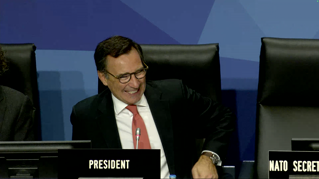
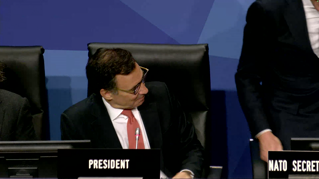
NATO Secretary General Mark Rutte meets with the President of the NATO Parliamentary Assembly (NPA), Marcos Perestrello
NATO Secretary General Mark Rutte meets with the President of the NATO Parliamentary Assembly (NPA), Marcos Perestrello
NATO Secretary General Mark Rutte meets with the President of the NATO Parliamentary Assembly (NPA), Marcos Perestrello
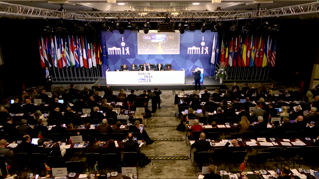
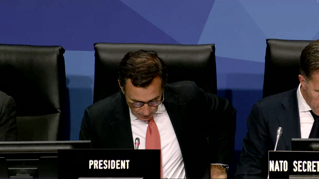
NATO Secretary General Mark Rutte attends the 72nd Annual Session of the NATO Parliamentary Assembly in Berlin
NATO Secretary General Mark Rutte attends the 72nd Annual Session of the NATO Parliamentary Assembly in Berlin
NATO Secretary General Mark Rutte attends the 72nd Annual Session of the NATO Parliamentary Assembly in Berlin
NATO Secretary General Mark Rutte attends the 72nd Annual Session of the NATO Parliamentary Assembly in Berlin
NATO Secretary General Mark Rutte attends the 72nd Annual Session of the NATO Parliamentary Assembly in Berlin
NATO Secretary General Mark Rutte attends the 72nd Annual Session of the NATO Parliamentary Assembly in Berlin
NATO Secretary General Mark Rutte meets with the President of Moldova, Maia Sandu
NATO Secretary General Mark Rutte meets with the President of Moldova, Maia Sandu
NATO Secretary General Mark Rutte meets with the Minister of Foreign Affairs of Germany, Johann Wadephul
NATO Secretary General Mark Rutte meets with the Minister of Foreign Affairs of Germany, Johann Wadephul
NATO Secretary General Mark Rutte meets with the Minister of Foreign Affairs of Germany, Johann Wadephul
NATO Secretary General Mark Rutte meets with the President of the German Bundestag, Julia Klöckner
NATO Secretary General Mark Rutte meets with the President of the German Bundestag, Julia Klöckner
NATO Secretary General Mark Rutte meets with the President of the German Bundestag, Julia Klöckner
NATO Secretary General Mark Rutte meets with the President of the German Bundestag, Julia Klöckner
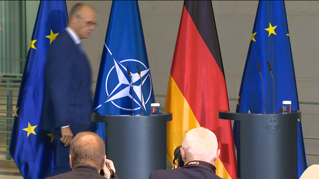
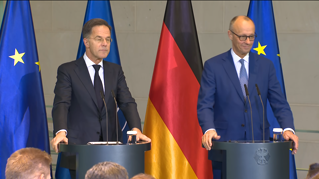
Joint press conference by the NATO Secretary General Mark Rutte with the Federal Chancellor of Germany, Friedrich Merz
Joint press conference by the NATO Secretary General Mark Rutte with the Federal Chancellor of Germany, Friedrich Merz
Joint press conference by the NATO Secretary General Mark Rutte with the Federal Chancellor of Germany, Friedrich Merz
Joint press conference by the NATO Secretary General Mark Rutte with the Federal Chancellor of Germany, Friedrich Merz
Joint press conference by the NATO Secretary General Mark Rutte with the Federal Chancellor of Germany, Friedrich Merz
Joint press conference by the NATO Secretary General Mark Rutte with the Federal Chancellor of Germany, Friedrich Merz
Joint press conference by the NATO Secretary General Mark Rutte with the Federal Chancellor of Germany, Friedrich Merz
Joint press conference by the NATO Secretary General Mark Rutte with the Federal Chancellor of Germany, Friedrich Merz
Joint press conference by the NATO Secretary General Mark Rutte with the Federal Chancellor of Germany, Friedrich Merz
NATO Secretary General attends the 72nd Annual Session of the NATO Parliamentary Assembly in Berlin