Close
Back


From now on you can download videos from our website
If you would also like to subscribe to the newsletter and receive our latest updates, click on the button below.
Enter the email address you registered with and we will send you a code to reset your password.
The password must be at least 12 characters long, no spaces, include upper/lowercase letters, numbers and symbols.
Click the button to return to the page you were on and log in with your new password.
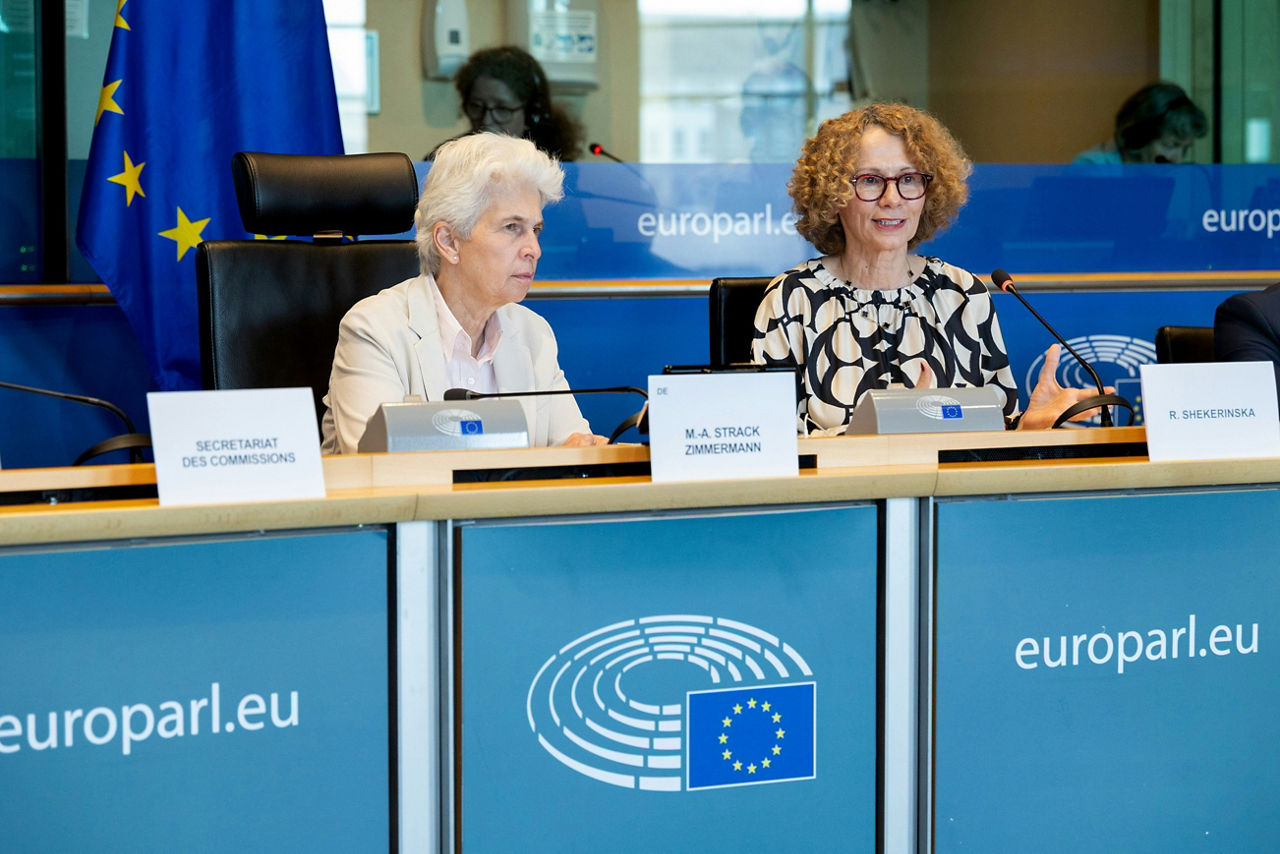
NATO Deputy Secretary General Radmila Shekerinska
Thank you so much for inviting me again to the European Parliament, Madam Chair, Marie-Agnes. It's great to see you both in the European Parliament and in NATO Headquarters. I look forward to welcoming some of you in the future. We do see NATO and the EU as really unique partners, and I think that was very visible in Ankara as well, because we have had the president of the European Commission, we have had the President of the Council joining us for the event, and the High Representative Kaja Kallas also participated at our NATO-Ukraine Council meeting. I think the fact that we always come here after a Summit and talk to European parliamentarians and the fact that we always have European officials at our Summits, it's a clear demonstration of our strategic relationship between the two organisations. I really appreciated the fact that you will be visiting SHAPE tomorrow, if I'm not mistaken, and that our Supreme Allied Commander will also join you at a session of the Committee. We are now discussing the results of the Ankara Summit, and I'll start with a very general statement, and this is that the Ankara Summit was really a transformational and successful Summit, and I'll mention the three reasons why I come up with this assessment.
First, on defence investment, and we have discussed this last time I was here, but in Ankara we have demonstrated very clearly how Allies are delivering on the commitments made last year in The Hague. So, when we when the leaders gathered in The Hague, it was all about future tense – “we will”. But actually, in Ankara, we have proven that we are translating these commitments into action. So, the numbers are really impressive. Allies are really providing concrete and credible plans on how to invest 5% of GDP in defence by 2035, because this was The Hague pledge. Remarkably, just one year after this 10-year project, European Allies and Canada are already investing around 4% of GDP in defence and security. Very, very close to 4% just in the first year on a 10-year project. Last year they spent 20% more than the previous year, and looking at 2025 and 2026 combined, that's an extra 258 billion US dollars dedicated, invested in defence and security - a quarter of a trillion in just two years. This is not only an example how we are implementing the pledge in The Hague, but this is also an example of how we are rebalancing our transatlantic Alliance for the better. And it's not a coincidence that the big motto, the big title of the Summit in Ankara was “A stronger Europe, in stronger NATO”. This is the so-called NATO 3.0. So European Allies and Canada, really working with the United States, are assuming greater responsibility for the Alliance’s defence. We welcome EU's efforts – you have asked me about how can we work even better - we really welcome EU's efforts to support a more capable European defence, interoperable, compatible, complementary to NATO, and the contributions and capabilities of NATO's non-EU Allies are of course also important, and this also has to be part of the of the equation. They are indispensable for our collective defence. It is crucial that we all move in the same direction by ramping up also defence investments. And the EU plays a crucial role in strengthening this capacity.
Second reason why we see the Summit as tremendously successful is on the important issue of defence production, of defence industrial cooperation as well. In Ankara, we have had a separate, but practically in parallel or together with the Summit, we had a NATO Summit Defence Industry Forum. This was really an impressive defence industry event showing the strength of Euro-Atlantic defence cooperation. New procurements in the amount of 50 billion were signed only at the event at the forum, and many were from European industry with strong transatlantic ties as well. So, what we have seen is really breakthroughs, really important multinational contracts, a lot of industrial cooperation in all of the domains that we considered a priority, like air defence, strike capabilities, intelligence and surveillance, space capabilities - all these things really came up very, very prominently. It was a message to our industries, to our people, but also to our adversaries - that NATO is delivering, and that we are all stepping up the production. It was also a concrete demonstration of how we turn our words and commitments into action, how we turn the cash in our budgets into real capabilities. And this is all necessary so that our military can do their job, safe and secure continent, safe and secure transatlantic. And what we have seen across the board, interacting with different industry representatives, is that we are seeing really a transatlantic industrial revolution. NATO and the EU have really a common interest in stepping up defence industry cooperation, both in Europe, in the EU, but also with the non-EU Allies. The two organisations working together, breaking down barriers, is crucial to accelerate production and innovation of our defence industry base. And what strikes me the most, and you can go back into the events and you can see the signing, you will see really strong companies signing these contracts, and some of them, they will sound either European or American. But actually, if you dig deeper into the product, into the project, you will see that they might be nominally American or European; but in essence, the supply chains are so interconnected that they really, the cooperation element is already baked in, and this speaks really strongly in favour of a transatlantic industrial revolution. So, we need less barriers, not more.
And the third big takeaway, the third big success for the Summit, was a very clear signal on continued support to Ukraine. President Zelenskyy also came to the Ankara Summit, and he came there in a much stronger position that we have seen before, even at previous Summits. We see in the last months, how Russia is struggling on the battlefield. We see Russia feeling the pressure with Ukrainian on strike successes, and this was very visible. And all Allies have really appreciated these Ukrainian successes. But let me be very clear here: Russia's aggression is far from over. And, just before the beginning of the NATO Summit, it was very clear that the pressure on Ukraine from Russia continues to be incredibly, incredibly strong. So, Moscow launched the most massive barrage of drones and missiles on Kyiv just the day before the Summit, killing, I think, over 20 people, and very much the attacks are directed not only towards military sites but very much towards critical infrastructure and residential area. So, Ukraine really needs a continued support from us, particularly with air defences, to make sure that they can defend themselves, to make sure that they can fight for their freedom, but also when the time will come to start negotiations from a position of strength. And I think this was the big message from President Zelensky, that especially on air defence, they need our support now. They need interceptors now. PURL and other NATO mechanisms provide this urgently needed help, this urgently needed support because they are based on Ukraine's priorities, and this support will contribute also to Ukraine's future deterrence. At the Summit, Allies pledged 70 billion euros in military equipment, in training, and assistance for Ukraine in 2026. And what was equally important is that we have committed to contributing at least, and I repeat, at least the same amount for 2027. So, it's a floor, it's not a ceiling in our commitment. Ukraine is one of the priorities on which NATO and EU cooperate the most, and this is where we have even more in common. We have welcomed, as you have mentioned, the European Union's decision to provide multi-year funding to Ukraine through the Ukraine Support Loan, and this is, to be very clear, a part of the commitment that we have expressed in the declaration. Furthermore, many Allies sent a very clear message that Ukraine has become also a security provider. Our companies are investing more and more in Ukraine's defence industry and in their innovation, and it is really a two-way street. So, all of us, and NATO, and the EU are not only supporting Ukraine, but we are also learning from their experience, their knowledge, and their successes. I do believe that these three priorities that we have placed in front of us before the Summit-they were our focus-and we were able, with a consensus of all 32 Allies, to have really meaningful results on three of them.
But we have mentioned at the Summit – we have shown that we can deliver, but we know that we cannot rest on our laurels because this effort will require a sustained effort from all Allies every year in the future, and this is again how we keep our citizens safe, as the Secretary General has mentioned at the press conference, we are talking about a transformation of our Alliance, NATO 3.0. What remains the same is our nature, NATO will remain a defensive Alliance. But we need to invest in our strength so that we can keep our defences and our deterrence as strong as ever, because the threats have become also more complex and more dangerous. And let me use at the end the opportunity to thank you all for being very supportive, not only for NATO-EU cooperation but also for our goal to have a stronger Europe in a stronger NATO. Thank you.
Marie-Agnes Strack-Zimmermann, Chair of the SEDE Committee
Thank you very much, Radmila. And we will continue. Salvatore de Meu already told us, and so we will now move to questions and answers in a ping pong format. I will give two minutes for questions. So, we start EPP. Malta.
Peter Agius, MEP
Yes, thank you for your feedback. The NATO Summit was a success. In conclusion, point three: We are building for the future a stronger Europe and a stronger NATO. That's where it's all about, and that's also our involvement that we have to talk about: what does it mean exactly? And I think that if we want to have a European pillar in NATO, then we need some issues. First is our own critical enablers. That's that is what the United States is asking from us, but it is also what we need from our European side by ourselves. My question is: How can we build on these critical enablers on a European way? Second element: a rapid reaction force. There is the assessment of the Secretary of State of Defence Hegseth saying within six months we will have an assessment on the American troops in the European Union. But nevertheless, we will need our own rapid reaction force. How can we build this in this NATO 3.0 and the European pillar? Third element is the European defence industry. Of course, it's good that there is a ramping up of our budgets. The European budgets doubled in five years. We came from 200 billion. Now we have 400 billion from the European member states. The question is not only ramp up the budgets, but also strengthen the European defence industry. And I think that there are elements for improvement. If we talk about the SCAF project, for example, this is not the best way to do it. So, my question is: Do you have propositions for a better, real European defence industry, starting from the European perspective and not starting from the member state perspective? Thank you.
Marie-Agnes Strack-Zimmermann, Chair of the SEDE Committee
Thank you very much. Next will be Sven.
Sven Mikser, MEP
Yes. Yes, thank you, thank you very much, Madam Deputy Secretary General. You describe the Summit as a tremendous success, and usually when I hear such phrases, that awakes the sort of sceptic in me. But I agree that in some aspects it was. I mean, obviously there were big fears ahead of the Summit, and there were not very high expectations. And so the fact that it wasn't a failure was already a very significant success. But I agree that in some aspects it was a great success with regard to the progress on defence spending, the defence industrial commitments that you mentioned, also the very strong support for Ukraine. But I would like to... there were also lingering topics like the situation in Greenland, the ongoing fighting in the Strait of Hormuz and Iran that actually escalated again, or full-scale fighting resumed virtually during the Summit itself, and these are issues that actually divide the Allies. So, how would you describe the political unity? Obviously, it's good that the ironclad commitment to Article Five was included in the Summit declaration. But what's the political state of affairs and temperature? And secondly, a very precise question. I think it was very good that at a time when there's a big shortage of different systems and inventory items on both sides of the Atlantic, but also Ukraine, that the U.S. president made a statement about allowing Ukrainians to start producing Patriots. Do you have any information to share with us? What's the timeline of that? How it will actually play out? Thank you.
NATO Deputy Secretary General Radmila Shekerinska
Thank you very much. Let's try the ping pong because there were quite a number of questions, so I'll try to cover them all. NATO 3.0 is about transformation, and for this transformation to succeed, we need the cash, we need the capabilities, we also need the change in the mindset. And what we have seen across the board is that we are moving in the right direction on all of them. Are we there? Not. But this is why we said it's a process, and part of this process is actually getting the capabilities that European Allies and Canada did not have, and they counted solely on the U.S. doing the heavy lifting there. So, what we have seen also during the Summit is, I've mentioned it when it comes to the defence industry, we have seen joint procurements or contracts, or already an implementation of some of them, focusing on these issues. Let me just come up with one example: air-to-air refuelling. This is an area where European Allies and Canada were always expected to do more strategic lift, and for example, one of the big contracts that was signed with Airbus actually deals with both. It's both increasing the fleet on air-to-air refuelling - I think that we have now reached aircraft number 10, and we need two more. But it's also the other aircraft important for strategic airlift. So, these things are happening, but these things do require some time. But the focus is there: long strike capabilities, air defence, strategic enablers, intelligence surveillance. We have had a big breakthrough on the Global Eye capabilities, really a remarkable success. So, we already are focusing on areas in which European Allies and Canada needed to do more.
And of course, if we are to balance our transatlantic relationship, we will need to do it also during this review process that the U.S. has announced. So basically, this is it. This is why, when we were talking about the NATO Force Model, you know, and the U.S. has to plan also about the two theatre or multi-theater contingencies, European Allies and Canada, because they are investing more in their security, they were able to come up with capabilities to replace U.S. capabilities on which we have based our defence for too long. So, this is this is something that is happening, and this is a process we focus now, and we are we have done it through the capability targets, but we will continue doing it with the political guidelines of 2027 and the reviews that you have mentioned.
In order for this to work, we need defence industry that produces at scale and the necessary speed, and I think one of the numbers that probably did not get enough traction during the Summit - I find it the most striking - is that Allies and industries have invested 37 billion to just upgrade to increase their defence production capacity. 21 billion went to expanding existing facilities. 16 were used to open up completely new production lines, and this speaks of an answered call. This is defence industry really ramping up production. So, we have seen increased numbers in ammunition, even last year. This time again, it has gone up, but we see it now across the board, including in the domain of critical enablers. So, the defence industry kept asking us in the course of last year. We have heard the commitment, but is the money really coming? And they have seen last year with the budgets of 2025 and this year that these actually commitments have translated into contracts. And this is why it was really good to have 50 billion US dollars contracted at the NATO Industry Forum. I mentioned it, I'll mention it again. The real successes were European defence, EU, let's say, EU defence companies ramping up, but also the whole chain of companies coming from non-EU Allies, also companies coming from the other side of the Atlantic. So, if you if you see the Triton example, if you see the Airbus success, they are all also transatlantic successes. Because if you go into their supply chain, you will see a lot of cooperation there. And when it comes to should we use the comments successful or not at Summits. We are politicians, sometimes we tend to be very cynical, but I do believe that in order to move forward to continue the progress, we have to appreciate our successes. And all Allies have come forward with really increased defence investments, and this has to be appreciated. And you know, the success was visible in different metrics. You mentioned Article Five. I remember the discussions we have had last year. I remember questions that I got here in the Parliament last year about Article Five. Are we committed? Is everyone equally committed? Well, we have now this in the declaration very straightforward, and that commitment comes also with real steps in the right direction. So, a commitment, but also action. So, I do believe that a quarter of a trillion investment by the whole Alliance speaks volumes on how we have changed our mindset, and we have seen that if we don't invest in our security, we are in for a very unpleasant surprise in the future.
So, in order to meet the challenge of today, we have to continue investing in our in our security. Does this mean that we will agree on every single issue? No, but I think we have had an agreement on the defence investment. We have had an agreement by all 32 Allies on three very important enhanced vigilant activities. Just this year, we still have Baltic Sentry that focuses on the the situation with critical infrastructure in the Baltic Sea. We have the Arctic Sentry that deals with threats that have become now very visible to everyone, and this is the threat in the Arctic, from Russia, from the interests of China, but we are also very vigilant on our eastern flank, the so-called Eastern Sentry. So, on all this, we had the full backing of all 32 Allies, and they have all committed to Article Five at the Summit. And that was the strong message that I think our audiences need, but it's also a strong message to our adversaries, because they have, they always count on us not being united, and we always see it as a success when we counter this with a very, very strong Summit declaration. So, I think that on this, when we have issues, we are open about the differences. But when we have unity, we should showcase this unity, and we shouldn't be ashamed from showcasing it.
On the issue of interceptors, we have yeah, there was many positive news at the Summit. The takeaway from the bilateral meeting between the U.S. president and Ukrainian president. We also had some decisions when it comes to production of interceptors, also and sustainment in Europe. I think our focus is very much on interceptors now. We keep asking all Allies who have interceptors in their stockpiles. This is the moment to come up with some support towards Ukraine from our stockpiles. We are asking industry to continue increasing their production, and we are still also going to Allies and asking for support for the PURL, the Prioritised Ukraine Requirement List, because the key focus of PURL is air defence for Ukraine, and quite a number of Allies have already announced that they will continue financing this arrangement because they see that air defence is the game changer, especially when it comes to civilian casualties and critical infrastructure damage in Ukraine. And thank you very much. And let me thank your capitals also back home for the strong support in interceptors.
Marie-Agnes Strack-Zimmermann, Chair of the SEDE Committee
Thank you very much. Next will be Pierre Romain.
Pierre-Romain Thionnet, MEP
(Interpretation) Thank you, Madam Chair. Deputy Secretary General, thank you for the presentation. It's nice to have direct exchanges. There's some disagreement with what you've said on the fact that you said that the Summit was a success from the point of view that there are fewer barriers and not more barriers in terms of the defence industry market. I think this statement is part of the idea of maintaining the same state of reinforcement of the transatlantic industrial base. In the European Parliament, most of the new programmes we're negotiating, that we've been voting on for some years now, go in the different, in the other direction, reinforcement of the European market, a European preference in the files that we're negotiating and voting on when excluding U.S. companies or units in Europe belonging to U.S. companies - so there's a clear discrimination to prefer Europeans. So, it's a different route we're taking in Europe.
The second part of the statement is not necessarily against NATO 3.0. I think we have to decouple NATO 3.0 and the vision we can have a transatlantic industrial base, reinforcing European industrial autonomy and European companies, and scaling down purchases from the U.S. It's compatible with the objectives of NATO 3.0. You talked about euphemism. You talked about transformation, NATO, but it's a rupture NATO 3.0. It's the Americans or the U.S. administration. It's not a shared objective. There's this vision that has been imposed. They think that Russia isn't a threat, that a major threat for the U.S. is China, and Russia is a more regional threat, which the Europeans can manage themselves. That's the whole logic. But between NATO 3.0, it's a rupture for Europe. Washington is saying that they don't no longer have the same geopolitical objectives. So, there's a disagreement in the overall vision. It's a major rupture. We have to draw the consequences, not just spend more, buy in more, and there are interests that diverge from those of the Americans.
NATO Deputy Secretary General Radmila Shekerinska
Thank you very much for the question. Two points that I'll make.
The first one is: Are these things compatible? Yeah, we say NATO 3.0 means stronger Europe in stronger NATO, and we need both because what was agreed at the Summit, and it's very visible in the declaration, is that we all agree that Russia remains to be the main threat to Euro-Atlantic stability. Of course, our U.S. Allies also have other global responsibilities, and they do need to prepare also for the challenge of multiple theatres or threats in multiple theatres, and this is understandable. But let me say the call for more appropriate burden sharing or burden shifting is neither new nor surprising. It has been there since the beginning of the Alliance. It was a very clear position from President Eisenhower, through every single American administration, that European countries can invest and bear the burden of our joint security more. And I think I've shared this with you maybe last time I was here, as a minister of defence, I have heard this plea or this call again and again. But we cannot change History. What we can change is what we do now. And there was a very strong call from the U.S. but also very strong response from Europe, saying yes, we can do it, we can be stronger. And this will make the Alliance even stronger. We do believe that when it comes to our capability challenges, because people see that we are investing more in our security, they want to see this money translate into capabilities as soon as possible. We see the benefits of a stronger industry on both sides of the Atlantic, because the industrial production capacity is not satisfactory neither in Europe, nor in the U.S. or in Canada, and we see the value. And I think in Ankara we were really witnesses of the value of a strong industrial cooperation, which will be transatlantic and it will make European defence industry stronger, but also our Euro-Atlantic industry much, much stronger, and we don't see we don't see a contradiction in this. We have seen successful examples of European companies cooperating with -European Union companies- cooperating with Norwegian, with UK, with Turkish companies, but also with the US and Canadian. And some of these successful projects in Ankara were a real showcase of this, and I, unfortunately, most of the attention goes to the big political statements. But I would urge you to dig deeper, and see really remarkable capabilities that we have managed to procure or create because of this cooperation.
Marie-Agnes Strack-Zimmermann, Chair of the SEDE Committee
Thank you very much. The next will be for ECR. Alexander.
Alexander Vondra, MEP
Well, I could not be here from the beginning, so I'm hesitating whether to raise a question. But maybe you know, I was watching the Summit from a very large distance in Southern Africa, but you know, on the run-up to the Summit, I was questioning myself: Is Donald Trump coming, or not coming? It would be, you know. So, just on the distance and giving this uncertainty on the run-up before, so it looks like a peaceful gathering, but can you give us a bit more inside assessment? You know, how NATO staff, you, Mark Rutte, are evaluating the temper of Donald Trump departing back to Washington. Was he happy, or what is whether you can tell us a little bit more than most in the media, but maybe you know it's an incorrect political question. But it's important, you know, the bedrock of the transatlantic bond.
NATO Deputy Secretary General Radmila Shekerinska
Well, we were observing it from Ankara, but we were also listening through all the press conferences that happened after the Summit, and several people have repeated the word success. I think this is why it is easy, really, really, to say that the Ankara Summit was a successful one, a tremendous success, and if you want a quote from the U.S. president, I think he said there was a lot of love and unity in that in that room, and I think he said it actually while he was doing the press conference with the Ukrainian President Zelensky, and there was a lot of positive outcomes from that meeting, and a lot of strong positive statements there. So, you're absolutely right, sometimes it's the also the final atmospherics that tells the story. And if we analyse all these press conferences and all the statements of the leaders while departing from Ankara, it was a big win, and we have managed to ensure the consensus on all strategic things we needed. You know, what is the threat? What is our unified response? Our solidarity, Article Five support to Ukraine, strong industrial cooperation - all these things featured very, very prominently. And on all of them, we managed to have a consensus. And I know that many of you know how difficult it is to get through a consensus, especially on important issues.
Petras Austrevicius, MEP
Thank you, Chair. Some questions from my side. In fact, in I mean NATO is built not, you know, to support defence industries. I mean, NATO's mission is a bit different. But at Ankara was a very heavy focus on defence industries. You elaborated, I mean, more intensively on this issue. But do you see any new instruments to be developed or in the pockets of NATO as organisation to support or to cooperate with the defence industries apart from just bringing them together, signing contracts, and ensuring something for long term, is anything in this side? Because I see a certain competition with EU. I mean, we are now, for good reason, much focused on defence industries and programmes associated with. And here probably would be my question. I mean, seeing this strife from EU side, anything more in cooperation between EU and NATO in joint efforts for enforcing and bringing up defence industries? And my probably second point from my side would be: Was anything discussed? How NATO might NATO member states might learn more and in a more, let's say, comprehensive way from the military experience of Ukraine? It's urgent. I mean, all doctrine NATO 1.0 or NATO 2.0 is outdated. I mean, we have to see NATO 4.0 probably in this regard. Anything in this regard? I mean, any promise or good programmes in initiatives? Thank you.
NATO Deputy Secretary General Radmila Shekerinska
Thank you very much. First comment on defence industry. What's the role? I mean, we started with discussions about defence investments, and then we heard the call of many Allies saying, yes, we are willing. We increased our budgets, but actually, some of these capabilities will arrive in 10 years. This is this is not acceptable, and this undermines our security. So, this is why the focus on defence industry, which was there even last year, was I think very illogical and justified, but on the issue of defence industry, this is definitely an area where we cooperate very very well with the EU, because we know the capacity, the instruments, the financial means that are available. We have had signing ceremonies, which look like you know a nice thing to have. But actually, there was a lot of work behind them. They all started with what we called high visibility project, which were areas in which we saw that we have deficiencies, weaknesses, delays, the enablers, the critical capabilities we need, and it's these high visibility projects that helped Allies get to a situation in which they are signing contracts.
But we are continuing our work with defence industry. We have announced the so-called NATO Front Door, which is basically a single point of access for the procurement. It can be a single point to access for innovation events. So, this is in a way helping Allies, but also helping industry to understand. And we also initiated a so-called NATO Engine. It will help us scale up production. So, it's practically a platform, open to industry, so that they can search for partners in which, you know, scaling up production might be quicker. So, they don't start from scratch, but they use industrial capacities which are already available, but could be now used for defence industry.
And on your second question, I can go on with industry, but yeah, we will keep this for our next meetings. When it comes to Ukraine, this has been a focus of ours for quite some time, since the moment we started supporting Ukraine. Last year - beginning of last year, one of the first things, one of my first jobs as a Deputy Secretary General, was the privilege to open up a separate centre in Poland, JATEC, that focuses entirely on lessons learned from Ukraine. So, we have Ukrainian officials, Ukrainian officers, Ukrainian military experts who work with NATO experts on actually considering lessons learned, revising doctrines, taking into account what happens at the battlefield, but also what new technologies can offer, even as we speak. We also work very much with Ukrainian colleagues on inviting them to our military exercises. So, we have quite a number of exercises throughout the year, and in most cases, we do have a Ukrainian team that joins us. As you might know, we have a separate command that works on transformation. So, although we talk about NATO 3.0, [an] Alliance like this – a military alliance, a political-military alliance – needs constant transformations, and we have a separate command, under the leadership of Admiral Vandier, that focuses on these things. This is where the lessons learned go, and they actually are reflected very much into our planning. They're very much taken into account when we develop capabilities, and in that respect, Ukraine is really proving to be the security provider.
Marie-Agnes Strack-Zimmermann, Chair of the SEDE Committee
Okay, Mr. Neuhoff.
Hans Neuhoof, MEP
I'll speak German. (interpretation) Thank you, Ms Shekerinska, for your presentation. You pointed to the big increase in defence spending by the European NATO members. You were enthusiastic and gave us figures about that. I would like to take a closer look at the role of the Europeans in this connection. Mr. Thionnet mentioned this already. For years, we've been talking in the EU about strategic autonomy. At the same time, we can see that the dependence in defence and research exists on the U.S. It hasn't been eased up. It's actually increased. The Financial Times last year presented an analysis over 10 years, 2015 to 2025, when it comes to imports from the US to Europe, so in the next four, five-year window, it's increasing to 64%. We talk about strategic autonomy. The French president, on the French National Day, said how important it is that the Europeans finally become independent. Commission President von der Leyen says time and again that we must emancipate ourselves from the US, but in fact, the developments go in the opposite direction. And in these defence purchases, it's not just short-term items, rather strategic systems. I'm thinking about the purchase of F-35s by the Bundeswehr, the Aegis system acquired for German frigates. These are dependencies lasting years and decades. So, my question to you, first of all, is strategic autonomy not just a total illusion, and what you call de facto, what you said is a contradiction. Isn't this just a form of self-deception? Secondly, briefly, in Istanbul or in Ankara, it was mentioned that the spending on supporting Ukraine in defence since the access of Trump, the spending by the US up to 2024, that has been totally assumed by the Europeans. Is that a topic?
NATO Deputy Secretary General Radmila Shekerinska
I might not have received all of the translation, maybe only on the last sentence, but I think I can guess the question. Let me let me be very clear. I will not comment on, you know, statements and contributions by different leaders, or the decisions that the EU makes. But let me say that what was clear in Ankara, what is also clear at previous meetings with defence ministers and foreign ministers, is that we are all very much aware of the threats that are around us. We have mentioned Russia as the long-term threat to our European and Euro-Atlantic security. We have mentioned the threat of terrorism that remains to be something that we focus on. But the world has become much more unpredictable. Look at the developments in the Middle East. Look at the behaviour of certain countries like North Korea, also the military build-up of China. We need to really focus on strengthening the Alliance. And what we have said is that, within the Alliance, we do need a more appropriate burden sharing, and for this, we need a burden shift. So, a stronger Europe within a stronger Alliance was the approach that Ankara Summit really confirmed as the appropriate recipe, which means European Allies and Canada stepping up, and they are doing it. And this means also European Allies and Canada stepping up when it comes to supporting Ukraine, and they have done it. And it is also visible when you look at some of our activities on the eastern flank. The majority minus one of all the Forward Land Forces are led by a European general, by a European-led force.
We have seen really this mindset shift, and this is something that becomes an investment in our own security. So, our focus has been on a stronger Alliance, and this stronger Alliance can happen because also the U.S. was observing us and saying that, for many decades, we were not contributing enough to our shared security. So, with the burden shifting, with the burden sharing, with the increased defence investment by European Allies and Canada, we are creating a more mature transatlantic Alliance, which will bring a better security for all of us on both sides of the Atlantic.
What the Secretary General was clear [on] was, of course, we need the US for our security, but it is also Europe that supports the security of the US and Canada on the other side of the Atlantic. It's mutual. It's mutually beneficial, and it makes our joint security concerns answered in the best possible way. This is how we see it.
Marie-Agnes Strack-Zimmermann, Chair of the SEDE Committee
So, I know you have to go. We have three more questions. Please, colleagues, one minute, and we start with Pekka.
Pekka Toveri, MEP
Thank you, Chair. Thank you, Deputy Secretary General, for your brief. We've been talking about the strategic level, but let's go to operational level. Putin is not stupid. He knows that the Alliance is getting stronger and stronger, and his window of opportunity to operate against NATO is closing, and we've got already warning from our different intelligence chiefs that Russia will try to do something and attack what is our biggest vulnerability: is the unity of the NATO with the Narva scenario kind of operation. And very well knowing that Putin's great strength is that he decides things, whereas we have no North Atlantic Council, it's a committee and it always takes time. So, have there been discussions about creating this capability to operate immediately, without waiting for the politicians to make the decisions, which always take a long, long, long time? Thank you.
NATO Deputy Secretary General Radmila Shekerinska
Well, thank you very much. We have seen Russia using, as you said, moments of weakness, but we are showing clearly a moment of strength, and this is the only way we can continue to deter Russia. What became very clear was not only that we are investing in our capabilities, in our defence budgets, but also, we have really empowered our Supreme Allied Commander on doing what is needed in order to protect every inch of Allied territory, and Russia knows it, and Putin knows it, because actually, if you yeah, you will talk to him. Our plans. I mean, we made also the decisions on our integrated air and missile defence. We have revised our… We have a more proactive deterrence and defence, and it means that if Putin tries to challenge us in that way… this is a defensive Alliance, but if challenged, our response will be strong, and there is no doubt about this. Our decision-making process has been made in order to meet the moment. This is why we have done a lot of work in the course of, especially last year, on how our defence plans are activated, and SACEUR has really the authority to activate these plans so that he can protect really every inch of Allied territory. So, very much an issue on which no single Ally had any doubts, but I take your point that Russia sees itself as weak, and that this makes the situation sometimes a bit more complicated. This is why our strength has to be very visible, and our posture is always very, very, very strong.
Marie-Agnes Strack-Zimmermann, Chair of the SEDE Committee
Costas Mavrides.
Costas Mavrides, MEP
Thank you, Chair. I don't know how much I can ask you, Madame, within one minute, right here. That's why I would concentrate one specific issue. Maybe it's going to be an easy question. It depends on you. Do you know of any member of NATO which occupies part of an EU territory? Do you know of any member of NATO that occupies part of Syria? Do you know of any member of NATO that has a threat of war against another member of NATO? Do you know of any member of NATO which, based on our latest report here in the European Parliament, is not democratic, more an authoritarian Islamic regime? I'm done. To make it easy, the answer is the same to those questions, and you know what I mean. Given that I may have three more seconds, I would say that a day is coming when those who feed Erdogan will regret it, but by that time we will pay, as Europe, a very heavy price.
NATO Deputy Secretary General Radmila Shekerinska
These were rhetorical, but not really questions. And of course, you will understand we have 32 Allies, and this is an Alliance of democracies where decisions are made with a consensus. And we were able to protect the 32 Allies now, previously even a smaller number by providing citizens with the security that they need, and of course, this is where I will finish.
Marie-Agnes Strack-Zimmermann, Chair of the SEDE Committee
Okay, last but not least, Kostas Papadakis.
Kostas Papadakis, MEP
Thank you, Chair. I will speak in Greek. (Interpreter) These NATO decisions are dangerous for populations. We're seeing escalation across the world. These imperialist wars in Ukraine, in the Persian Gulf. And of course, we have a defence industry which is being boosted by all this. We see a new situation which is becoming a regular occurrence. Turkey is getting compensation through new contracts, whereas the casus belli is still in place against Greece, and this is a bilateral issue, according to the Secretary General of NATO. And we're talking about new projects with Cyprus, about common developments and operations. Don't you think we are starting the risk of war here by not recognising the border between Allies, and that this might lead to more problems? Thank you.
NATO Deputy Secretary General Radmila Shekerinska
As you said, we will not, and we have never commented on bilateral issues. But you have mentioned also the question of how the world is becoming a more dangerous place. And, you know, we were confronted with an Iranian missile that was approaching our territory as an Alliance, and we were able to protect against them. And I was just reminded by my colleague, for the previous question, that back in 2022, SACEUR was able to activate defence plans on the morning of the invasion. So, there are instruments, and now we have even more capabilities. And this stronger Alliance provides for a stronger Euro-Atlantic. This is what we try to focus on. And of course we don't have the ambition to solve all the problems, but our focus is really, in times and a world that is more dangerous, to really do our utmost to invest in our future security, and this is how we are approaching every single issue: more security, a stronger Europe in a stronger NATO.
Marie-Agnes Strack-Zimmermann, Chair of the SEDE Committee
Radmila, thank you very much. So, we are many countries, and the colleague from Cyprus and Greece have different views. It's historical reasons, in reality. And so, thank you very much for your open words. I think it's really very, very important that we work together. We have different jobs to do, but I think it's really a good idea. I mean, we are both in Brussels, and we have to change a lot, and so we could do what we have to do. And thank you very much for your open words, and congratulations for this moment in Ankara. I think we need good news, and I think the atmosphere you could, even just my colleague said, realised. And I think this is very important not only for us, also to show Russia that we are working together. Thank you very much for your time. I hope you are still okay, always running, and I hope you will come back. Thank you very much.