
Close
Back


From now on you can download videos from our website
If you would also like to subscribe to the newsletter and receive our latest updates, click on the button below.
Enter the email address you registered with and we will send you a code to reset your password.
The password must be at least 12 characters long, no spaces, include upper/lowercase letters, numbers and symbols.
Click the button to return to the page you were on and log in with your new password.
08 June 2021
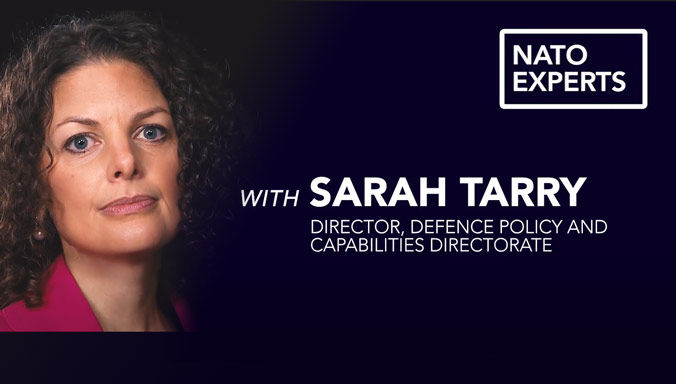
Sarah Tarry, Director, Defence Policy and Capabilities Directorate, discusses resilience.
In today’s increasingly complex and uncertain security environment, there is a greater need to prepare for threats and challenges before they occur. And while resilience is a national responsibility, we are all less vulnerable together. For that reason, NATO supports Allies in their efforts to build up their resilience to the full range of threats.
Why does resilience matter to NATO and its citizens?
From the Berlin airlift – right before NATO was established – to the over half a million military personnel from Allied nations who have supported civilian authorities throughout the COVID-19 pandemic, resilience has always been central to our nations’ idea of peace and security. In a security environment that is increasingly complex and unpredictable, there is a greater need to prepare for threats and challenges before they occur. This can only be achieved through a whole-of-society effort.
What does it mean for a NATO Ally to be resilient?
Resilience can be lots of things, but for NATO it means having the resources, infrastructure and systems that allow Allies and their societies to continue to function in the face of the full spectrum of threats and hazards, from natural disasters to cyber attacks, and from hybrid threats to even an armed attack. It is our ability to withstand shocks and surprise – to be prepared for the unexpected.
How does NATO ensure Allies are resilient?
At NATO’s Warsaw Summit in 2016, Heads of State and Government committed to enhancing resilience by striving to achieve baseline requirements to ensure continuity of government and essential services to the public, such as energy supplies, food and water resources, transport and telecommunications, and medical care, as well as to protect our populations and critical infrastructure, and to support military operations.
Today, the baseline requirements play an important role in setting the resilience standards that Allies should meet. A number of NATO’s partners also make use of the baseline requirements to assess and evaluate their own level of resilience. Through NATO, Allies and partners share their experience and expertise to develop good practices and guidance that help them stay current, assess risks, learn lessons, develop plans and make investments.
Collectively, Allies regularly review the challenges and progress in meeting these baseline requirements and provide direction on further efforts in this area.
Resilience is also an important part of the NATO 2030 initiative to make our Alliance even stronger. Allies will address how we can build up our resilience at the NATO Summit in 2021.
How do NATO Allies work with the civil sector to ensure preparedness and resilience?
We live in open societies, dominated by integrated services and private ownership. Our governments and armed forces increasingly rely on the commercial sector, for example with regard to military transport, military communications and host nation support for military operations. For these reasons, civilian experts work together every day across the Alliance to make sure the things we need get where they need to be and the systems, plans and supplies are in place or available.