Close
Back


From now on you can download videos from our website
If you would also like to subscribe to the newsletter and receive our latest updates, click on the button below.
Enter the email address you registered with and we will send you a code to reset your password.
The password must be at least 12 characters long, no spaces, include upper/lowercase letters, numbers and symbols.
Click the button to return to the page you were on and log in with your new password.
At first, it's a small black dot suspended between the dramatic peaks of Bardufoss, Norway. Then it gets a little bigger, gaining angles and edges, and you hear a sound like someone's trying to scrape off the sky.
Jet noise.
If you’re a certain kind of person — the kind who can’t hear it without jerking their eyes skyward or leaping out of a chair to find the nearest window — it’s enough to make the hairs on the back of your neck stand up.
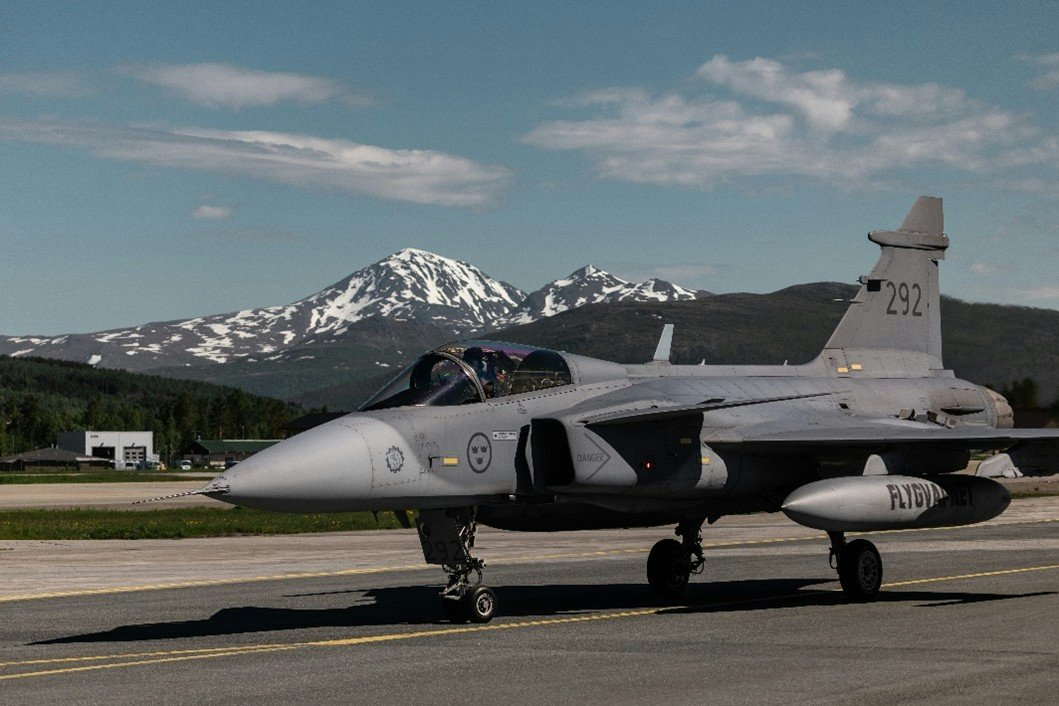
Then the stiletto shape of a JAS 39 Gripen splits the air over your head, passing low enough that you can see the Swedish three-crown emblem stencilled on its hull. It breaks right to enter the landing pattern at Bardufoss Air Station, leaving thunder in its wake. The jet drifts in for an easy landing.
This is one of the Gripens belonging to the Swedish Air Force’s 172nd Fighter Squadron. Members of the unit made the trip to the Arctic air base from their home station in Ronneby, on Sweden’s southern coast, to participate in exercise Ramstein Flag 26.
Organised annually by Allied Air Command, Ramstein Flag is NATO's largest air exercise in Europe, designed to run Allies through the paces of full-throttle multinational air warfare. Sweden has participated in the exercise since its accession to NATO in 2024, and its presence in Norway — its neighbour and close partner even before Sweden joined NATO — is hardly unusual.
From non-alignment to NATO
But there is something symbolic about seeing Swedish fighters operating here. The country’s presence reflects Sweden’s growing involvement in the Alliance, which it joined in the wake of Russia’s full-scale invasion of Ukraine in 2022, marking a historic shift in Sweden’s security policy.
“It was more of a relief, actually,” says Lieutenant Colonel Erik, Gripen pilot and commander of the Swedish detachment in Bardufoss. “From my point of view, it was the logical choice. If you are interested in preventing war, having all 32 countries together is a more powerful deterrent than standing on your own.”
Sweden acceded to NATO in March 2024. Since then, its armed forces have taken on an increasing role in the Alliance. Shortly after joining, Sweden sent an armoured battalion to reinforce NATO Multinational Brigade Latvia. After participating in an air policing in Poland in 2025, the Swedish Air Force sent a detachment of fighters to Iceland earlier this year, leading a NATO air policing mission for the first time. While there, they patrolled the strategically important waters around the island and trained with fighters from Denmark and Germany.
This is a significant change in not just mindset, but doctrine as well. Before Russia’s full-scale invasion of Ukraine, the mission of the Swedish Armed Forces was to defend their homeland. Now, their mission extends to defending the homelands of 31 other Allies as well.
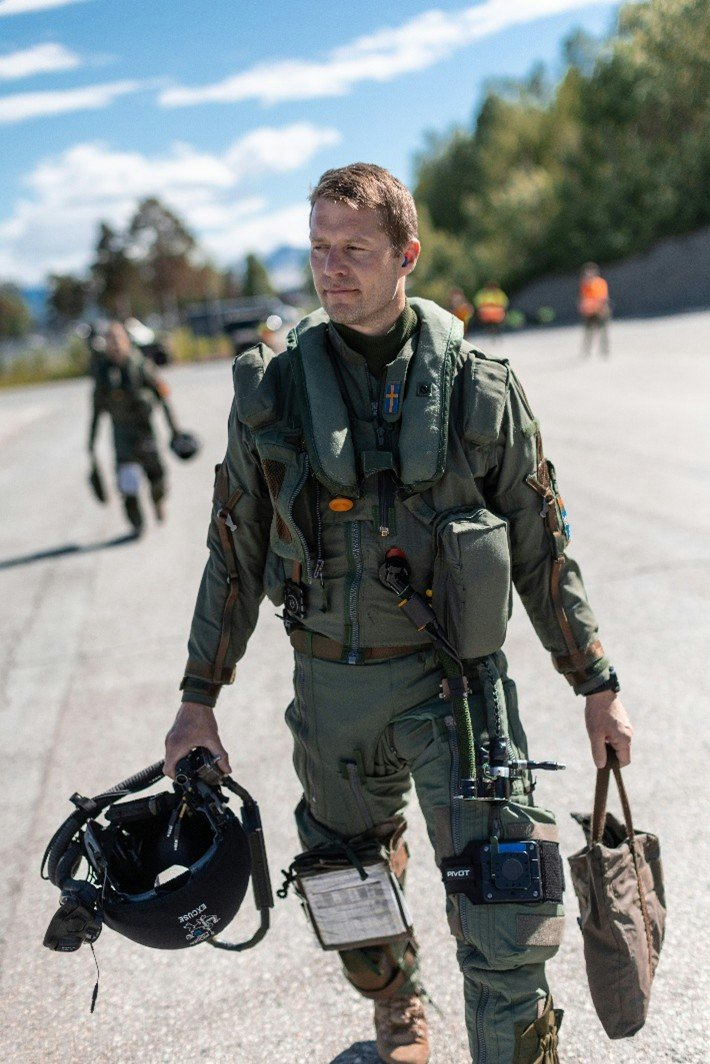
And that means being ready to operate somewhere other than home. It’s not easy to pack enough gear, tools and spare parts to keep a detachment of cutting-edge fighters running nearly non-stop for two weeks. Certainly, life for these aviators would have been easier if they’d stayed in Ronneby in southern Sweden. But every time they load their gear into containers, kiss their families goodbye and spool up their engines for a long flight over the mountains, they get a little better at it.
“We need to be able to operate from a wider area, and we need to be comfortable operating from places we don’t usually work from,” says Erik.
Bardufoss may not be that far-flung or exotic for Swedish pilots, but the air station is a uniquely appealing home for fighter jets: it features bunker-like hangars dug out of a mountainside and shielded with heavy steel doors. Were the air station attacked, anything inside would be safe from harm.
Plus, there are the views. After their missions, the pilots return to Bardufoss with GoPros full of “fjord-surfing” clips, all featuring steel-grey jets soaring above the blue waters and craggy peaks of Norway’s Troms County. In the days before the exercise began in earnest, they made reconnaissance flights over the famous Lofoten peninsula before cutting up to Nordkapp, in Norway’s far north
Sure, the rest of their days are filled with mission planning in basement bunkers, lengthy briefing sessions and some physically exhausting high-G dogfights with their NATO Allies. The life of a fighter pilot isn’t all glamour, despite Hollywood’s attempts to convince us otherwise.
“It’s a beautiful place,” Erik says. “Great views, great people. It’s great coming back home and dropping down from 25,000 feet, straight into the break…”
Before he can finish his sentence, one of the Gripens — a two-seater reconnaissance jet coming back from Nordkapp — does exactly that and drowns his words in a healthy slathering of jet noise.
Note: In accordance with Swedish Air Force policy, Lieutenant Colonel Erik is not identified by his full name.


