Close
Back


From now on you can download videos from our website
If you would also like to subscribe to the newsletter and receive our latest updates, click on the button below.
Enter the email address you registered with and we will send you a code to reset your password.
The password must be at least 12 characters long, no spaces, include upper/lowercase letters, numbers and symbols.
Click the button to return to the page you were on and log in with your new password.
The Polish commandos step into darkness under a steady rain. They carry snub-nosed assault rifles in their arms and mount night vision goggles on their helmets. Their rucksacks are big, but not bulging. They’re travelling light, kitted out for speed and stealth.
Ahead of them is nearly 100 kilometres of forest and farmland. They need to cross it in a matter of days to hit a high-priority target with a one-way attack drone. For every step of their journey, they’ll be hunted – by drones equipped with thermal cameras, dogs with keen noses and thousands of US Army paratroopers who know they’re out there.
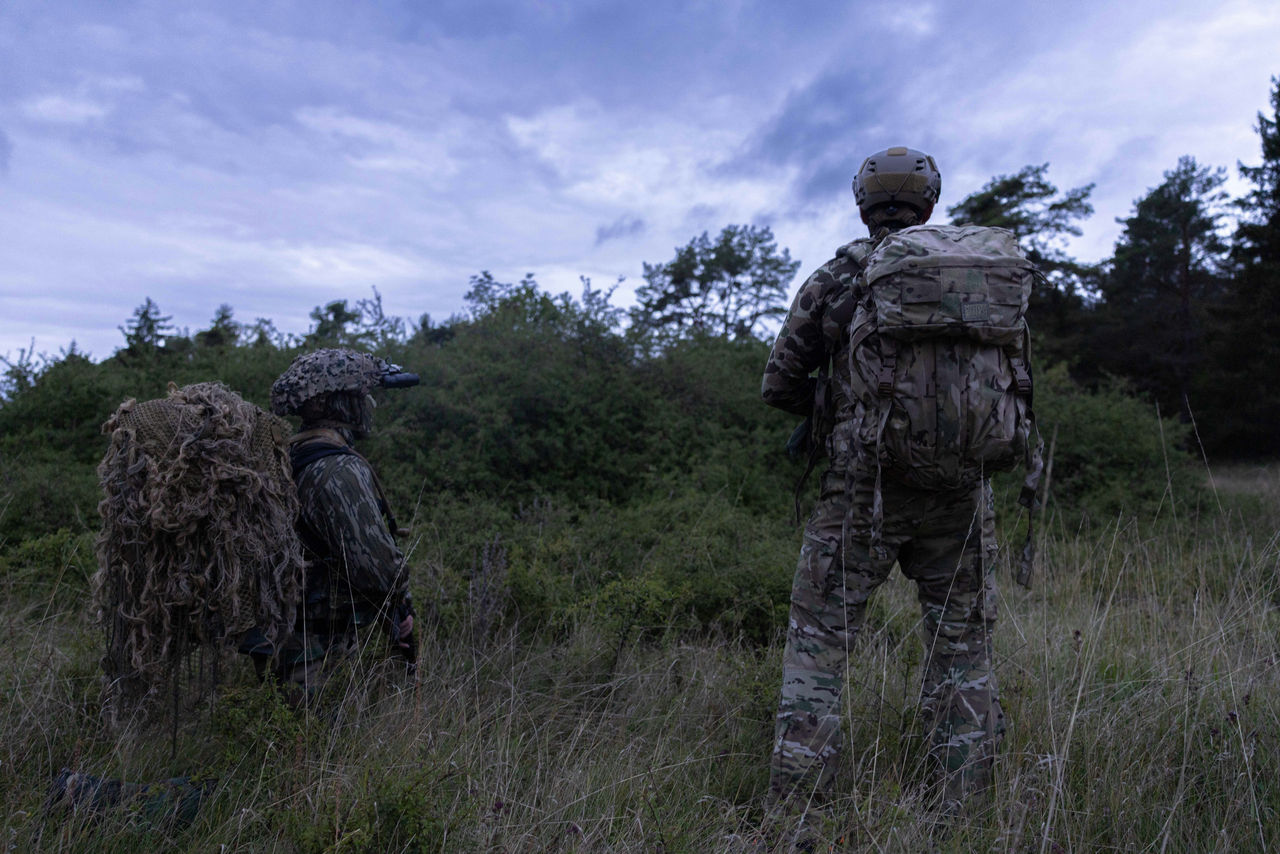
Allied Special Operators step out during Exercise Deep Strike.
To evade them, the commandos won’t use any of the high-tech wizardry typically associated with Special Operations Forces (SOF); indeed, on the modern battlefield, sophisticated electronics can broadcast a team’s location, leading to their capture. Instead, the commandos will fall back on their innate resilience and their knack for creative problem-solving that define NATO’s elite.
This is exercise Deep Strike, a punishing scenario devised by US Special Operations Command Europe (SOCEUR) to test NATO’s most elite units against the unforgiving threats of the modern battlefield. Its designers describe it as a “living document” that captures lessons learned by Ukrainian Special Operators in their struggle against Russia.
The idea emerged from conversations held between Allied SOF commanders and the leader of NATO Special Operations Forces Command (SOFCOM), US Army Lieutenant General Richard Angle. Allied commanders described the need for an exercise that would pit their operators against the deadliest threats on the modern battlefield under the most demanding of circumstances: a time-sensitive, deep-penetration strike. General Angle, who also serves as the commander of SOCEUR, directed the command, based in Stuttgart, Germany, to develop the training.
After running two trials with teams from the US Army’s 10th Special Forces Group, SOCEUR has opened up the course to Special Operations Forces (SOF) units from other NATO countries. Poland is the first to send a team.
“The idea is that, if we can replicate the front lines of modern warfare here, we can use that to train NATO SOF forces and eventually develop it into an evaluation or validation event,” says a US Army Special Forces major who works at the Joint Multinational Readiness Center, the sprawling training area in Hohenfels, Germany that hosts Deep Strike events.
While the advent of cruise missiles and long-range artillery has made it easier to hit targets behind the front lines, they’re only as good as the targeting data fed into their systems – and when the data is sketchy or incomplete, Allied commanders can count on the strength, resilience and creativity of Special Operators to complete the mission.
“You hand the team a very wicked problem, and its members have the expertise and experience developed over years to build a solution, even when the mission is extraordinarily high-risk,” the major says.
Over the past few decades, Special Operators have used cutting-edge technology to dominate their foes: night vision goggles let them see in the dark. Surveillance drones monitor the area of operations, while fighter jets circle above, ready to provide fire support with satellite-guided bombs. Helicopters can carry them across the battlefield, allowing them to surprise their foes and quickly evacuate their wounded personnel.
The tactics witnessed during Russia’s full-scale invasion of Ukraine, however, bring these technological advantages into question. When both sides have night vision goggles, nobody owns the night. The proliferation of advanced heat-sensing thermal optics makes moving undetected even more difficult. Integrated air defence systems dramatically raise the risk of flying fighter jets or medevac helicopters, meaning troops fight without the assurance of air support, and more wounded soldiers die while waiting for life-saving treatment.
And on the modern battlefield, the skies buzz with the sound of cheap, one-way attack drones. In Ukraine, the proliferation of these weapons has created a “kill zone” that extends dozens of kilometres deep on either side of the front line.
Penetrating a front line like this isn’t mission impossible — but it’s close. The Special Forces major compares the conditions faced by Ukrainian troops to the opening scene from the techno-thriller film Terminator 2, in which human resistance fighters sneak and crawl through a landscape of twisted metal while being hunted by killer machines.
“That’s almost the image that comes to mind,” he says. “First World War trench warfare with flying Terminators. Along the Russia-Ukraine front, thermal imaging and unmanned systems have changed movements. In some situations, you avoid moving at night because thermal imagery is so effective. During the day you have to be very careful. These systems are no longer just assets you use for advantage — you also have to protect yourself from them.”
While counter-drone doctrine is still taking shape across Allied militaries, the Polish SOF team has a plan. It can’t be shared here, for fear of compromising tactics that might save their lives in combat; suffice it to say that they’re paying attention to Russia’s war against Ukraine.
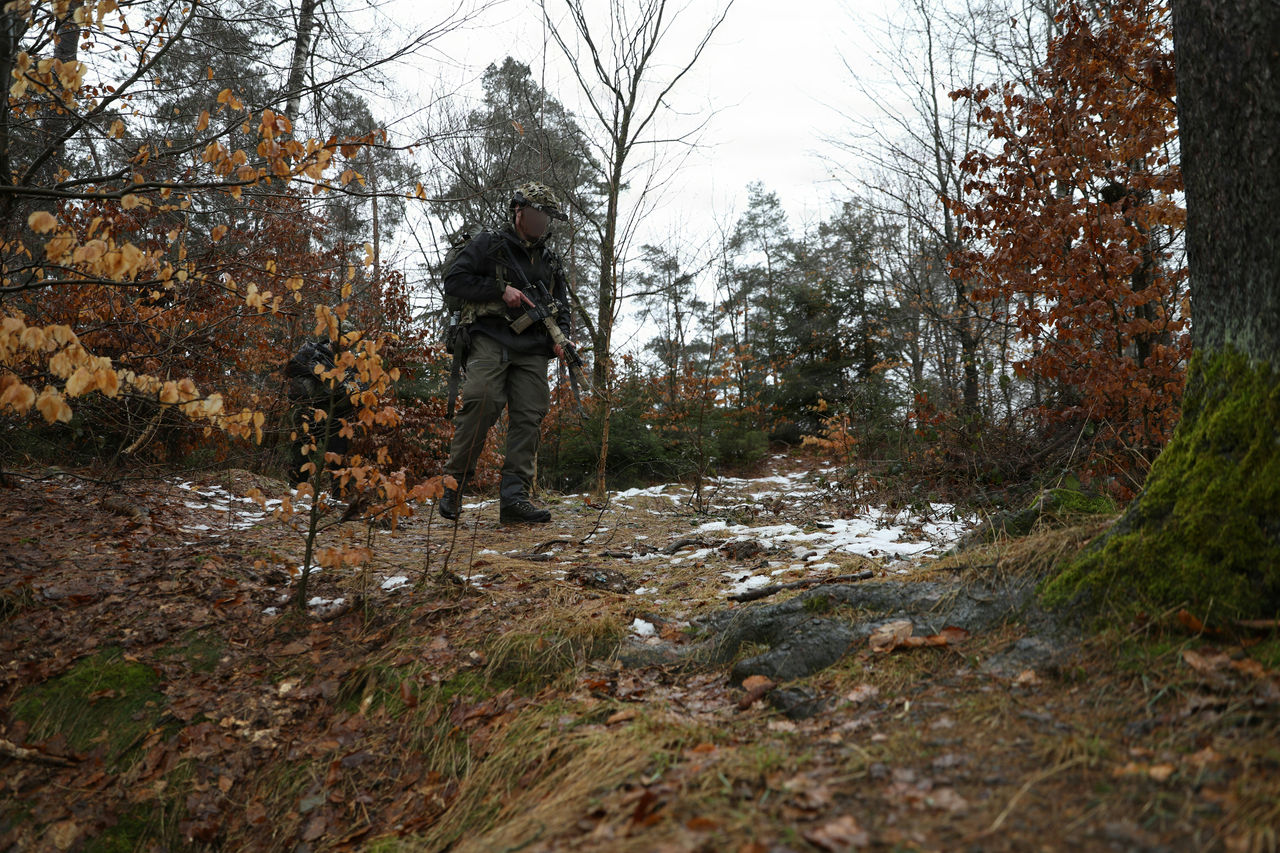
US Army Special Forces navigating through the forest during Deep Strike. Photo: US Army National Guard, SOCEUR via DVIDS
Back to basics
As the Polish operators ready their kit for the long walk, a seasoned US Army Special Forces warrant officer watches them adjust their packs. He is among the first to complete the Deep Strike course, and he notes that, for most Allied SOF, stripping down the kit and going simple isn’t a hindrance. If anything, it comes naturally to them. For example: the culminating event for Special Forces selection is a brutal orienteering challenge – a strenuous course designed to test your navigational skills. To be the best, you have to know where you’re going without relying on any GPS. Navigation fundamentals run deep in their blood.
The warrant officer says he even prefers navigating by maps and “terrain association” — the art of navigating by terrain and landmark to find one's way. It makes an operator much more aware than they might be if they’re constantly glancing at a screen, he says.
For the Polish operators, relying on their own rigorous training was enough to evade the thousands of paratroopers searching for them. They slipped through their adversary’s lines and marched for days to reach their target area, where they launched an attack drone with a dummy charge to strike a high-value target – in this case, a simulated electronic warfare asset.
The next team might not be so lucky. The major says each new iteration of Deep Strike will incorporate the latest threats from the battlefield in Ukraine.
“If current events don’t inform the scenario, then the scenario is only as good as the last time we updated it,” the major says. “We stay informed through both open and classified reporting.”
Over the coming months, Allied SOF units will test themselves against Deep Strike. And they won’t be the last; the major says more than a few Allied SOF units have queued up to participate. He finds that, with each run, they learn something new, and those lessons will be disseminated to the broader Special Operations community via SOFCOM.
Note: In accordance with Operational Security policies set by Polish Special Operations Command and US Special Operations Command, the precise identities of operators and units are withheld.


