Close
Back


From now on you can download videos from our website
If you would also like to subscribe to the newsletter and receive our latest updates, click on the button below.
Enter the email address you registered with and we will send you a code to reset your password.
The password must be at least 12 characters long, no spaces, include upper/lowercase letters, numbers and symbols.
Click the button to return to the page you were on and log in with your new password.
Good afternoon, and Hendriks, thank you so much for welcoming me so warmly to TalTech, and thank you to the students, to the researchers and professors who are here with us today.
The last time I spoke to students here in Tallinn was in October 2024, and a lot has changed in those two years. Russia has lost hundreds, hundreds of thousands of troops in Ukraine, and instead of speaking peace, Putin has continued to send so many to slaughter for no real gain.
With these failures on the battlefield, Russia has ramped up its brutal airstrikes on Ukrainian civilians, and as you know, it has launched a campaign of hybrid attacks across Europe, including here in Estonia, to weaken our support for Ukraine. On top of all of this, there have been major advances in AI and autonomous systems, as you know well here at the University of Technology.
But it's not just the world that has changed, NATO has changed as well, undertaking a historic transformation that is strengthening our alliance. At the NATO summit in 2025 in The Hague, Allies committed to invest 5% of their annual GDP in defence by 2035. And since then, they have indeed made major progress, with some already meeting the 5% target, and Estonia has even surpassed it.
Allies are using this money to develop cutting-edge defence capabilities: drones, satellites, aircraft, AI-enabled systems, and much more. And as they grow their capabilities, European Allies and Canada are stepping up and taking on more responsibility for our shared security, not only to rebalance with the United States, but to reinforce the European pillar of NATO and to further strengthen the transatlantic bonds at the heart of our Alliance.
All of this is building NATO 3.0, which is a stronger, a fairer, a more capable NATO with Europe, Canada, and the United States working together to keep our one billion people across the Alliance safe.
We are transforming for the future, but even now, NATO is rarely enabled to defend every inch of our territory, and NATO Allies are fully committed to Article 5 of our founding treaty, which states that an attack on one of us is an attack against all of us. That was the message that all Allies sent at our Summit in Ankara, where they reaffirmed their ironclad commitment to collective defence. And this is also my main message here today. NATO stands with Estonia against every threat.
Let me be very clear, there is no imminent military threat to NATO territory. If there is a build-up, like there was before Russia's full-scale invasion of Ukraine in 2022, then we will see it and we will deal with it. We are prepared and we have trained for this, which is why Putin is not attacking us directly, but waging a campaign of hybrid attacks against us instead.
But in the face of these threats, we should prevent, we should prepare, and we should persevere. Prevent attacks by maintaining vigilance and further building our strong defences, prepare our societies to withstand any disruption, and persevere in our support for Ukraine, no matter what. Putin wants to intimidate us, divide us, and weaken our support for Ukraine, but he will fail because we are united in our commitment to support Ukraine. And because we are committed to protecting our freedom and our way of life, and to ensuring we have what it takes to do that through investment, through innovation and industry.
And also here, Estonia is leading by example. You are spending 5% on core defence, which is the vital military capabilities needed to defend our alliance. You are supporting Ukraine. In fact, you are one of Ukraine's biggest supporters on a per capita basis. Estonia is leading on defence spending and support for Ukraine because you know that freedom has a cost, and it is well worth paying to maintain independence and security.
This investment is good for Estonia and it is good for NATO. Estonian startups are developing cutting-edge technologies, and NATO is supporting them through the NATO DIANA Innovation Accelerator here in Tallinn. Estonian tech companies are manufacturing drones, air defence interceptors, cyber security systems, battlefield software, energy storage solutions, and much more.
And Estonian defence companies are working closely with companies from the other NATO Allies and partners, combining Estonia's strengths in software, AI, and autonomous systems with the heavy manufacturing capabilities and large-scale resources of other countries.
And all of this in the meantime is also growing Estonia’s economy. Creating good jobs for skilled workers, and opportunities for people with good ideas. And we know that Estonia is a place where people can turn a good idea into reality, which many people in this room have done, or no doubt will do in the near future.
It is also making NATO stronger. Across the Alliance, European Allies and Canada are stepping up to take the lead for the conventional defence of Europe. And Estonia is a great example of this. At Tapa Army Base, you host NATO’s Forward Land Forces in Estonia, helping Allies train on the ground and gain experience working together. At Ämari Air Base, you host the NATO Air Defence mission, helping Allies protect NATO’s skies along the eastern flank. You have also led the creation of NATO’s digital shield, sharing your cybersecurity expertise through the NATO Cooperative Cyber Defence Centre of Excellence here in Tallinn.
And what’s remarkable about Estonia is that it’s not just your national defence forces, or your advanced tech sector, or your growing defence industry that are contributing to NATO’s strength, it’s everyone. At NATO, we talk about a whole-of-society approach to resilience and what this really means is that everyone – school children and retirees, construction workers and CEOs – knows what to do when disaster strikes.
In Estonia, we see a level of national civil preparedness that we would like to see across the whole of NATO. Tens of thousands of people volunteer through the Estonian Defence League, helping enhance national readiness. And again, I’m sure that many of you in this room have volunteered, or completed military service. And you have learned resilience skills in school, from basic survival skills to media literacy against disinformation. And this model of civil resilience helps keep Estonia strong and free. By sharing it with NATO Allies, Estonia is helping our entire Alliance to build resilience and stand firm against Russia’s escalating wave of hybrid attacks. This spirit of solidarity within Estonian society, and with your NATO Allies, is truly inspiring. Your NATO Allies also stand with you.
And in that spirit of solidarity, I want to finish my short introduction with a story about some students like you. Students from what was then Tallinn Technical University, and the University of Tartu. And this was back in 1982, during the Soviet occupation. The students went to a Communist Youth League summer camp. Maybe you’ve heard about the story. And in principle, this was to help the Soviet economy by contributing cheap labour, and to provide training in good old Soviet work ethics. But in practice, the students did something else. They set up a NATO base, in 1982, in Soviet-occupied Estonia. Taking advantage of their lack of supervision, they wrote a protest song to the tune of Yankee Doodle and despite the piano, don’t worry, I won’t sing for you today. They created English-language signs, a strict exercise schedule, and even had afternoon tea every day, because it was a British NATO base.
Little did they know that 35 years later, a British-led NATO multinational battlegroup would be deployed to Estonia. Or that one of them would go on to become Estonia’s Ambassador to NATO, and help pave the way for Estonia’s NATO membership in 2004. I end with this story because I believe it is a good reminder of the mindset of resilience, and the spirit of resistance, that Estonians showed during the long Soviet occupation. And it is also a good reminder that so often in history it is young people, like you, who dare to stand up, to laugh at the would-be empire and to show the world how weak it really is.
We are in a serious moment. Russia is brutally attacking Ukraine. It is harassing Europe with hybrid attacks. And it remains a long-term threat to NATO. But we must remember that they’re doing this not because they are strong, but because they are weak. Not because they are winning, but because they are desperate. And as long as we stand together, united in NATO, we are stronger than any threat they can make. As long as we have young people like you, showing courage and creativity, our Alliance will keep our one billion people safe, now and in the future.
Thank you.
Moderator, Silver Tambur
Thank you, Secretary General. So, we will now open the floor for questions. Please raise your hand, and two of my colleagues will come to you, either of them, with a microphone. So briefly introduce yourself as well, and try to ask as concise questions as possible, because time issues. But I will start with a question, and that connects with the audience here and our university. I guess you have a very good overview of what's needed for our common security. So, what would you say, what is the most urgent innovation or problem or challenge that we have, that you know students here or researchers could start working today to solve this?
NATO Secretary General Mark Rutte
Well, there is a wide range of issues we are working on, but of course we are trying to capture all the lessons from what Ukraine is now experiencing in its fight against Russia. And let me start by saying that if we would be in a situation of a conflict with Russia, it would be different from Ukraine at the moment for various reasons, but at least one of the things we rapidly need to develop further is our drone technology, our counter-drone technology.
Of course, a lot is happening there today. We have this joint centre in Poland where we capture all the lessons from the war in Ukraine, so there is a NATO-Ukraine centre, so that we can quickly then distribute it amongst Allies, so that we can start to implement it in our daily activities. And one of the things we are learning is that it is not so much about having the drones on the shelf, but having the drone-building capability when it is needed, because these drone technologies constantly change and rapidly develop.
So, this is one area where we need help. And another one - and then I'll stop on this - is when it comes to air defence, that not only the counter drone technology, but also more generally, that we have to develop a more layered system of air defence. We are doing that. Of course, we have the high-end systems like the Patriot systems and the SAMP/Ts, but also here we have to make sure that every layer we are able, in a cost-effective way, to protect our skies and particularly, of course, our cities and critical infrastructure.
Moderator, Silver Tambur
Thank you. And we have a first question here. I think the lady raised your hand. My colleague comes with the microphone as well. Oh, okay, sorry, there's already one there. Okay, and then you're next.
Question (Student)
Thank you. So my question is about the hybrid attack. So how does NATO decide when a hybrid attack becomes actually an armed attack under Article 4 or 5? Thank you.
NATO Secretary General Mark Rutte
Yes, we are explicitly ambiguous about that, because we don't want to make the Russians more knowledgeable or any other nation which wishes us not well, but ill. We don't want to be them to be more informed. But let me say about hybrid that what Estonia did with the situation in August - attributing it to Russia, sharing all the information with NATO - is extremely helpful, and I call upon all NATO Allies to do that and also to share the information. That's one.
And when it comes to hybrid, let me assure you, we have all the response options. There is, of course, an issue that we cannot always be public about it, and that the reaction will not always be, let's say, tit-for-tat. That we will decide how and when we will react. But we have all the response options, and just one example where it was visible was indeed after the cutting of the undersea sea cable late 2024 between Finland and Estonia, that we started Baltic Sentry - which the Russians hate, and therefore I love, because it imposes a lot of complexity and cost on the Russians. And from that you see more and more Allies building on this, also acting against the Russian shadow fleet, which is a big source of income. And we only saw yesterday again the French Republic acting against one of these vessels. So, we are getting better at that, and that means that it doesn't go unanswered. But you will not always see it.
Moderator, Silver Tambur
Thank you. And a question here.
Question (Student)
Thank you, Honourable Secretary General. My name is [inaudible], and I am studying political sciences here in the University of Technology. I have a question about the relations between NATO and the European Union. On State of the European Union, President Ursula von der Leyen proposed an initiative to form EU's own Security Council to make it easier for member states to call upon NATO's Article 5 and perhaps trade the European Union's own Article 4, and call upon Article 4. How would this initiative strengthen the relationship between NATO and the European Union, and should the European Union perhaps have its own army instead of all members states having their own military forces? Thank you.
NATO Secretary General Mark Rutte
Okay. Thank you for that very important question. Let me start by saying that the relationship between NATO and the European Union is very strong. Not only personal, because Ursula von der Leyen and myself we are colleagues for many years now. But also because she, having her background as a former defence minister of NATO's biggest ally in Europe, Germany, she understands this stuff, and her team understands it, and she is quite strong in making sure that then the rest of the EU, where necessary, understands it.
And that's basically about the division of labour, where NATO is about command and control, it's about the standards, it's about everything which has to do with direct making sure that we keep one billion people safe. And the EU has a lot of added value when it comes to getting the money, making sure the defence industrial base is developed. When it comes to societal resilience, we have a joint responsibility. When it comes to military mobility, that a bridge can not only hold a car, but also a tank if necessary, and of course everything when it comes to military mobility more generally. So we have the clear division of labour.
Now, to your question of her announcement in the State of the Union, the speech the President of the European Commission delivered in September, I totally understand what she wants there, and I think has a, it will absolutely work also in conjunction with NATO, because the EU, when it comes to resilience, when it comes to, indeed, issues around hybrid, also has its responsibility. We had a good discussion on this only a couple of months ago in a joint press statement. When it comes to hybrid, so I already said before that, hey, we welcome this and we think it is a good initiative.
And when it comes to a European military, hey, listen, this is the thing: NATO has a command-and-control system to make sure that 32 military work together. That if The Netherlands or the UK or Sweden is attacked, that everybody knows what to do collectively in an Article 5 situation to make sure that that war ends as soon as possible, in line with the excellent speech General Grynkewich, Supreme Allied Commander, delivered in Warsaw last Monday.
And this is based on 32 separate militaries. If you want to have a European joint military, that can only work if Estonia and others are willing to give up on their own militaries and have a sort of joint European military. I mean, the United States has one military. There is not a separate army or navy for New York, as it is for Michigan. There is one US military. So, this can only work if you then have truly one. But that can only work if the Dutch and Estonians and the others are willing to give up on their national sovereign responsibility for creating their own military force. I don't think that will happen.
So then, if you will have separate militaries, you have to make sure that the command-and-control structure is there and the plans are there, and that's what we all have detailed. Countries know what capabilities they need to deliver for the collective defence, and we all know who will do what, like the German-Dutch army corps helping out if a situation were to arise in this part of NATO territory, and others know where they have to go to, so part of the plans. Sometimes people think I'm against the European military. I'm not against it, but not in addition to all the national militaries, because then it gets too complex. And again, I think for sovereignty reasons it will not happen. And from the command of control structure we have in NATO, it is not necessary to have it.
But it is not a principled position being against, as long as we don't duplicate and don't have separate structures within Europe, in EU, separate to NATO, because then, if an attack happens, we will spend weeks deciding who will do what, and as soon as we have decided, we find ourselves in a difficult situation, and nobody wants that. So, I think we are pretty much aligned here between the EU and NATO on who is doing what and to the most effect.
Question (Student)
Hello. My name is Laura Elizabeth, and I'm a student of food, plastic, and textile technology. And my question for you, which side needs NATO more, Ukraine or NATO itself?
NATO Secretary General Mark Rutte
It's difficult to answer that question, because when you look at Ukraine, it’s first of all, crucial that Russia will not be successful in occupying another country, colonising another nation in the Europe of the 2020s. This we left behind us, and particularly since the Soviet Union was dissolved, and you regained your independence. This was something of the past that you would invade another country to try to colonise it. So, there is a principal question at stake here: why we have to support Ukraine, and also a practical reason, because of course, it is in Ukraine's interest and NATO's interest that Ukraine can go forward as a sovereign, independent nation, which is able to defend itself, also after the peace deal.
So, it's difficult to say who needs what more. But when it comes to Ukraine, we are learning a lot from them now. But they still learn from us. So, when it comes to drone and counter-drone technology, we are learning from Ukraine, but when it comes to battlefield tactics and strategies, NATO is still able to supply a lot of insights to Ukraine. So, it is really a two-way street, you could argue, in terms of who is doing what in learning from each other.
Moderator, Silver Tambur
Thank you. We have a question here.
Question (Student)
Yes. Hello. My name is Christian Peter. I am studying electro-energetics and mechatronics here in TalTech, and my question is: last year, around the same time, you were asked if Europe could become equal to the United States in terms of, what was the word, like presence. I believe it was something along those lines. Anyways, do you think Europe at this point has become closer to an equal, or even maybe surpassed United States?
NATO Secretary General Mark Rutte
The first question is whether you want that, because the question I think which was posed to me was, could Europe go it alone? And I think there is merit in staying together: the United States, Canada, and the European part of NATO. We are so much stronger trans-Atlantic than [if] we would go separate ways. Don't forget, for the defence of the United States, NATO is also crucial. We defend the United States from these nuclear submarines ending up on the shores of the, Russian nuclear submarines ending up at the shores of the United States.
We make sure that the transatlantic is safe, the Euro-Atlantic area is safe, that the High North is safe, that Europe is safe, all in the interest of the United States. So, the United States has a direct interest in NATO for its defence, and we have an interest in the US, with its huge power and industrial output and innovation power. And, of course, the nuclear umbrella is the ultimate guarantor of our freedom, to stay involved in NATO. So, I always doubt whether there is any need to go separate ways.
The US certainly doesn't want it, so let’s not then as Europe think that we can do it. But then, what we need to do as Europeans in NATO is become much stronger. So, what you are seeing now is a Europe which is becoming more capable of at least taking care much more of the conventional defence of Europe, and that will take time because you might be already on 5% even core defence spending. But for the rest of NATO, we are now including defence-related spending around 4% which is already quite a good achievement in only a year and a half since we made the decision in The Hague on this 10-year trajectory.
But to build all those capabilities, to get all the men and women in uniform, to make sure that we can implement all the plans we have, so that we can not only defend ourselves today, but also stay ahead of Russia and others in three, five, and seven years, that will take time. But again, let's not go separate ways. I would plead against it. The US would plead against it. I don't think it is in the interest of the Europeans.
Moderator, Silver Tambur
Let's move on. A gentleman in a navy shirt has waited a long time. Can we get a microphone here? Just here, the second, the third row, or second, sorry.
Question (Student)
Hello, I am also a Taltec student, but in the Maritime Academy branch. So, the question is: since there are hybrid attacks, there are also radar jamming in the Baltic Sea for merchant ships. For example, I have heard lots from sailors that ships losing radar, losing GPS, so they have to use old maps and stuff like that. So, my question is, what can NATO do to keep Baltic Sea and all of the other seas safe for merchant sailors?
NATO Secretary General Mark Rutte
What NATO can add here is to make sure that we have all the information that we coordinate and implement where necessary in next steps. For example, to Baltic Sentry or to Eastern Sentry, which is the defence of the whole Eastern flank from Finland, including the whole Eastern flank, including the Black Sea, which came after the airspace incursions in Poland in September last year.
But, of course, also the individual nations like Estonia and the others bordering on the Baltic Sea have a specific responsibility here to make sure that you maintain whatever is possible in terms of tracking what ships are doing, and that your own ships can sail safely. And again, wherever possible, we coordinate within NATO. Not always possible to tell you everything whilst the Russians and others are listening to these conversations. But here, NATO is first of all the platform to make sure that we have all the information, we share what we need, and we implement where necessary extra measures.
Moderator, Silver Tambur
Thank you. Unfortunately, our time is up. We can't take any more questions. Thank you Secretary General.


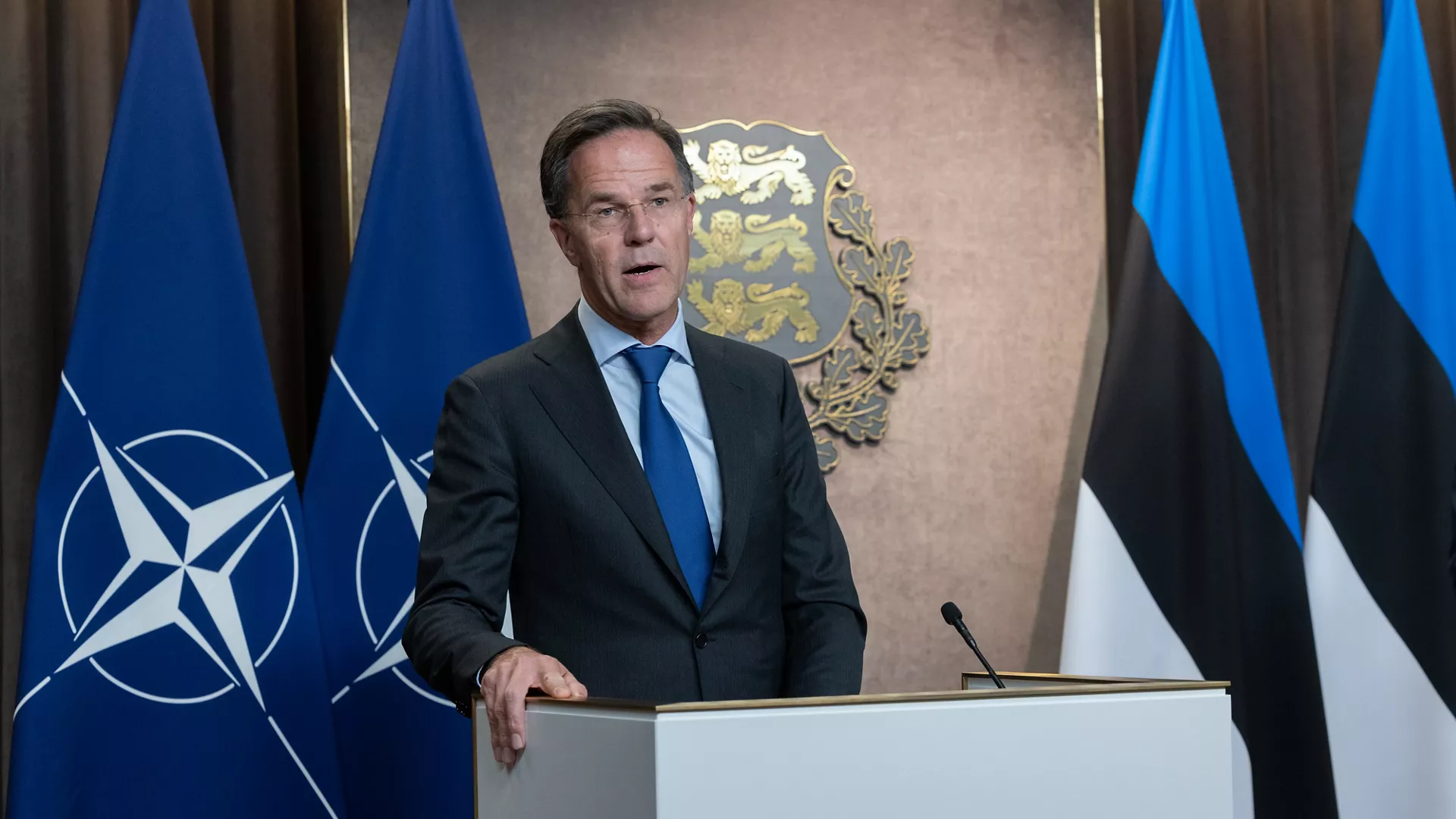


NATO Secretary General Mark Rutte meets with the Prime Minister of Estonia, Kristen Michal
NATO Secretary General Mark Rutte meets with the Prime Minister of Estonia, Kristen Michal
NATO Secretary General Mark Rutte meets with the Prime Minister of Estonia, Kristen Michal
NATO Secretary General Mark Rutte meets with the Prime Minister of Estonia, Kristen Michal
NATO Secretary General Mark Rutte meets with the Prime Minister of Estonia, Kristen Michal
NATO Secretary General Mark Rutte meets with the Minister of Foreign Affairs of Estonia, Margus Tsahkna
NATO Secretary General Mark Rutte meets with the Minister of Foreign Affairs of Estonia, Margus Tsahkna
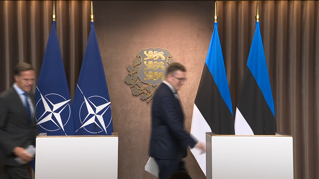
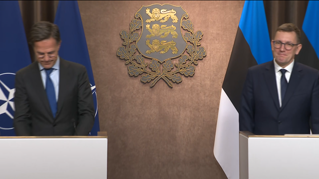
Press conference with the NATO Secretary General Mark Rutte and the Prime Minister of Estonia, Kristen Michal
Press conference with the NATO Secretary General Mark Rutte and the Prime Minister of Estonia, Kristen Michal
Press conference with the NATO Secretary General Mark Rutte and the Prime Minister of Estonia, Kristen Michal
NATO Secretary General Mark Rutte with the Prime Minister of Estonia, Kristen Michal
NATO Secretary General Mark Rutte with the Prime Minister of Estonia, Kristen Michal
Speech by the NATO Secretary General Mark Rutte at the Tallinn University of Technology
Speech by the NATO Secretary General Mark Rutte at the Tallinn University of Technology
Speech by the NATO Secretary General Mark Rutte at the Tallinn University of Technology
Speech by the NATO Secretary General Mark Rutte at the Tallinn University of Technology
Speech by the NATO Secretary General Mark Rutte at the Tallinn University of Technology
Speech by the NATO Secretary General Mark Rutte at the Tallinn University of Technology
NATO Secretary General Mark Rutte at the Tallinn University of Technology
NATO Secretary General Mark Rutte at the Tallinn University of Technology
NATO Secretary General Mark Rutte at the Tallinn University of Technology
NATO Secretary General Mark Rutte at the Tallinn University of Technology
NATO Secretary General Mark Rutte meets with the President of Estonia, Ülle Madise
NATO Secretary General Mark Rutte meets with the President of Estonia, Ülle Madise
NATO Secretary General Mark Rutte meets with the President of Estonia, Ülle Madise
NATO Secretary General Mark Rutte meets with the President of Estonia, Ülle Madise
NATO Secretary General Mark Rutte meets with the President of Estonia, Ülle Madise
NATO Secretary General Mark Rutte meets with the President of Estonia, Ülle Madise
NATO Secretary General Mark Rutte with the Minister of Defence of Estonia, Martin Herem
NATO Secretary General Mark Rutte with the Minister of Defence of Estonia, Martin Herem, and the Chief of Defence of Estonia, Lt. Gen. Andrus Merilo
NATO Secretary General visits Estonia