Close
Back


From now on you can download videos from our website
If you would also like to subscribe to the newsletter and receive our latest updates, click on the button below.
Enter the email address you registered with and we will send you a code to reset your password.
The password must be at least 12 characters long, no spaces, include upper/lowercase letters, numbers and symbols.
Click the button to return to the page you were on and log in with your new password.
Prime Minister Sinkevičius, dear Mindaugas,
It's a pleasure to welcome you to NATO Headquarters for the first time as Prime Minister.
And we have just discussed how we will continue to keep NATO strong and successful, and Lithuania safe and secure.
NATO defends every inch of Allied territory against any threat from any direction. Just two weeks ago, Italian jets deployed by NATO from Šiauliai Air Base shot down a drone that violated Lithuania's airspace. This is collective defence in action.
The repeated drone incidents along our eastern flank show the evolving nature of the threat, and we are strengthening our integrated air and missile defence, a multi-layered, 360-degree approach that gives us greater protection against the full range of airborne threats. Through initiatives such as Drone Edge, we are adapting and reinforcing our posture against drones. We will strengthen cheaper counter drone defences, so we are not using high-end jets against low-cost threats. NATO will continue to build the shield that protects the skies over Lithuania, the Baltic region, and, of course, beyond.
NATO is also with you in the Baltic Sea, and with NATO Forward Land Forces based in Lithuania. You are investing heavily in the development of the Rūdninkai Training Area, the largest military infrastructure project in your country's history to host these troops.
Lithuania leads by example on defence investment. This year, you are expected to reach 5.38% of GDP for core defence spending. Lithuania doesn't just meet its commitments; it sets the standards.
On Ukraine, Lithuania's committed at least 0.25% of GDP annually in military assistance, with a clear focus on air defence and ammunition. You are also spearheading practical industrial cooperation, having already contributed $38 million directly into Ukraine's defence industry and advancing joint production.
Prime Minister, you were recently yourself in Ukraine, and I welcome Lithuania's commitment to support Ukraine's energy infrastructure ahead of winter and provide other help, including with railway locomotives.
Russia continues its reckless campaign of hostile actions against NATO Allies. It is trying to weaken our resolve and stop our support for Ukraine. But Russia is failing. It is failing on the battlefield in Ukraine, and it is failing to undermine our unity and support for Ukraine. Our message to Moscow is clear: we will do even more for Ukraine, and not less.
Prime Minister Sinkevičius, dear Mindaugas, thank you for your personal commitment to NATO, and for everything Lithuania is doing for our great Alliance. Along with its Allies, Lithuania is helping to build a stronger Europe in a stronger NATO. European Allies and Canada are stepping up, investing more, expanding production, and taking greater responsibility for our shared security. That makes NATO stronger and Lithuania more secure.
So, thank you, and I look forward to continuing our good work together.
Milda Vilikanskytė, Lithuanian National Radio and Television:
Secretary General. I have a few questions for you. Maybe at first, we know about planned sabotage act in Leipzig, in other parts of Germany, United Kingdom, Denmark. Also, you mentioned downed drone in Lithuania. We hear quite a few countries saying, "Let's stop calling this our hybrid threats because it is not hybrid nor threats anymore”. Would you agree with that? That we should stop it calling hybrid threats, and then what response should be? Because it is clear that that approach that we have right now is not deterring. And another question is: We hear Prime Minister of Poland, Chancellor of Germany, talking about decisive weeks or months, both for Ukraine and for Europe, with that information that you have, can we say that we reach the peak of those decisive weeks, or we are just turning to that peak? And what should we expect? Thank you.
Mark Rutte, NATO Secretary General:
Well, first on the word hybrid, I've said as many times before. It sounds a bit ‘cuddly’, and in the end, these are grey zone tactics, and what we are seeing these can be drones, or sabotage, or even cyber attacks. But hey, we have all the response options we need. You will not always see them public. They will not always be symmetric. It will not always be tit for tat. But we have the response options we need. You have seen that in the past. For example, when it came to the cutting of the undersea sea cable between Finland and Estonia in the late 2025 (2024), we launched Baltic Sentry, which is protecting our vital undersea infrastructure. And from Baltic Sentry, more and more what we are seeing is Allies, and so this was symmetric. Asymmetric is what happened after that. Also visible, that more and more Allies are making it more difficult for Russia's shadow fleet to function. We have Allies like Sweden and the United Kingdom and Belgium and France. The French President has taken the whole initiative on this in October last year, working on the shadow fleet and making sure that these leaking old ships are not providing Russia with money. More generally speaking, I would urge some calm because we are investing in our defence. Russia is not in a good place. Their economy is not in a good place. When you look at Ukraine, they're losing at the moment over 40,000 a month, dead or seriously wounded, a month. These numbers are staggering. They are huge. Terrible news for the families involved here, obviously. But this also shows you that you have to deal with a president who is willing to sacrifice now up to 1.2 million of his own people in a totally unprovoked war of aggression against Ukraine. So, some calm is in place here, but also carry on. Carry on with the investments like the Lithuanian government is doing and the rest of NATO is doing at the moment. Carry on making NATO stronger. And finally, next to calm and carry on, keep the support for Ukraine going because the best response to any action in this grey zone of what Russia is doing is more support for Ukraine instead of less support for Ukraine. Because in the end, what they want to do is divide us and lose focus on Ukraine and start discussing amongst each other what's happening and why and how does this all fits together? Now calm, carry on and support Ukraine. More support for Ukraine, not less support for Ukraine. Exactly as we are doing, also thanks to European Union, the Ukraine Support Loan, the excellent news that we have now reached the 10 billion threshold when it comes to the PURL money. These are vital stuff from the U.S. into Ukraine, paid for by Canada and European Allies, including here the European Union playing a big role. So, all of this is crucial, is important. We should not be naive about to your second question, not be naive about Russia, but they know we are stronger, and we have to make sure, by carrying on our investments, that we are also stronger in two, three, and five years from now, and that's exactly what we are doing.
Allison Hart, NATO Spokesperson:
All right, we're just about out of time. We'll take one final question - AFP.
Olivier Baube, AFP:
Thank you, Olivier Baube from AFP, Agence France-Presse. I have a question to you, Prime Minister, following what Mr Rutte said on the need to stay calm. I mean, are you worried that this increasing hysteria and fear of hybrid attacks, exaggerating the threat, could undermine Europe's confidence and play into Russia's hand at the end?
And for you, Secretary General, if I may, you said that Russia's campaign, hybrid campaign, is failing, but it doesn't look like it when they are managing to set fire to key facilities, disrupt railway lines, and causing panic in Europe. Does that look like failure?
[response from Prime Minister]
Mark Rutte, NATO Secretary General:
And I totally agree. And to your second question, no, I'm not saying that these malign grey zone activities are not having an impact. They can have an impact, and sometimes they have an impact, clearly. What I'm saying is we have all the response options, sometimes visible, sometimes not - not always public, not always tit for tat. You have heard the Supreme Allied Commander yesterday saying, “Hey, when able, when you are sure it is the Russians, or almost sure it is the Russians, attribute it to the Russians” - exactly like Estonia did today. I applaud it. And also share whatever information you have as Allies with NATO, with SHAPE, and with the team of the Supreme Allied Commander, so that we have the complete picture. So, the response options are there. We do what is necessary, and Allies can help indeed by attributing, but also by making sure that we have the collective overview of what is happening. It's exactly as we are doing in the spirit of staying calm, carry on. We are stronger and they know it.
NATO Spokesperson Allison Hart:
All right, that's all we have time for today. Thank you so much for joining us.


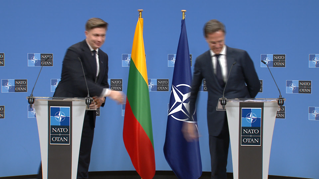
NATO Secretary General Mark Rutte with the Prime Minister of Lithuania Mindaugas Sinkevičius
NATO Secretary General Mark Rutte with the Prime Minister of Lithuania Mindaugas Sinkevičius
NATO Secretary General Mark Rutte with the Prime Minister of Lithuania Mindaugas Sinkevičius
NATO Secretary General Mark Rutte with the Prime Minister of Lithuania Mindaugas Sinkevičius
NATO Secretary General Mark Rutte with the Prime Minister of Lithuania Mindaugas Sinkevičius
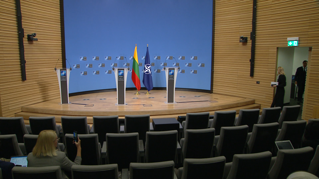
Joint press conference with NATO Secretary General Mark Rutte with the Prime Minister of Lithuania Mindaugas Sinkevičius
Joint press conference with NATO Secretary General Mark Rutte with the Prime Minister of Lithuania Mindaugas Sinkevičius
Joint press conference with NATO Secretary General Mark Rutte with the Prime Minister of Lithuania Mindaugas Sinkevičius
Joint press conference with NATO Secretary General Mark Rutte with the Prime Minister of Lithuania Mindaugas Sinkevičius
Joint press conference with NATO Secretary General Mark Rutte with the Prime Minister of Lithuania Mindaugas Sinkevičius
Joint press conference with NATO Secretary General Mark Rutte with the Prime Minister of Lithuania Mindaugas Sinkevičius
Joint press conference with NATO Secretary General Mark Rutte with the Prime Minister of Lithuania Mindaugas Sinkevičius
Joint press conference with NATO Secretary General Mark Rutte with the Prime Minister of Lithuania Mindaugas Sinkevičius
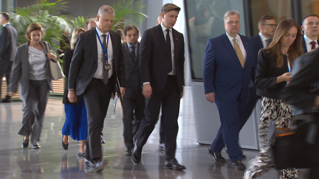
NATO Secretary General meets with the Prime Minister of Lithuania