Close
Back


From now on you can download videos from our website
If you would also like to subscribe to the newsletter and receive our latest updates, click on the button below.
Enter the email address you registered with and we will send you a code to reset your password.
The password must be at least 12 characters long, no spaces, include upper/lowercase letters, numbers and symbols.
Click the button to return to the page you were on and log in with your new password.
(As prepared)
Good afternoon.
Thank you for such a warm welcome.
It is an honour to deliver The Ditchley Foundation’s 62nd Annual Lecture.
The Foundation was established to support transatlantic relations, to bring together decision makers and experts, to exchange ideas, in such an inspiring setting.
I cannot think of a better place to share my thoughts on the future of NATO, and why the Alliance matters more than ever.
What is known as NATO 3.0.
It is not a reboot, but a rebalancing of our security for the better.
With a stronger Europe in a stronger NATO.
This is my first time at Ditchley Park, and as a keen student of history, I am fascinated by the role this stately home has played in our transatlantic story, and its connection with Winston Churchill.
As a wartime prime minister, Ditchley Park was his secret weekend retreat.
Discreet and hidden, Ditchley Park is where Churchill met envoys of President Roosevelt, to make the case for American military support and negotiate Lend-Lease.
After the war, Churchill knew the absolute necessity of maintaining a strong transatlantic Alliance.
During the House of Commons debate in May 1949 to approve the North Atlantic Treaty, Churchill’s speech was…
How can I put this… very British.
And I have reassured my staff I won’t do Churchill’s voice for the next quote:
“We give our cordial welcome to the Atlantic Pact.
We give our thanks to the United States for the splendid part they are playing in the world.”
Churchill spoke from the opposition benches, but gave full credit and congratulations to Labour’s Foreign Secretary, Ernest Bevin, one of the principal architects of our North Atlantic Treaty.
It was the start of more than seven decades of continuous commitment by the United Kingdom to NATO.
This first age of the Alliance, NATO 1.0 you might say, stood its ground, held the line, and pushed back against the brute force of the Soviet Union and communist hegemony.
This allowed freedom and democracy to win the Cold War.
NATO 2.0 started at this “end of history”.
Marked by the move away from the territorial defence of Europe to “out of area” operations.
But even with these new demands, defence budgets declined, and military power dwindled across Europe.
There was the casual assumption, made by many, that our biggest friend and Ally would always provide most of the muscle and pick up the bill, no matter what.
It is neither right nor realistic to expect so much from one country – even when that country is the United States.
So, we are rebalancing our Alliance.
To stay transatlantic, NATO is becoming more European.
A NATO with Europe, and Canada, spending more, producing more, and doing more for their security.
This is the idea of NATO 3.0.
Building for the future.
A stronger Europe, in a stronger NATO.
A modernised Alliance, agreed by all NATO leaders at our Summit in Ankara this July.
I am a committed European, with a transatlantic outlook.
I see this as a defining moment for this Alliance, and for Europe.
We need more UK – and more Europe – in the Alliance.
The UK and Europe have the power to lead.
With their collective military, industrial, and technological might.
America’s Allies have broad shoulders and are ready for more responsibility.
NATO faces the most dangerous and complex security environment in a generation.
Russia and its war against Ukraine; terrorism; Iran; and the tectonic shifts of global geopolitical competition.
It is clear, if we do not invest more in our security, our collective defence will not be credible.
Our countries - our precious democracies - and our Alliance, would be at greater risk of attack.
We cannot protect our way of life, if we do not invest in our defence. And we are.
European Allies and Canada are now on a trajectory to equalise their defence spending with the United States.
You all know about our historic commitment that we made in The Hague last year to invest 5% of GDP in defence and security by 2035.
In 2025 alone, European Allies and Canada spent nearly 20% more on core defence than they had the year before. Looking at 2025 and 2026 combined, that’s 258 billion dollars in extra investment. Staggering sums.
I recognise that it takes political courage to do what is right.
And Europe and Canada are taking the difficult decisions to massively increase defence investment. The threats we face demand it.
Here we should also give credit to President Trump.
I know he pushes hard on defence spending, but ultimately, he’s right.
We needed this shot of adrenaline.
In Europe and Canada, there is a new found determination to provide the resources, forces and capabilities we need to enhance our warfighting readiness.
Investing in deep precision strike, integrated air and missile defence, drones, and intelligence capabilities.
At the Ankara Summit alone, Allies announced more than 50 billion dollars in new procurements.
Military might and industrial might go hand in hand.
And we are re-energising our defence industrial base and increasing defence cooperation across Europe and North America.
In NATO 3.0, we are also seeing a more European-led NATO, with European generals in more posts in NATO’s command structure.
America’s allies have already taken greater responsibility for defence across the eastern flank, in the Baltic region, and in the Arctic.
For example, 8 out of 9 of NATO’s Forward Land Forces, based in countries from the Black Sea to the Arctic Circle, are led by European Allies or Canada.
NATO is, and will always be, a transatlantic Alliance.
That is the principle that underpins NATO 3.0 and the rebalancing of our security.
A secure Europe, a secure Atlantic, and a secure Arctic are priorities for NATO, and also essential for America’s long-term security.
The Russian nuclear submarines for example coming out of the Kola Peninsula aren’t targeting Europe.
Their aim in wartime is the destruction of the US homeland.
And NATO Allies work together to ensure they would never break out into the North Atlantic.
NATO unity, solidarity and collective strength remain the foundation of peace, security, and prosperity for our citizens.
These one billion people, on both sides of the Atlantic.
In Ankara, all Allies reaffirmed their ironclad commitment to our collective defence under Article 5.
An attack on one is an attack on all.
We must now turn our new momentum into a lasting transformation.
NATO must be the engine for this change – turning national investment into common requirements, integrated forces, credible plans, and collective deterrent power.
The United Kingdom has a central role in building this stronger Europe in a stronger NATO.
Your nuclear deterrent is being upgraded, and British conventional forces are deployed on land, at sea and in the air, across the Euro-Atlantic area, and beyond.
The UK is also leading a European initiative for deep precision strike capabilities, with a coalition of countries that have committed over $50bn.
Stronger UK defence makes us all safer.
It is essential that your armed forces continue to provide the hard power NATO needs.
The UK is already investing more in defence.
And I welcome the new prime minister’s assurance that his government will meet its NATO commitments. We discussed this today.
There is, of course, a defence dividend.
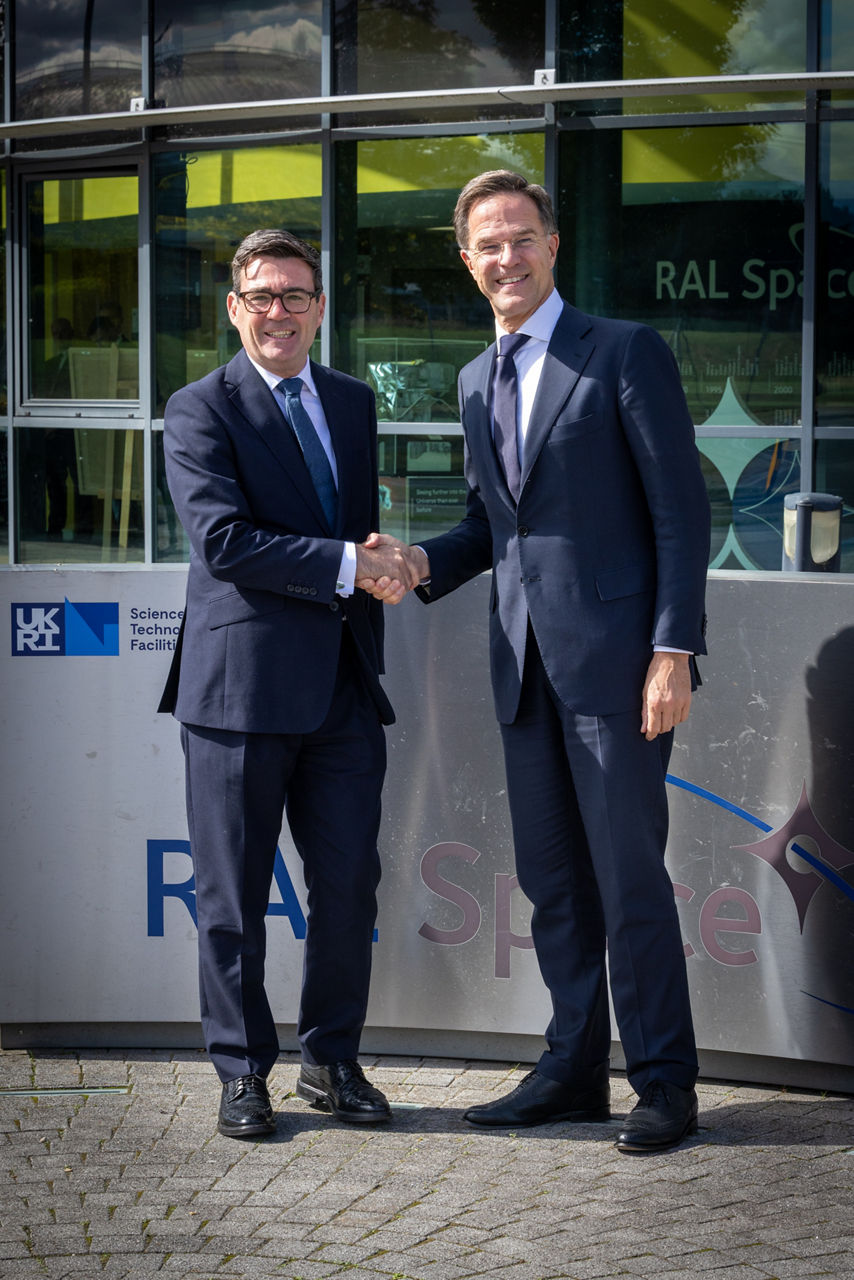
I was with the prime minister this afternoon at a defence innovation centre near Oxford, to see the “white heat of technology” and the new capabilities that will keep us safe.
It’s part of a new defence industrial revolution that is sweeping across the Alliance, creating jobs and growing economies.
The UK is serious about security.
It is leading, along with NATO Allies, the push back against Russia’s dangerous and reckless campaign against us.
It was a UK operation earlier this year that exposed Russian submarine activity around undersea cables.
It was the UK’s cyber defenders that exposed Russia’s malign campaigns in cyberspace.
And it was the UK authorities that caught and convicted Russian-backed saboteurs in London trying to disrupt support to Ukraine.
The UK, along with other Allies, is also imposing costs on Russia, by countering its shadow fleet.
Collectively we will continue to strengthen our ability to deter and defend all Allies, against any threat.
NATO will not be intimidated by Russia’s campaign of hostile actions.
Russia wants to stop us helping Ukraine – but their actions will only lead us to do more for Ukraine.
Russia’s actions are a sign of weakness, and a symptom of Putin’s failure in Ukraine.
We will keep Ukraine strong, so peace can prevail.
The UK has been a good friend to Ukraine in its hour of need, and has shown real leadership.
In the Ukraine Defence Contact Group providing military aid, and in the Coalition of the Willing.
And now by sharing Storm Shadow missile technology, so Ukraine can hit back against Russian aggression.
And let’s not forget that this is also an investment in our own security.
What we are learning from Ukraine is helping strengthen our own defences, including with Ukraine’s expertise in drones and air defence.
NATO 3.0 is the most significant transformation of our Alliance in a generation.
We must continue to have open and honest conversations about the tough decisions this modernisation will require.
On better burden sharing, and real burden shifting.
We are confident enough in NATO to have our differences, and we are strong enough to overcome them.
Because we agree on the fundamentals.
Defending our people, our freedoms, and our democracies.
We always have, we always will.
Winston Churchill said in his speech accepting the Charlemagne Prize in 1956, that NATO’s founding treaty is “simple and majestic”, and that:
“NATO is the striking product and expression of a world wearied by war, determined to build its own organisation, in such strength and power, that there will be peace.”
Who could disagree with that?
Today, in our Atlantic Alliance we agree it is time for a more capable and rebalanced NATO.
A more European NATO.
An Alliance that overcomes unhealthy dependencies, and creates a true transatlantic partnership, built to last.
This rebalancing makes our Alliance stronger.
All doing their fair share to strengthen our collective deterrent power.
That is NATO 3.0.
And why it matters.
Thank you.


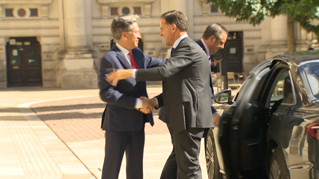
NATO Secretary General Mark Rutte meets with the Prime Minister of the United Kingdom, Andy Burnham
NATO Secretary General Mark Rutte meets with the Prime Minister of the United Kingdom, Andy Burnham
NATO Secretary General Mark Rutte and Prime Minister of the United Kingdom Andy Burnham visit RAL Space
NATO Secretary General Mark Rutte and Prime Minister of the United Kingdom Andy Burnham visit RAL Space
NATO Secretary General Mark Rutte and Prime Minister of the United Kingdom Andy Burnham visit RAL Space
NATO Secretary General Mark Rutte and Prime Minister of the United Kingdom Andy Burnham visit RAL Space
NATO Secretary General Mark Rutte and Prime Minister of the United Kingdom Andy Burnham visit RAL Space
NATO Secretary General Mark Rutte and Prime Minister of the United Kingdom Andy Burnham visit RAL Space
NATO Secretary General Mark Rutte meets with the Prime Minister of the United Kingdom, Andy Burnham
NATO Secretary General Mark Rutte and Prime Minister of the United Kingdom Andy Burnham visit RAL Space
NATO Secretary General Mark Rutte and Prime Minister of the United Kingdom Andy Burnham visit RAL Space
NATO Secretary General Mark Rutte and Prime Minister of the United Kingdom Andy Burnham visit RAL Space
NATO Secretary General Mark Rutte and Prime Minister of the United Kingdom Andy Burnham visit RAL Space
NATO Secretary General Mark Rutte and Prime Minister of the United Kingdom Andy Burnham visit RAL Space
NATO Secretary General Mark Rutte and Prime Minister of the United Kingdom Andy Burnham visit RAL Space
NATO Secretary General Mark Rutte and Prime Minister of the United Kingdom Andy Burnham visit RAL Space
NATO Secretary General Mark Rutte and Prime Minister of the United Kingdom Andy Burnham visit RAL Space
NATO Secretary General Mark Rutte meets with the Secretary of State for Foreign, Commonwealth and Development Affairs of the United Kingdom, Ed Miliband
NATO Secretary General Mark Rutte meets with the Secretary of State for Foreign, Commonwealth and Development Affairs of the United Kingdom, Ed Miliband
NATO Secretary General Mark Rutte meets with the Secretary of State for Foreign, Commonwealth and Development Affairs of the United Kingdom, Ed Miliband
NATO Secretary General Mark Rutte meets with the Secretary of State for Foreign, Commonwealth and Development Affairs of the United Kingdom, Ed Miliband
NATO Secretary General Mark Rutte meets with the Secretary of State for Foreign, Commonwealth and Development Affairs of the United Kingdom, Ed Miliband
NATO Secretary General Mark Rutte meets with Secretary of State for Defence, Wes Streeting
NATO Secretary General Mark Rutte meets with Secretary of State for Defence, Wes Streeting
NATO Secretary General Mark Rutte meets with Secretary of State for Defence, Wes Streeting
NATO Secretary General Mark Rutte meets with Secretary of State for Defence, Wes Streeting
NATO Secretary General Mark Rutte meets with Secretary of State for Defence, Wes Streeting
NATO Secretary General visits the United Kingdom