Close
Back


From now on you can download videos from our website
If you would also like to subscribe to the newsletter and receive our latest updates, click on the button below.
Enter the email address you registered with and we will send you a code to reset your password.
The password must be at least 12 characters long, no spaces, include upper/lowercase letters, numbers and symbols.
Click the button to return to the page you were on and log in with your new password.
Herr Bundeskanzler, lieber Friedrich, Herr Bundesverteidigungsminister, lieber Boris,
Thank you for the warm welcome. It is always a pleasure to be in Berlin.
And this is my message: Germany leads and Germany delivers. And the NATO Summit in Ankara next week will also be all about delivery.
Delivering increased defence spending, more defence production, and strong support for Ukraine.
I have the honour today to join the meeting of the cabinet, the engine of a government that is powering ahead on defence spending. Germany is on track to invest 3.5% of GDP in defence by 2029. And that’s an extraordinary achievement.
It takes political courage, resolve and conviction to do this. Increasing defence investment means making tough decisions – but it is the right thing to do when we face a more dangerous world.
The Summit next week will focus on turning extra spending into combat-ready capabilities, and significantly scaling up our defence industries.
Germany is an industrial powerhouse, with major defence companies and world-class research institutions.
NATO’s message to industry across the Alliance is clear: Be ready, speed up, work together. Open new production lines, expand supply chains, and deliver quickly what we need for our security.
Deterrence is built in factories as much as it is projected by our armed forces.
NATO is, and will always be, a transatlantic Alliance but we need to rebalance it for the better. As you have already said, Friedrich. Working closely with the United States, European Allies and Canada are taking greater responsibility for conventional defence in Europe.
Germany already makes strong contributions to our shared security.
Only yesterday, indeed, the 1st German-Netherlands Corps took on the role of a tactical headquarters on NATO’s eastern flank, for NATO ground forces in Estonia and Latvia.
Germany’s new Armoured Brigade, permanently stationed in Lithuania, recently held its first large-scale combat drills.
German aircraft, indeed, support Baltic Air Policing to keep our airspace safe. And at sea, the German Navy plays an indispensable role in protecting critical infrastructure in the Baltic Sea.
Germany is a leader on Ukraine. You are its strongest supporter in Europe, committed to uphold its freedom and uphold its sovereignty.
The command that coordinates security assistance and training for Ukraine is in Wiesbaden. And you co-chair the Ukraine Defence Contact Group, bringing Allies and partners together to provide urgent military aid for Ukraine.
At the Summit next week, Allies will commit to provide sustainable, predictable and long-term security assistance for Ukraine. And here I welcome the strong German leadership on this issue.
We agree we must keep up the pressure on Russia. Even when its war against Ukraine ends, Russia will remain a long-term threat to Euro-Atlantic security.
The global security environment is complex and is volatile. Look at how Iran tried to hold the world economy hostage by blocking the Strait of Hormuz. I welcome commitment by Allies to ensure freedom of navigation through the Strait.
Chancellor Merz, Minister Pistorius,
Germany, Europe, and North America have always been stronger together in NATO. By investing more in defence, strengthening industry and bringing innovative new systems we will remain fit for the future.
This is how we will stay safe in a more dangerous world.
So, lieber Friedrich, lieber Boris, wir sehen uns nächste Woche in Ankara. Ich freue mich darauf.
CNN:
Secretary General, given all of the rhetoric that comes from the United States and from the White House, NATO 3.0, the stopping of funding, is it not now down only to the Europeans for the defence of Ukraine?
NATO Secretary General Mark Rutte:
Well, when it comes to the defence of Ukraine, the US is still indispensable. The flow of key support from the United States into Ukraine continues, paid for by Canadians and Europeans, and I think that's only fair. This is this famous PURL programme, and these are, for example, the interceptors for the Patriot systems protecting the critical infrastructure in Ukraine, energy infrastructure, the inner cities, and only the US can do this at scale, and is still doing that and helping in so many other ways, not always to be disclosed in a press conference. So it is and, and. Europe is massively supporting Ukraine in money and in support, and in defence industrial output, look at Germany, when it comes to what Germany is doing bilaterally, but also through the Czech ammunition initiative and other initiatives, and also investing in defence industrial base in Ukraine, so that's Europe, but also the US, and we need both. It is really and, and.


NATO Secretary General Mark Rutte visits Germany
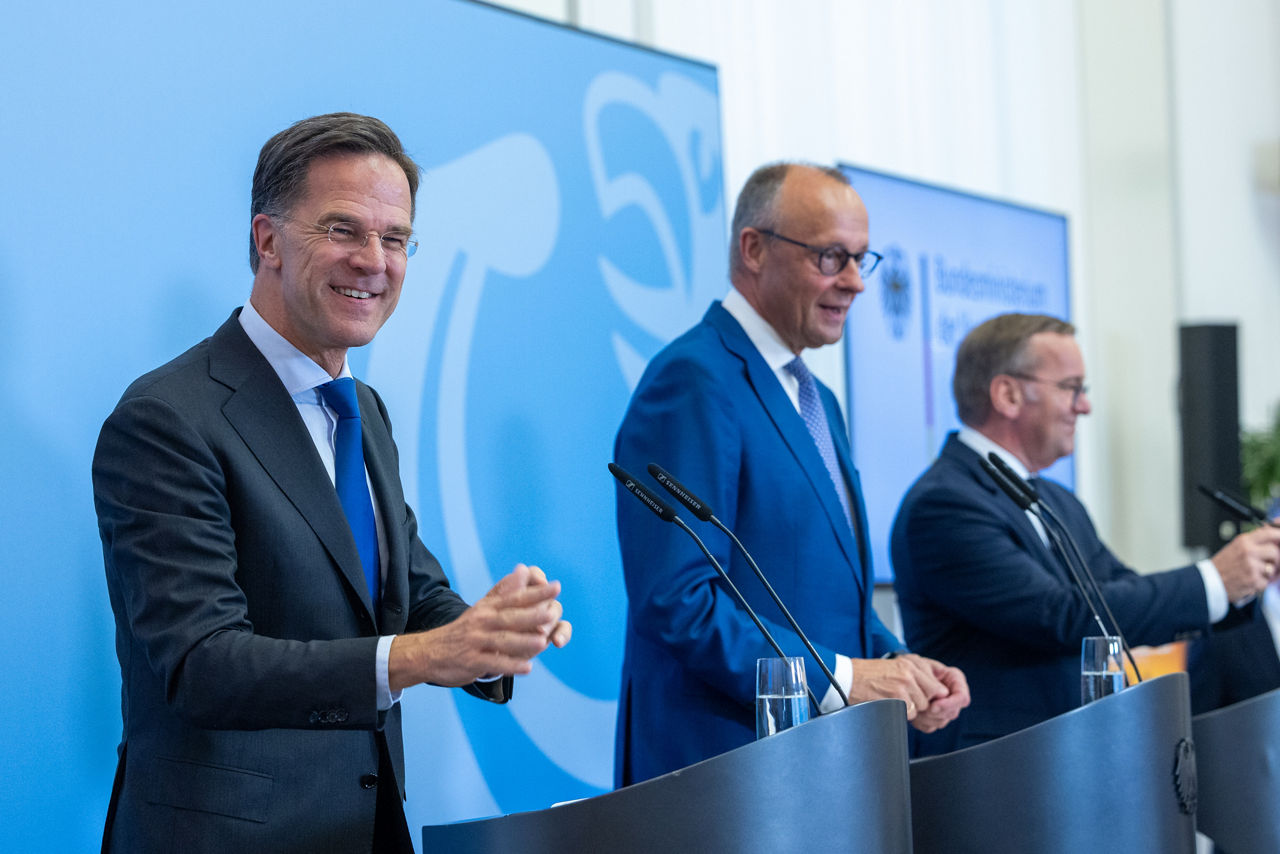
NATO Secretary General Mark Rutte with Friedrich Merz, Federal Chancellor of Germany, and Boris Pistorius, Minister of Defence of Germany
NATO Secretary General Mark Rutte meets with Friedrich Merz, Federal Chancellor of Germany, and Boris Pistorius, Minister of Defence of Germany
NATO Secretary General Mark Rutte with Friedrich Merz, Federal Chancellor of Germany, and Boris Pistorius, Minister of Defence of Germany
NATO Secretary General Mark Rutte visits Germany
NATO Secretary General Mark Rutte visits Germany
NATO Secretary General visits Germany