Close
Back


From now on you can download videos from our website
If you would also like to subscribe to the newsletter and receive our latest updates, click on the button below.
Enter the email address you registered with and we will send you a code to reset your password.
The password must be at least 12 characters long, no spaces, include upper/lowercase letters, numbers and symbols.
Click the button to return to the page you were on and log in with your new password.
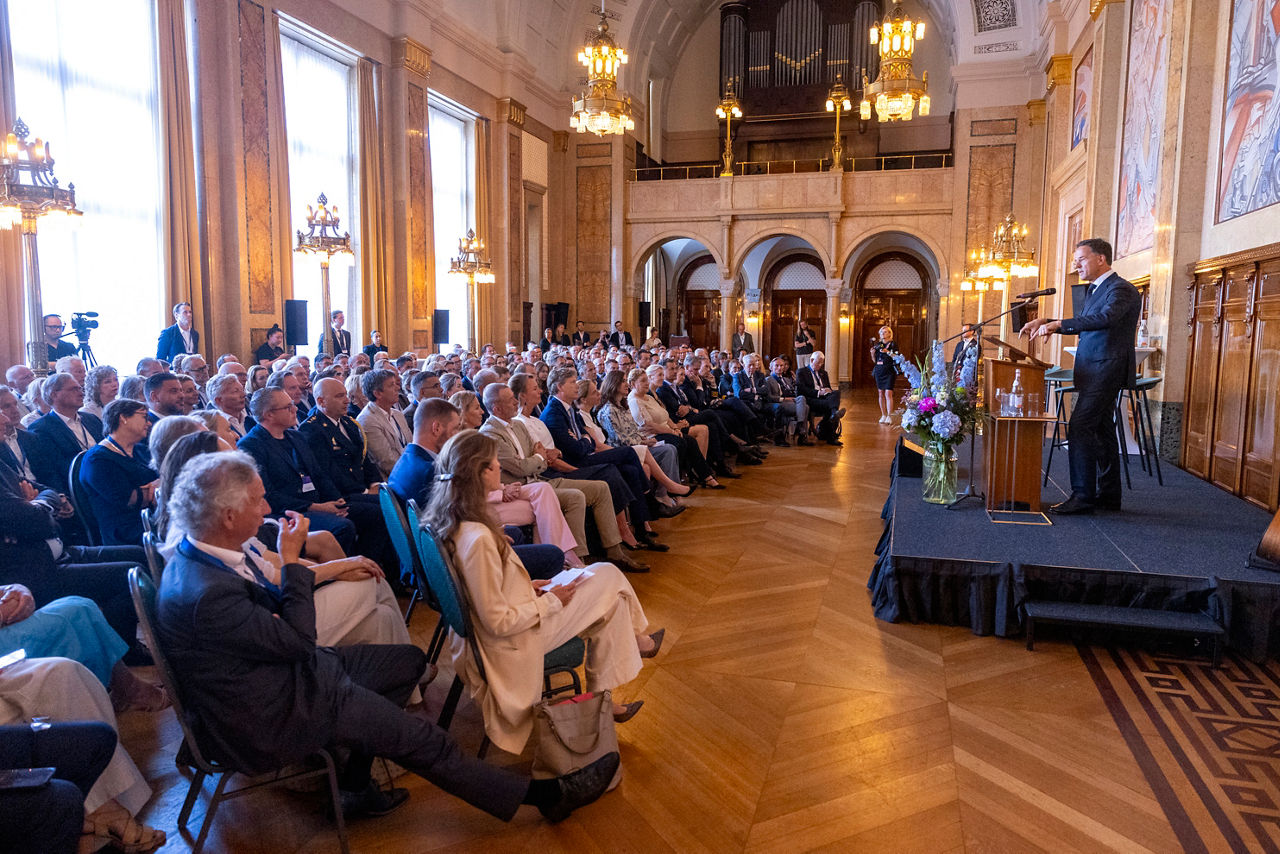
[full speech, as prepared – translated from Dutch]
Thank you very much, Marcia. Good to see you again!
And it’s good to see you again too, Carola, in this beautiful hall!
And good morning, everyone.
What a privilege it is to be here. And what an impressive group of people gathered here today.
This is not a traditional NATO meeting. And that is exactly the point.
Because the subject we are discussing today is no longer only about soldiers, ministers, or diplomats.
It concerns all of us.
Today we are talking about resilience, as we call it at NATO.
And let me be clear from the outset: we are all facing an enormous challenge together.
The world has fundamentally changed. Uncertainty is growing. Our freedom and security can no longer be taken for granted.
The threats are increasing, and they are real.
From the Arctic to the Mediterranean.
From space to deep underwater.
From missiles and drones to sophisticated cyberattacks.
Russia’s war against Ukraine is still raging on — here, on European soil.
A brutal and devastating war.
For more than four years now, missiles and drones have been launched daily at innocent civilians. This war has now lasted longer than the First World War, and the front line stretches some 1,250 kilometers.
And this war is much closer than most people think.
It is less than a day’s drive to Lviv. That is how close it is.
Meanwhile, that war is directly affecting us.
Moscow is conducting an increasingly aggressive campaign against our societies.
Cyberattacks. Sabotage. Disinformation.
Here in the Netherlands, and elsewhere in Europe.
Russian sabotage is not only aimed at military targets or defense companies.
It targets everything that keeps our society functioning.
Damaged undersea cables in the Baltic Sea.
Explosive attacks on railway lines.
Arson in shopping districts.
A cyberattack on an electricity grid.
These are not isolated incidents. They are the result of a deliberate campaign to destabilize our societies.
And Russia is not alone in this. Other countries are also seeking to disrupt our societies.
We see China rapidly modernizing its military. And that is certainly not just to organize impressive parades in Beijing.
China is also massively expanding its nuclear arsenal. From 200 warheads in 2020, China is expected to possess more than 1,000 nuclear weapons by 2030.
And Iran has, of course, been a source of instability for many years, attempting to spread terror and chaos.
In short: war and insecurity are no longer distant problems.
We live in a world that has become harsher. Less stable. And we are confronted with this every day.
So together, we must do more to protect our security and our way of life.
We must become stronger together. Smarter. Better prepared.
Resilience is our first line of defence.
And resilience is not only a task for defence organizations or NATO.
Resilience begins in our neighborhoods and in your workplaces.
We all have a role to play. It is like a large puzzle with many pieces.
And only when all those pieces fit together properly does the full picture emerge.
Everyone in this room holds a piece of that puzzle.
Government. Energy companies. Technology firms. Ports. Healthcare institutions. Transport companies. Infrastructure operators. Educational institutions.
We are far more dependent on one another than we realize.
To illustrate this, I ask you to think about the role of the people present in this room during a crisis or conflict.
What is the impact on my organization if my neighbor’s organization collapses?
What happens to my organization if the Port of Rotterdam is shut down tomorrow by a major cyberattack?
What are the consequences if I am left without electricity or telecommunications for days?
These questions affect you. Your companies. Your employees.
They affect all of us.
We expect our Allies to come to our aid if we are attacked.
The Port of Rotterdam plays a crucial role.
Tens of thousands of military personnel from the United States and Canada would arrive through the Port of Rotterdam to help defend Europe.
But are we prepared to receive all those troops?
They need fuel. Food. Electricity. Beds. Hospitals. Vehicles. Bridges. Railways. Ports. And much more.
Many of you in this room would be directly or indirectly impacted by that situation.
In times of war, it is not only about tanks, fighter jets, and soldiers.
Society cannot simply be put “on hold” so defence organisations can do their job – especially not during a prolonged conflict.
Our entire society will be impacted and must be prepared.
And so my message this morning is actually very simple:
Resilience is everyone’s responsibility.
We cannot simply point to the government. Citizens and businesses must also take responsibility and be prepared.
From NATO’s perspective, I would like to mention three important areas where your commitment is needed.
The first area is energy.
We can develop the most advanced weapons systems imaginable — but if we cannot use them, they are worthless.
And that requires energy.
Fuel for aircraft, tanks, and ships.
Electricity for drones, radars, data centers, and the defence industry.
And the demand for energy is growing rapidly.
New weapons systems consume more energy, not less.
For example, an F-35 uses 60% more fuel than an F-16.
Modern tanks and frigates also require far more energy.
At the same time, the civilian sector and ordinary citizens must continue to receive electricity and fuel, even during a conflict.
Yet forecasts show that by 2050, as much as 80% of Europe’s refining capacity may have disappeared.
The reduction of refining capacity — and therefore insufficient fuel supply — is an enormous risk.
We must close that gap.
The second area is infrastructure.
NATO relies heavily on the civilian sector for logistics and communication.
On land. At sea. In the air. In space. And online.
Ninety percent of military transport during major operations is supported by the private sector.
More than 70% of defense satellite communications run through commercial providers.
And virtually all transatlantic internet traffic runs through undersea cables.
So yes — ports like Rotterdam are crucial.
But so are roads, railways, bridges, refineries, cables, pipelines, and satellites.
That infrastructure must continue functioning. It must remain protected and become less dependent on countries that do not share our values.
I am thinking, for example, of China.
We must remain vigilant.
NATO can help protect infrastructure.
In the Baltic Sea, NATO strengthened its military presence last year to detect, disrupt, and deter malicious actions against undersea infrastructure.
As a result, this infrastructure is now better protected, and the threat is being effectively deterred.
But you in the private sector are also, to a large extent, the owners of that infrastructure. You manage it and maintain it.
Managing vulnerabilities and supply chain risks ultimately lies in your hands.
Are you prepared for that?
Are the plans ready?
Do you know what will be expected of you and your people if the threat level increases?
Finally, the third area I want to focus on today is our society. Our people.
Ultimately, resilience begins with strong societies. With citizens and employees who are prepared.
We cannot defend ourselves without the people who help protect our security every single day.
We cannot scale up defence production without enough people to do the work: engineers, technicians, IT specialists — people with knowledge and expertise.
A student who begins a technical education today could be working in the defense industry by around 2030.
So the question is actually very simple:
Are we doing enough today to inspire young people to pursue technology, innovation, and security?
How do we ensure that talent chooses sectors that are crucial to our security?
That is not only a task for government, but for all of us.
I know there are organizations in this room that support and encourage their employees if they want to become reservists.
That is incredibly important — enabling people to use their talents and qualities for a safer Netherlands and a stronger NATO alliance.
Because investing in defense does not only mean investing in tanks, drones, or ammunition.
It also means investing in people.
NATO brings allies together. To cooperate. To share information. To learn from one another.
And when it comes to resilience, we can learn a great deal from our northern neighbors — especially the Nordic countries — where a “total defence” or “whole-of-society” approach to security is the norm, not the exception.
I saw this with my own eyes last week during a working visit to Sweden, where they even have a dedicated minister for resilience.
There, the military is not seen as a separate entity. It is viewed as an integral part of society, working closely with the private sector and with citizens.
I encourage all of you, just as I have done, to visit and learn from your counterparts there.
But returning to our own country: last year, allies in The Hague agreed to invest significantly more in defense.
I am sure that has not gone unnoticed.
Five percent of GDP.
That additional funding is urgently needed.
For fighter aircraft. Tanks. Air defense. Ammunition. Drones.
But also for more resilient infrastructure, stronger resilience, and civilian preparedness.
In doing so, we help keep one billion people safe — on both sides of the Atlantic.
I also want to say here that the Netherlands is taking important steps.
Higher defence spending. Greater production capacity. And continued support for Ukraine.
That matters. And it must continue.
The Netherlands is showing leadership here, and that is widely recognized.
And today, I ask you — CEOs, directors, chairpersons, and executives — to take the lead in the area of resilience. Focused on concrete actions. I have already shared a number of suggestions today.
Resilient energy systems, resilient infrastructure, resilient societies.
Let us work together to ensure that all the pieces of the puzzle come together for our security — and that the puzzle is completed.
Thank you very much.