Close
Back


From now on you can download videos from our website
If you would also like to subscribe to the newsletter and receive our latest updates, click on the button below.
Enter the email address you registered with and we will send you a code to reset your password.
The password must be at least 12 characters long, no spaces, include upper/lowercase letters, numbers and symbols.
Click the button to return to the page you were on and log in with your new password.
26 June 2026
2 MIN READ
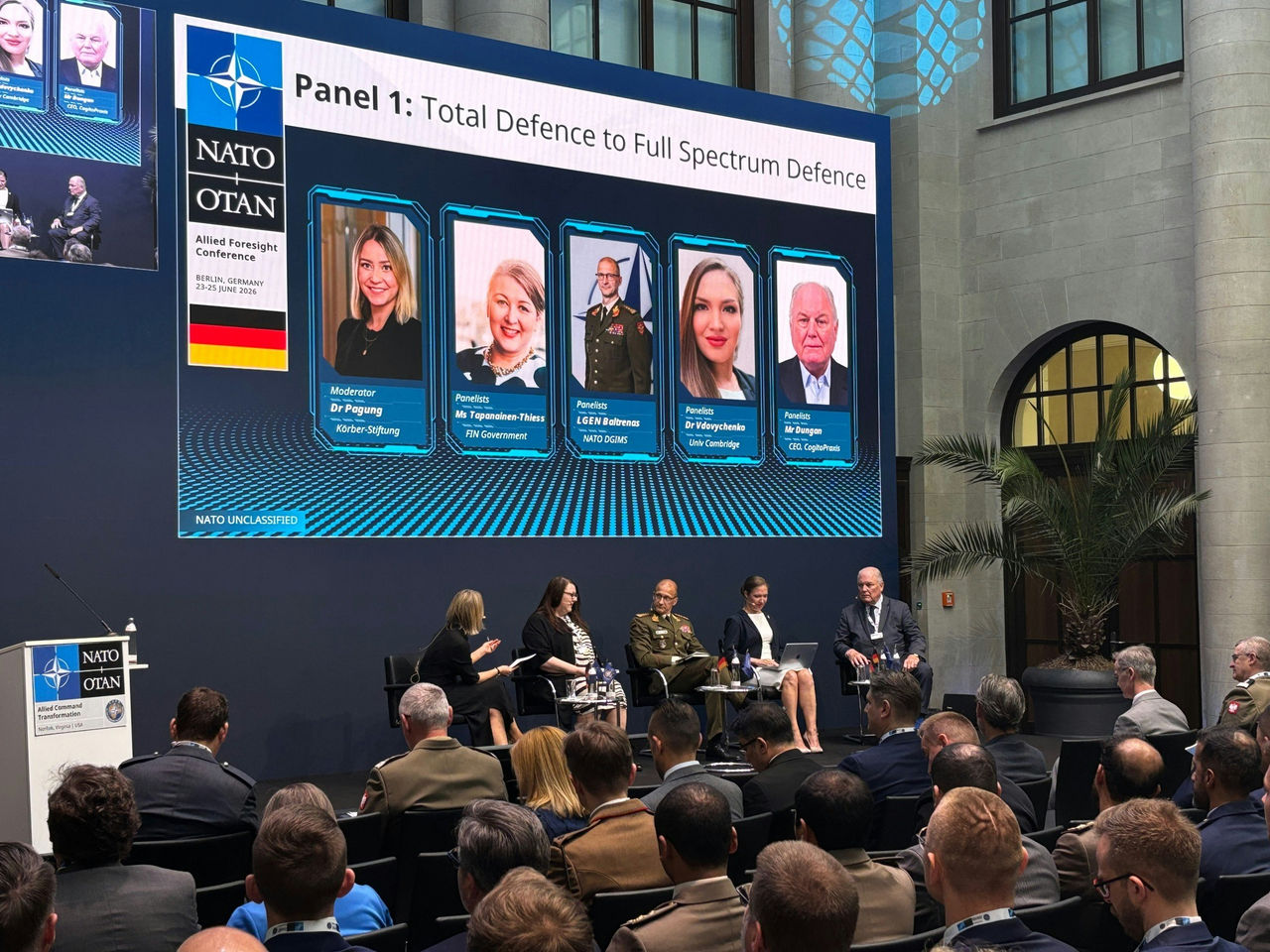
Berlin, 23 June 2026 — Lieutenant General Remigijus Baltrėnas, Director General of the International Military Staff, addressed the Allied Foresight Conference 2026 organised by NATO Allied Command Transformation in cooperation with the German Bundeswehr Office for Defence Planning.
Speaking during the first panel “Total Defence to Full-Spectrum Defence,” Lieutenant General Baltrėnas highlighted that NATO has succeeded in preventing Russia’s war against Ukraine from expanding beyond Ukraine’s borders. He also underlined that lessons learned from the war, and NATO’s ability to adapt rapidly to changes in warfare, are shaped by the complexity and consensus-based nature of the Alliance.
Lieutenant General Baltrėnas emphasised that, in order to ensure full-spectrum defence, there is a clear need to scale up industrial capacity, particularly in the production of modern military capabilities and tools. He also identified effective data management and data sharing as critical areas for NATO’s future development.
The panel examined how nations can better integrate military and civilian instruments across domains, strengthening resilience against conventional, hybrid, cyber and other threats both below and above the threshold of conflict.
During the Allied Foresight Conference 2026, participants discussed how NATO can sharpen decision-making, align military and civilian instruments of power, and strengthen its ability to compete, deter and prevail.
The Director General of the International Military Staff leads the International Military Staff at NATO Headquarters in Brussels. The International Military Staff comprises around 500 military and civilian personnel from NATO member countries and supports the NATO Military Committee.


Director General of the International Military Staff (DGIMS) during the Panel "Total Defence to Full-Spectrum Defence" at the Allied Foresight Conference 2026 in Berlin.
Director General of the International Military Staff (DGIMS) during the Panel "Total Defence to Full-Spectrum Defence" at the Allied Foresight Conference 2026 in Berlin.
21 October 2026
7 October 2026
24 September 2026