
Close
Back


From now on you can download videos from our website
If you would also like to subscribe to the newsletter and receive our latest updates, click on the button below.
Enter the email address you registered with and we will send you a code to reset your password.
The password must be at least 12 characters long, no spaces, include upper/lowercase letters, numbers and symbols.
Click the button to return to the page you were on and log in with your new password.
30 June 2023
2 MIN READ
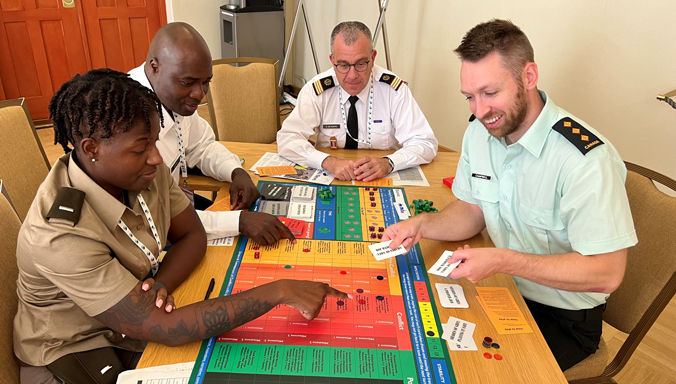
From 24th to 30th June 2023, NATO’s Interallied Confederation of Medical Reserve Officers (CIOMR) held their annual Summer Congress in Helsinki, Finland. As part of the congress, the Junior Medical Reserve Officer Committee delivered a weeklong workshop (JMROW), which brought together 36 junior healthcare professionals (OF-3s and below), from six nations. The aims of JMROW were to introduce NATO structures and doctrine, develop skills required for interoperability and build relationships with partner nations.
The workshop started with briefings by Colonel David Willey, Liaison to NATO’s Committee of Chiefs of Military Medical Services (COMEDS), on NATO’s functions and basic medical concepts, which were developed through an operational planning exercise delivered by the Multinational Medical Coordination Centre/European Medical Command (MMCC/EMC). The subsequent exercise allowed for collaborative learning and small group discussions among some of NATO’s most junior medical officers, setting a foundation for multinational, integrated care delivery in the future operational environment.
The JMROW included a fireside leadership discussion with Major General Marc Bilodeau, Surgeon-General from Canada, who shared his experience leading in peacetime and on operations, and how our healthcare leaders of tomorrow can prepare for a future in command. Up next, Major General W. Scott Lynn, Commanding General of the USAR Medical Command presented his concept of the ‘poly-med’: the need for healthcare leaders to develop their expertise across multiple domains in order to lead military healthcare effectively.
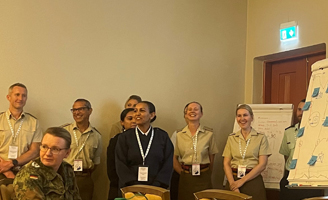
The programme then continued with a senior leader panel discussion on the Reserve contribution to Large-Scale Combat Operations (LSCO), and a workshop on the challenges presented by Disease Non-Battle Injury (DNBI) in LSCO. Participants also benefitted from briefings on the lessons learned from the war in Ukraine and how these could affect how we prepare our healthcare systems for future conflicts. Finally, participants exercised their diplomacy and negotiation skills under the supervision of the 11th Security Force Assistance Brigade.
The JMROW provides excellent training for future leaders to develop their skills in operating in a multinational space. The CIOMR’s Junior Officer programming is open to Officers OF-3 and below from NATO and PfP nations, and attendance from more nations is strongly encouraged. For further information, please contact JMROC@CIOMR.ORG