
Close
Back


From now on you can download videos from our website
If you would also like to subscribe to the newsletter and receive our latest updates, click on the button below.
Enter the email address you registered with and we will send you a code to reset your password.
The password must be at least 12 characters long, no spaces, include upper/lowercase letters, numbers and symbols.
Click the button to return to the page you were on and log in with your new password.
17 January 2023
2 MIN READ
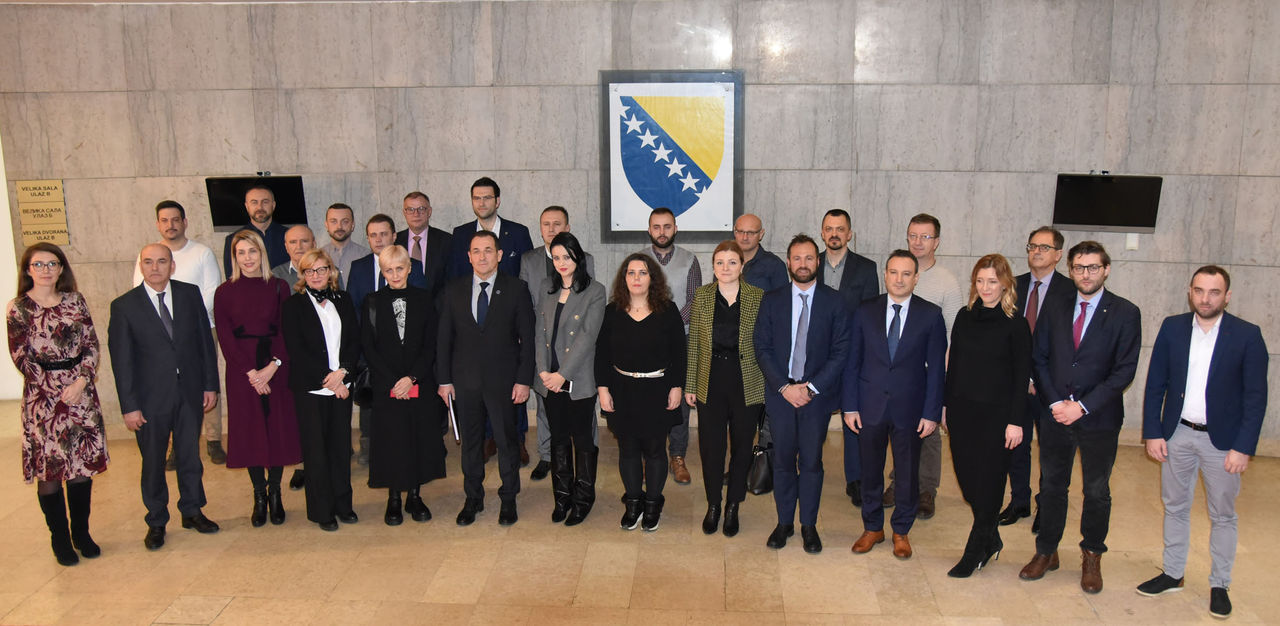
Experts from the NATO Science for Peace and Security (SPS) Programme met with representatives of the scientific community of Bosnia and Herzegovina in Sarajevo on Tuesday (17 January 2023). Officials and researchers from leading universities across the country gathered and exchanged views on further opportunities for cooperation, at an “SPS Information Day” held at the Parliamentary Assembly of Bosnia and Herzegovina.
The event, organised in cooperation with NATO Headquarters Sarajevo, highlighted the significant participation of scientists from Bosnia and Herzegovina in regional and international research efforts. In the past ten years, over a dozen activities have been developed with Bosnia and Herzegovina within the framework of NATO’s Science for Peace and Security Programme, in such topics as cyber defence, counter-terrorism and the detection of explosive hazards in cooperation with experts from NATO and partner nations. These activities have helped to build the capacity to address cyber and hybrid challenges in Bosnia and Herzegovina and across south-eastern Europe, and to develop innovative tools and approaches to counter terrorism and violent extremism.
“Our cooperation aligns with our evolving partnership and with an ever-changing security landscape, and is increasingly focusing on the application of technologies to tackle new and emerging challenges,” said Dr. Claudio Palestini, a Senior Advisor with NATO’s Science for Peace and Security Programme. At the event, three Bosnian scientists explained their recent involvement in SPS-supported research and development projects, presenting their efforts to enhance explosives detection through artificial intelligence and virtual reality; to increase the security of communications by employing quantum technology in 5G networks; and to optimize fuel cells. The event was also an opportunity to explore new collaborative activities, including a multi-year project on emergency response and management.
“Today's meeting is just one example of the activities we are undertaking in cooperation with NATO, specifically with the aim of further strengthening and improving our mutual cooperation. We need to optimally use the opportunities offered within the NATO SPS programme and together be much more active, do research and seek new innovative solutions for a broad range of challenges,” said Dr. Selmo Cikotić, Minister of Security of Bosnia and Herzegovina, at the opening of the event.
The NATO Science for Peace and Security Programme remains open to research and scientific exchanges involving scientists and experts from Bosnia and Herzegovina. Opportunities for cooperation are announced as calls for proposals, which can be found on the SPS website or by subscribing to the SPS mailing list.