
Close
Back


From now on you can download videos from our website
If you would also like to subscribe to the newsletter and receive our latest updates, click on the button below.
Enter the email address you registered with and we will send you a code to reset your password.
The password must be at least 12 characters long, no spaces, include upper/lowercase letters, numbers and symbols.
Click the button to return to the page you were on and log in with your new password.
08 November 2022
1 MIN READ
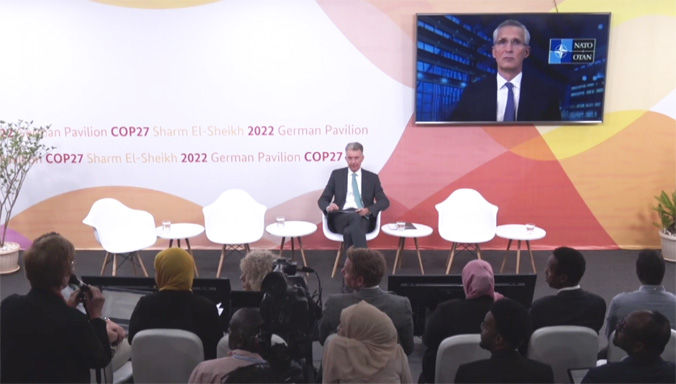
Russia’s weaponisation of food and energy as part of its illegal war in Ukraine underlines the need to increase resilience, diversify energy supplies and sources, and accelerate the transition to cleaner, greener economies, NATO Secretary General Jens Stoltenberg said today (8 November 2022).
Mr Stoltenberg was speaking virtually at an event co-hosted by NATO, the German Federal Foreign Office and the Munich Security Conference at the COP27, the United Nations’ Climate Change Conference in Sharm El-Sheikh, Egypt.
NATO’s new Strategic Concept adopted at its Madrid Summit in June describes climate change is a “defining challenge of our time” and pledges to make NATO the “leading international organisation” when it comes to understanding and adapting to the security impact of climate change. In Madrid, NATO also agreed a concrete target to cut emissions from the Alliance’s bodies and commands by at least 45% by 2030 and to move towards Net Zero by 2050.