
Close
Back


From now on you can download videos from our website
If you would also like to subscribe to the newsletter and receive our latest updates, click on the button below.
Enter the email address you registered with and we will send you a code to reset your password.
The password must be at least 12 characters long, no spaces, include upper/lowercase letters, numbers and symbols.
Click the button to return to the page you were on and log in with your new password.
27 September 2022
2 MIN READ
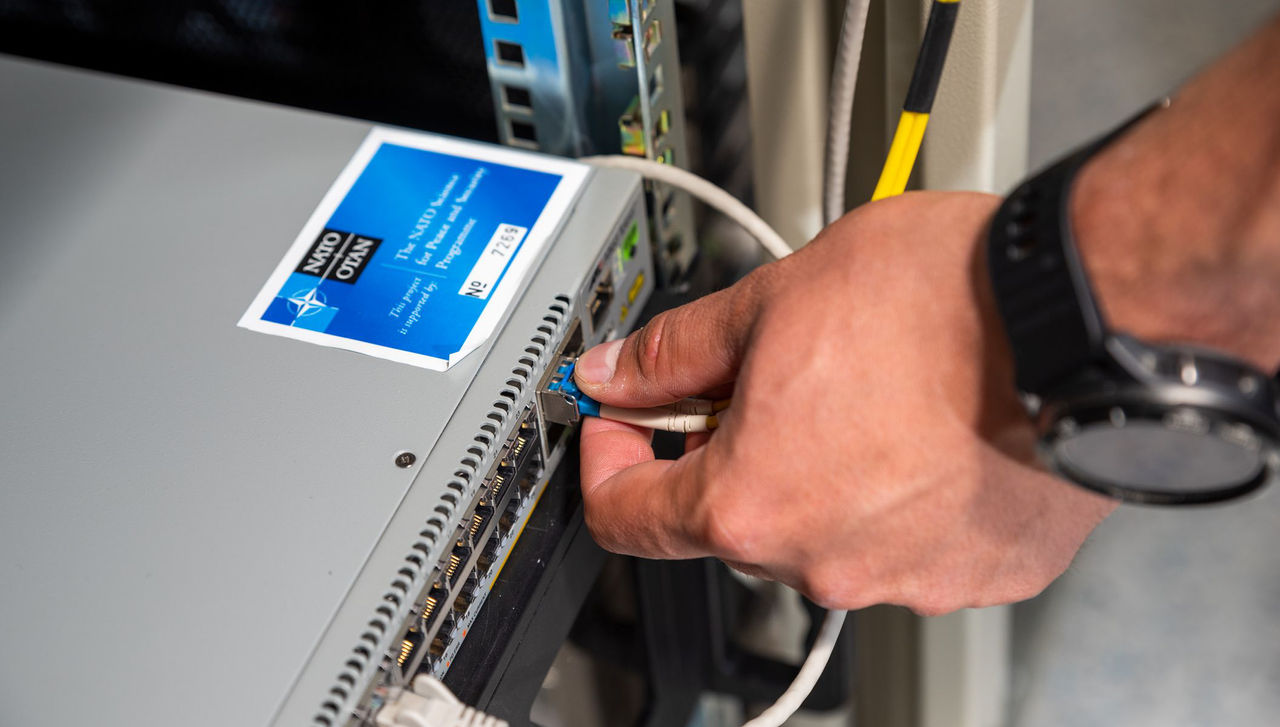
Innovative projects led by scientists in NATO and partner countries are breaking new ground to harness the power of quantum to make communications impossible to intercept and hack. The application of these quantum technologies in the security and defence sectors could help to future-proof the transmission of information, protecting it from increasingly advanced hacking systems and contributing to NATO’s efforts to maintain its technological edge.
NATO Science for Peace and Security (SPS) Programme research and development projects have been examining the security-related applications of quantum technologies, addressing their three main fields: computing, sensing and communications. Quantum computing and sensing are improving the abilities of computer and remote measurement technologies to levels that they are not traditionally able to achieve. In the field of quantum communications, SPS activities are showing the most promising results. These projects develop systems for the encryption and secure transmission of information using quantum key distribution (QKD) and post-quantum cryptography (PQC). Through these techniques, they respond to rising security concerns related to new technologies – such as quantum computers, which can decipher secret communications – by preventing unauthorised access.
Testing quantum key distribution (QKD)
QKD is a quantum communication method to share decryption keys. In this system, an encrypted message is sent over traditional networks, while the keys to decrypt the information are transmitted through quantum means. This way, only the intended recipient can decode the message, making any eavesdropping impossible. By applying this method, an SPS project succeeded in connecting Italy and Malta with a prototypical QKD link using submarine optical fibre cables for the first time.
Another SPS-supported research initiative investigated QKD techniques to send cryptographic keys from one endpoint to another, which was located hundreds of kilometres away. Meanwhile, researchers at a university in the Czech Republic are studying the application of QKD technology on a 5G network to explore its potential to enhance cyber security in future communication systems.
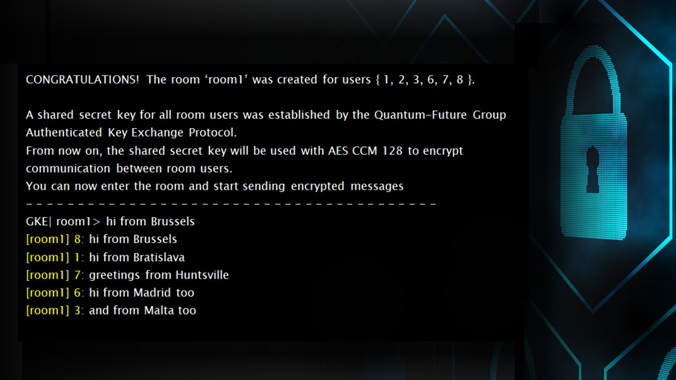
Rendering of the experimental quantum-safe communication environment that connected users in Belgium, Malta, Slovakia, Spain, and the United States.
Demonstrating post-quantum cryptography (PQC)
Unlike QKD, which uses physical quantum properties to protect information, PQC uses cryptography and mathematical functions as an alternative approach to secure communications. An international group of scientists supported by SPS recently demonstrated that, using PQC, it is possible to securely transmit information without the possibility of decryption by a hacker, even one who has a quantum computer. Through a secure protocol, five research groups based in Malta, Slovakia, Spain, the United States and NATO Headquarters in Brussels, Belgium, succeeded in communicating in a completely secure space, free from the risk of intrusion.
NATO’s new Strategic Concept, agreed by Allies at the 2022 Madrid Summit, recognises the critical role of technology, and in particular, emerging and disruptive technologies (EDTs), in shaping the future of the Alliance. To explore the potential and risks associated with EDTs, the SPS Programme is supporting research activities that address technological trends in EDTs, like artificial intelligence, autonomy, bioengineering, and especially quantum technologies. Future SPS activities investigating quantum will look at how to integrate both QKD and PQC to secure information infrastructure in the best and most holistic way for the Alliance.