
Close
Back


From now on you can download videos from our website
If you would also like to subscribe to the newsletter and receive our latest updates, click on the button below.
Enter the email address you registered with and we will send you a code to reset your password.
The password must be at least 12 characters long, no spaces, include upper/lowercase letters, numbers and symbols.
Click the button to return to the page you were on and log in with your new password.
23 May 2022
2 MIN READ
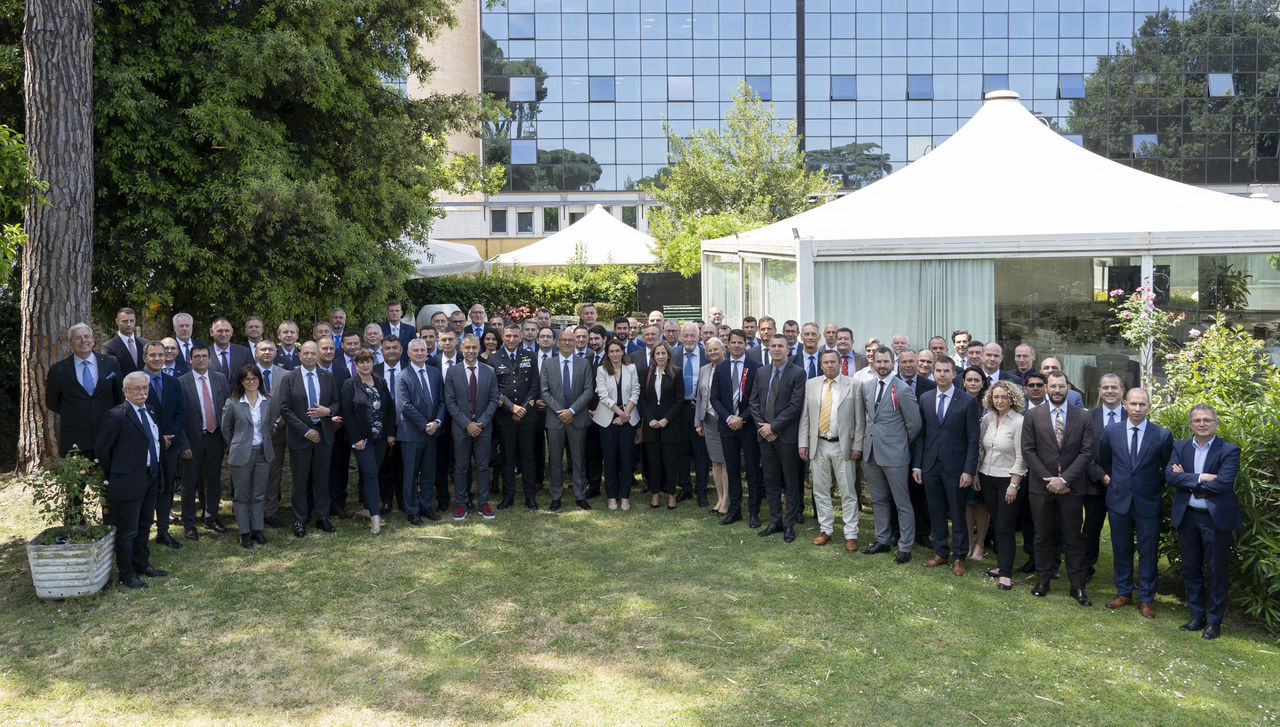
Last week, the NATO Aviation Committee met in Rome (Italy) to discuss prospects of future civil-military cooperation on aviation. The event was co-organized by NATO and the Italian Air Force.
It was chaired by Dr. Giorgio Cioni, Director of the Armament and Aerospace Capabilities Directorate in NATO’s Defence Investment Division, and featured the participation by representatives of NATO member and partner countries as well as of international organizations and other relevant civil and military institutions operating in the field of aviation. It provided an important platform to share views on the opportunities and challenges to broaden multilateral cooperation on aviation issues – including their implications for our environment – a few weeks before the next NATO Summit in Madrid, at the end of June.
"Aviation is an enabler of NATO Deterrence and Defence. This requires a comprehensive, committed and collective civil-military approach, nationally and internationally. It also brings together the relevant international organisations and Partners for the benefit of NATO missions, operations, exercises and training," said Dr. Cioni, Aviation Committee Chairman.
The Chief of Staff of the Italian Air Force, Lieutenant General Luca Goretti, welcomed the participants and opened the meeting by highlighting the importance of this Committee as advisor to the North Atlantic Council on aviation policy aspects. "In the unexpectedly unstable scenario Allies and Partners are facing, the role, the tasks and the missions fulfilled by Allied air force are now even more indispensable and urgent. The Air Component is a key capability of the Alliance," the General said. "On 21 March, the European Union approved the Strategic Compass, which is a cornerstone in the security and defence policy of the EU. In this framework, I think we, as NATO Military Authorities, should strive to seek for mutual benefit of enhanced cooperation and exchange of best practices between NATO and EU,” he added.
The President of the Italian Civil Aviation Authority, Dr. Pierluigi Di Palma, provided some insight on the relevant issues of civil and military interest. "ENAC and the Italian Air Force have an excellent working relationship in all fields of aviation," he said. "Particular attention is paid to the correct management of the airspace they share. In order to guarantee lean and efficient governance, a high level policy body was set up to share development strategies in both the civil and military sectors with the aim of coordinating and directing the choices in activities." The agenda of the meeting also gave the participants the opportunity to visit Rome civil military Area Control Centre, where ENAV (the main national civil ATS service provider) and Italian Air Force air traffic controllers work together for the common and safe use of airspace.
The NATO Aviation Committee mandate is to support the Alliance’s efforts to continue adapting to the rapidly evolving security environment in an increasingly complex and networked airspace.