
Close
Back


From now on you can download videos from our website
If you would also like to subscribe to the newsletter and receive our latest updates, click on the button below.
Enter the email address you registered with and we will send you a code to reset your password.
The password must be at least 12 characters long, no spaces, include upper/lowercase letters, numbers and symbols.
Click the button to return to the page you were on and log in with your new password.
19 May 2022
2 MIN READ
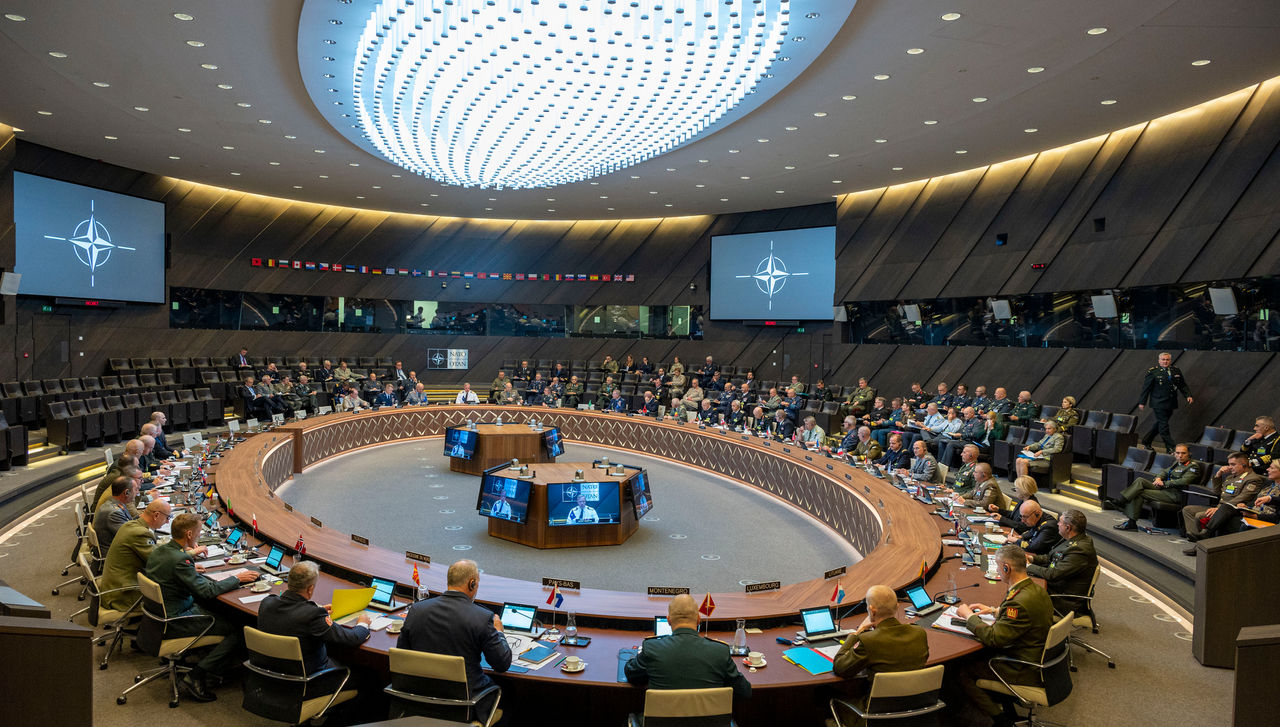
On 19 May 2022, NATO Military Committee met in Chiefs of Defence format in Brussels, Belgium. The focus of this meeting was on collective defence.
Admiral Rob Bauer, Chair of the Military Committee, set the tone for the day, “In the past few months, NATO has shown that is it capable to swiftly and effectively change its posture. We have implemented the largest reinforcement of collective defence in a generation. The foundation for that adaptation came from work that the Military Committee started a few years ago, in close cooperation with the Supreme Allied Commander Europe and the Supreme Allied Commander Transformation.”
The first session of the day began with the NATO Secretary General, Jens Stoltenberg briefing the Military Committee on the current geopolitical situation. This allowed the Chiefs of Defence and the Secretary General to discuss the dramatically altered security environment and the further adaptation of the Alliance.
The second session saw the Allied Chiefs of Defence to discuss Russia’s unprovoked and brutal invasion of Ukraine. The Ukrainian Chief of Defence joined the meeting via secure video teleconference, while the Chiefs of Defence of Finland, Sweden, and the Chair of the European Union’s Military Committee, attended in person. The exchange of views focused on the situation on the ground and the security implication of the war in Ukraine. The Chiefs of Defence reiterated the Alliance’s support to Ukraine, and their admiration for the Ukrainian people’s courage.
General Tod Wolters, Supreme Allied Commander Europe, began session three by briefing the Military Committee on the implementation of the Concept for the Deterrence and Defence of the Euro-Atlantic Area (DDA), and the longer-term posture. The Chiefs of Defence provided their guidance on the adaptation of NATO’s military posture.
The Indo-Pacific Region was the focus of session four. Here, the Chiefs of Defence of Australia, Japan, New Zealand and South Korea joined the Allied Chiefs to discuss the ongoing security dynamics and provide their regional insights. The Military Committee exchanged views on how these regional security developments impact global security challenges.
The final session of the day saw the Chiefs of Defence briefed by General Philippe Lavigne, Supreme Allied Commander Transformation. He provided an update on the implementation of NATO’s Warfighting Capstone Concept, and the ongoing digital transformation of the Alliance. The Military Committee discussed the importance of the new Strategic Concept and how this could drive NATO’s military adaptation. As NATO adapts, its strength remains the same, Allies uniting around one core task: to protect the 1 billion citizens who live on Allied soil.