
Close
Back


From now on you can download videos from our website
If you would also like to subscribe to the newsletter and receive our latest updates, click on the button below.
Enter the email address you registered with and we will send you a code to reset your password.
The password must be at least 12 characters long, no spaces, include upper/lowercase letters, numbers and symbols.
Click the button to return to the page you were on and log in with your new password.
13 April 2022
2 MIN READ
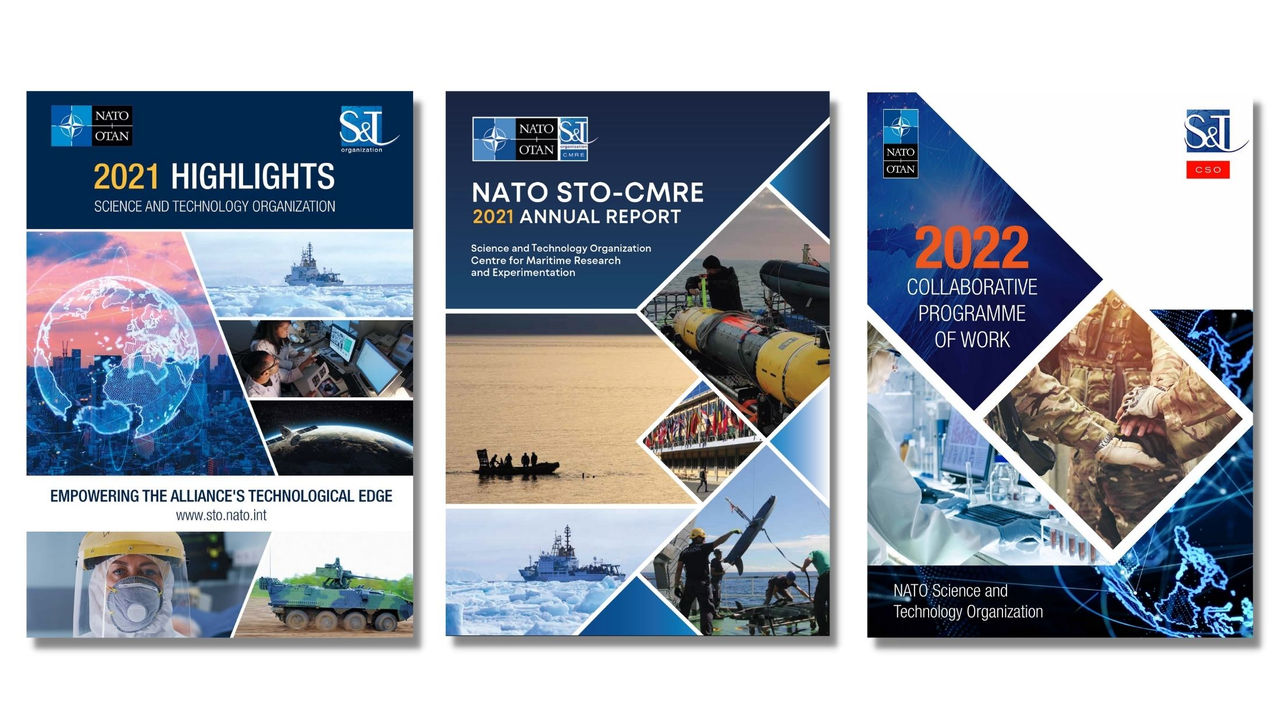
Despite the impact of the pandemic, the NATO Science and Technology Organization (STO) persistently delivered excellent Programmes of Work (PoWs) thanks to its network of over 5,000 scientists, engineers and analysts. This ensures that the STO remains at the vanguard of S&T, and is committed to sustaining NATO, Allies and Partners technological advantage in an ever-competitive world.
In 2022, the STO has distributed publicly three reports that highlight its insightful achievements and plot the way forward.
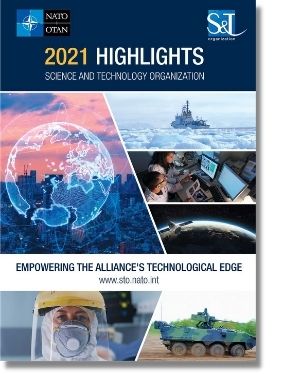
The 2021 STO HIGHLIGHTS exemplifies the impact and significance of STO PoWs for the Alliance, covering the Centre for Maritime Research and Experimentation (CMRE) PoW and Collaborative PoW (CPoW). This comprises over 300 activities ranging from major research programmes to horizon scanning and lecture series, as well as cooperative demonstration of technologies.
The report is intended as a compendium of recently completed projects and achievements in both CMRE and the Collaborative PoW 2021. It also summarizes the advice produced for NATO leadership to assist high-level decision-making on decisive topics such as: Women In the Armed Forces, CBRN Threats and Hazards, Emerging and Disruptive Technologies (EDTs), Climate change and S&T Trends 2020-2040.
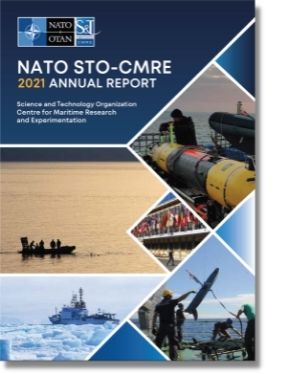
The mission of CMRE is to organize and conduct scientific research and technology development, centred on the maritime domain, delivering innovative and field-tested Science & Technology (S&T) solutions to address the defence and security needs of the Alliance.
The CMRE 2021 ANNUAL REPORT highlights the CMRE’s activities in executing its 2021 programme of work and its achievements in delivering value-added products and services to its customers, and in particular to NATO Allied Command Transformation as part of the Maritime S&T programme with its focus on: autonomous naval mine countermeasures; autonomy for anti-submarine warfare; data-environmental knowledge and operational effectiveness; and maritime unmanned systems enablers.
The annual report illustrates how CMRE’s scientists, engineers and technologists exploit emerging and disruptive technologies in innovative ways in order to maintain NATO’s technological edge.
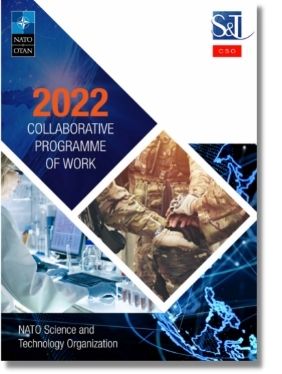
The 2022 COLLABORATIVE PROGRAMME OF WORK provides an overview of the Science and Technology Organization’s (STO) projects planned for 2022 in defence and security-relevant research and technology development for enhanced operational military capabilities for the Nations and NATO. The 2022 CPoW is comprised of 283 ongoing and planned technical research activities and 49 exploratory teams.
The CPoW is a tool designed to answer the Nations’ needs and NATO requirements. Therefore, its construct is based on the strategic orientation provided by the Nations, the Panels/Group during their business meetings, and the higher NATO centralised organization. Ultimately, the Nations, through the Science & Technology Board (STB), remain the collective authority deciding on how the CPoW should develop. The CPoW research projects, managed by the STO Collaboration Support Office (CSO) near Paris, France, will be conducted across all topical areas of the CPoW: Applied Vehicle Technology (AVT); Human Factors and Medicine (HFM); Information Systems Technology (IST); System Analysis and Studies (SAS); Systems Concepts and Integration (SCI); Sensors and Electronics Technology (SET); as well as Modelling and Simulation (NMSG).
For 2022, many CPoW projects continue to be focused on the applications and implications of the NATO Emerging and Disruptive Technologies: artificial intelligence, autonomy, big data, biotechnology, hypersonics, quantum sciences, space, and novel materials.