
Close
Back


From now on you can download videos from our website
If you would also like to subscribe to the newsletter and receive our latest updates, click on the button below.
Enter the email address you registered with and we will send you a code to reset your password.
The password must be at least 12 characters long, no spaces, include upper/lowercase letters, numbers and symbols.
Click the button to return to the page you were on and log in with your new password.
18 November 2021
2 MIN READ
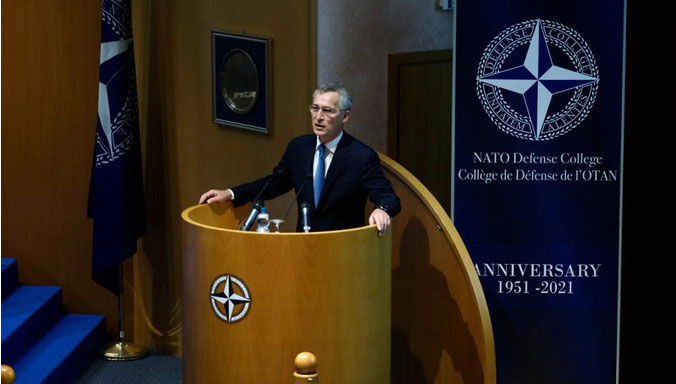
Today (18 November 2021), speaking at the NATO Defense College in Rome, Secretary General Stoltenberg said that the College is “NATO’s leading academic institution; and it makes a lasting contribution to our shared security, by helping our Alliance adapt to a changing world and stay ahead of the curve.”
He highlighted that “in 1951, the College opened its doors to 47 men from ten NATO countries for the first Senior Course; since then, some 15,000 graduates have passed through the College’s classrooms and corridors; women and men; civilian and military, from 80 countries, not only NATO nations, but from partner countries all over the world.” He went on to say: “the Defense College embodies the secrets of NATO’s success: our unity and ability to adapt,” he added.
Accompanying NATO’s Military Committee, its Chair, Admiral Rob Bauer highlighted the crucial role that the NATO Defense College plays within the Alliance and its adaptation. “Throughout its history, the Alliance has adapted. This adaptation has been assisted by the Defense College and the vital work its academics, researchers and students have undertaken. By bringing together military and civilian leaders from across allied and partner nations, the College has created a unique experience, allowing students and future military leaders to question established allied concepts, examine strategy and doctrine, and challenge leaders – scrutinizing our thinking and decisions, and ultimately making us better for it”, he added.
NATO Deputy Secretary General Mircea Geoană also spoke at the NATO Defence College on NATO’s efforts with regard to space. “Space systems are essential to our daily lives, enabling everything from mobile phone calls, to banking, GPS, satellite TV, and weather forecasts. In the defence realm, space enables us to communicate, navigate, track forces, gather intelligence, and detect missile launches; like the rest of our security environment, space is becoming more crowded, contested and competitive, so NATO is adapting in space too,” he said.
“NATO’s new space policy is not about militarising space. Our approach remains strictly defensive and fully in line with international law; but we need good situational awareness of what is happening in space; we need reliable access to space services; and we need to maintain our technological edge, also in space,” the Deputy Secretary General highlighted.