
Close
Back


From now on you can download videos from our website
If you would also like to subscribe to the newsletter and receive our latest updates, click on the button below.
Enter the email address you registered with and we will send you a code to reset your password.
The password must be at least 12 characters long, no spaces, include upper/lowercase letters, numbers and symbols.
Click the button to return to the page you were on and log in with your new password.
31 May 2021
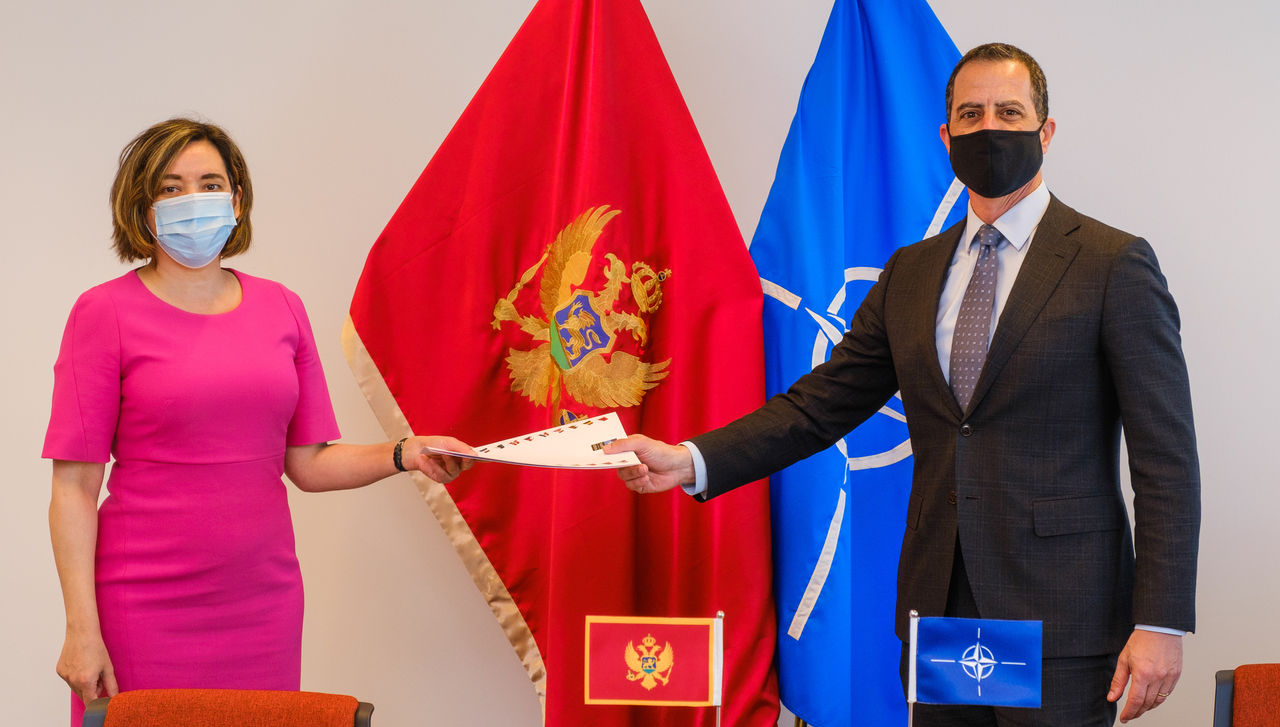
Today (31 May 2021), Ambassador Dubravka Lalović, Permanent Representative of Montenegro and Mr. Marc Di Paolo, Director of Defence Institution and Capacity Building Directorate in the Operations Division of the International Staff signed at NATO Headquarters in Brussels (Belgium) an agreement for the purchase of a magnetic resonance imaging scanner and an x-ray machine, in response to the COVID-19 pandemic. The agreement follows upon a request from Montenegro, through the Euro-Atlantic Disaster Response Coordination Centre (EADRCC) and the North Atlantic Council’s approval to support Montenegro in this endeavour, through a co-financing arrangement.
Montenegro will assist in the implementation of the project, by arranging for the procurement and delivery of the medical equipment designated for beneficiaries in Montenegro’s heath care sector. NATO will contribute to the project through the Pandemic Response Trust Fund with an amount of more than 430,000 Euro. The donated equipment will be used in a hospital in the northern city of Berane in order to reduce the pressure on the Clinical Center in Podgorica, which is the only city that has comparable equipment.
The total value of NATO’s COVID-19 support to Montenegro so far is approximately 800,000 Euro. Earlier this year, the Ministry of Health of Montenegro received 20 sets of ventilator equipment from the NATO Pandemic Response Stockpile. The donation was coordinated by NATO’s Euro-Atlantic Disaster Response Coordination Centre and made possible with financial contributions by the Czech Republic, Lithuania, the Netherlands, North Macedonia, the United Kingdom as well as the United States. This built on a previous shipment of 20 ventilators to the Ministry of Health. This equipment is helping patients in urgent need in dedicated COVID-19 hospitals in Podgorica, Cetinje, Niksic and Bijelo Polje.
This support is part of the NATO COVID-19 assistance packages for NATO Allies and partners. Eighteen Allies have made financial and in-kind donations of medical equipment and supplies to the Pandemic Response Trust Fund. To date, Allies have approved 10 assistance packages for four Allies: Albania, Czech Republic, Montenegro and North Macedonia, as well as for five partners, Bosnia and Herzegovina, Iraq, Moldova, Tunisia and Ukraine. Additional assistance is approved to North Macedonia and Ukraine.
The Euro-Atlantic Disaster Response Coordination Centre (EADRCC) is NATO’s main civil emergency response mechanism. The Centre operates on a 24/7 basis, coordinating requests and offers of assistance. It is helping to coordinate assistance, including medical and financial support. Since the start of the crisis, NATO’s Euro-Atlantic Disaster Response Coordination Centre has coordinated requests from the United Nations Office for the Coordination of Humanitarian Affairs and 18 NATO and partner countries, garnering more than 150 responses in return.