
Close
Back


From now on you can download videos from our website
If you would also like to subscribe to the newsletter and receive our latest updates, click on the button below.
Enter the email address you registered with and we will send you a code to reset your password.
The password must be at least 12 characters long, no spaces, include upper/lowercase letters, numbers and symbols.
Click the button to return to the page you were on and log in with your new password.
27 March 2019
1 MIN READ
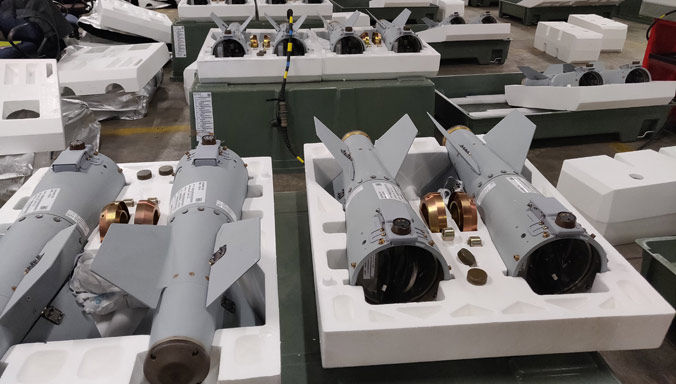
On Wednesday (27 March 2019), Belgium successfully transferred 92 GPS-guidance kits for precision guided munitions (PGMs) to Denmark under a new and much accelerated process. The exchange conducted under the NATO multinational Air-to-Ground PGM project allowed the two Allies to bring down the required time for the transfer from months or weeks to days. This provides participants in the project with better options for re-supplying their own stockpiles of munitions in a conflict.
“This is an important milestone as it adds a significant amount of flexibility to Allies with regard to sharing their stockpiles of precision-guided munitions. It will further enable the Alliance to address a capability and interoperability gap in this area and support some European Allies while reducing reliance on the United States when it comes to air to ground operations,” said Camille Grand, NATO Assistant Secretary General for Defence Investment.
Legal and technical obstacles had previously prevented quicker transfers of PGMs between Allies and partners. The NATO Air-to-Ground PGM project helps its participants to overcome these hurdles by leveraging an innovative U.S. approach for simplifying the multinational acquisition and exchange of U.S. sourced PGMs, coined the “Lead Nation Procurement Initiative”. Beyond easier and quicker transfers the NATO Air-to-Ground PGM project also enables participants to save money by acquiring PGMs together. To achieve this the NATO Support and Procurement Agency (NSPA) acts as the lead buyer for combining the requirements of participants with the intention to achieve lower per unit cost through multinational buys.
Eleven Allies and one partner nation are currently participating in the project – Belgium, the Czech Republic, Denmark, Greece, Hungary, the Netherlands, Norway, Portugal, Poland, Spain, the United Kingdom, and one Partner – Finland. It is expected that the two additional Allies will join this project during the June meeting of the NATO Defence Ministers.