
Close
Back


From now on you can download videos from our website
If you would also like to subscribe to the newsletter and receive our latest updates, click on the button below.
Enter the email address you registered with and we will send you a code to reset your password.
The password must be at least 12 characters long, no spaces, include upper/lowercase letters, numbers and symbols.
Click the button to return to the page you were on and log in with your new password.
11 February 2019
2 MIN READ
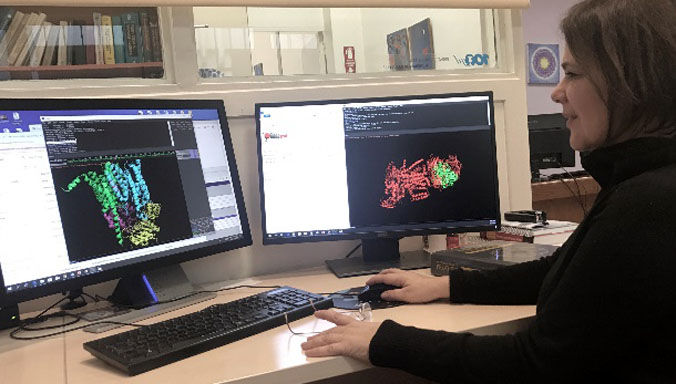
On the occasion of International Day of Women and Girls in Science, meet four women scientists leading NATO Science for Peace and Security (SPS) Programme projects in the areas of counter-terrorism, cyber security and communications.
This international day, established by the UN General Assembly in 2015 and since held every year on 11 February, is a reminder that women and girls play a critical role in science and technology communities and that their participation should be strengthened. This is a key objective of the SPS Programme.
Neutralising chemical, biological, radiological and nuclear materials
Prof. Turkan Haliloglu works at the Department of Chemical Engineering and is also the Director of the Polymer Research Centre at the Bogazici University in Turkey. She received the NATO SPS Partnership Prize for her role as director of a project aimed at neutralising anthrax. The discoveries are likely to have important medical implications on public health and safety.
”I have always been motivated and passionate about science. I have had wonderful women scientists as role models and I hope that I could also be one for my students and for early carrier women scientists,” she says.
She also stresses that ”young girls should be helped to strongly believe in their abilities and success if they engage in their studies with passion and perseverance”.
Developing chemical sensors to detect explosives in public areas
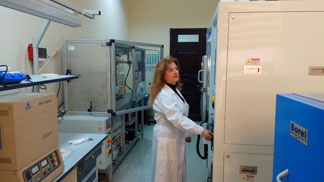
In Azerbaijan, Prof. Nahida Musayeva has been a scientist since 1990. She currently leads scientific research at the Institute of Physics of the National Academy of Science of Baku.
”I love this job. No matter how difficult it was, I have never given up on my career in the scientific field and now I am happy that I pursued my passion”, she says.
Together with experts from Italy, she is developing chemical sensors that can be carried by unmanned vehicles such as drones, to detect explosives in public areas like airports and urban areas.
She stresses that ”women in science still need to be supported, especially in developing countries”.
Developing a portable warning system to detect on-body concealed weapons
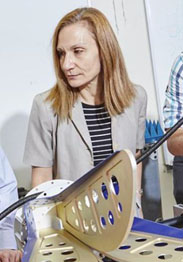
In Canada, Natalia Nikolova is a professor at the Department of Electrical and Computer Engineering of the McMaster University of Hamilton. Natalia led a project in the field of counter-terrorism that developed a portable warning system able to detect on-body concealed weapons, while the inspected person is moving.
”My training in radio and antenna engineering as well as theoretical and computational electromagnetism has allowed me to develop devices and methods that make a concrete difference in people’s lives, for example, in breast-cancer screening and in the detection of concealed weapons”.
For her, the presence of girls and women in science and technology will undoubtedly increase if two conditions are guaranteed: ”Fairtreatment at the workplace alongside equal pay for equal work with male colleagues”.
Developing a wireless network to provide communication in emergencies situations
Prof. Liljana Gavrilovska teaches at the Faculty of Electrical Engineering and Information Technologies Ss. Cyril and Methodius University in Skopje, Republic of North Macedonia.
“Nowadays, women still need to stand and fight for themselves to overcome the biases that characterise the scientific community.”
She led a project aimed at developing a highly flexible and adaptable wireless network capable of providing reliable communication in emergency situations.
”I believe that it will be up to the future generations of women and girls to stand up and to reduce the gender gap in the scientific field”, Prof. Gavrilovska explains.