
Close
Back


From now on you can download videos from our website
If you would also like to subscribe to the newsletter and receive our latest updates, click on the button below.
Enter the email address you registered with and we will send you a code to reset your password.
The password must be at least 12 characters long, no spaces, include upper/lowercase letters, numbers and symbols.
Click the button to return to the page you were on and log in with your new password.
05 November 2018
1 MIN READ

Dr Stephan Kieninger, fellow at Johns Hopkins University, School of Advanced International Studies, is the author of The Diplomacy of Détente: Cooperative Security Policies from Helmut Schmidt to George Shultz. He presented and discussed his book during a visit to NATO Headquarters in Brussels, Belgium on 5 November, 2018.
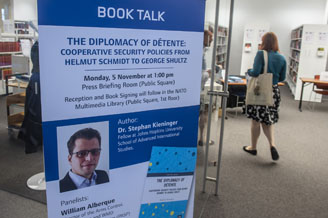
Mr William Alberque, Director of NATO’s Arms Control, Disarmament, and Weapons of Mass Destruction Non-Proliferation Centre and Ms Catherine Gerth, Head of Archives and Information Management at NATO joined the discussion.
Aiming to provide readers with an in-depth analysis and accurate portrayal of the events of the Cold War, Dr Kieninger meticulously scoured public, academic, and corporate archives for primary sources to use as supporting evidence in his book.
Two significant themes in Dr Kieninger’s book are Ostpolitik and trade. The book describes how former German Chancellor Helmut Schmidt found himself between the East and West, balancing trade and economic incentives with international relations and Western integration. It explains that building trust with the Soviet Union, as well as the Western powers, required a dual-track approach to constructive dialogue and improved global cooperation. The book quotes Chancellor Schmidt as saying that nations with a relationship built on economic interdependence will not go to war with one another.
The panel discussed the striking similarity between the Cold War politics of the late 20th century and the themes present in the contemporary political landscape. Dr Kieninger elaborates in his book that understanding the history of détente is essential to fully appreciate the role of diplomacy between nations. The delicate balance between deterrence and détente, or realistic détente, he says, is a familiar topic of discussion in modern politics. The lessons that can be learned from history are the importance of maintaining diplomatic relationships, open channels of communication, and not becoming complacent to threats from the outside.