
Close
Back


From now on you can download videos from our website
If you would also like to subscribe to the newsletter and receive our latest updates, click on the button below.
Enter the email address you registered with and we will send you a code to reset your password.
The password must be at least 12 characters long, no spaces, include upper/lowercase letters, numbers and symbols.
Click the button to return to the page you were on and log in with your new password.
22 June 2018
1 MIN READ

NATO Deputy Secretary General Rose Gottemoeller addressed the importance of practical cooperation and adaptation at an EU conference on ‘Climate, Peace and Security’ on Friday (22 June 2018). Participating in a panel discussion on ‘Indispensable Multilateralism’, Gottemoeller highlighted the importance of links between countries and organisations in ensuring that the right tools are brought to bear on the challenges of today and tomorrow.
The Deputy Secretary General provided examples of some of the work NATO is doing to reduce energy consumption and increase efficiency in field operations, including Exercise Capable Logistician 2019, which will take place in Poland. Among other technologies, it will feature energy-efficient tents with photovoltaic panels and LED lights, atmospheric water generators that draw moisture from the air, and micro-grid controllers that optimise the energy flow from diesel generators, wind, and solar, saving fuel. Through exercises like this, NATO works to improve efficiency and effectiveness. Gottemoeller highlighted that these technologies are not only relevant to militaries, but can be used in developmental contexts as well.
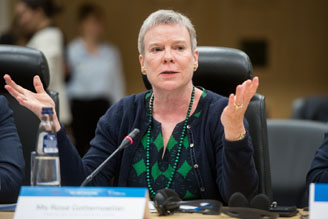
Panelists also discussed climate-related disasters and how multilateralism can help those confronted with the consequences. NATO’s Euro-Atlantic Disaster Response Coordination Centre coordinates national responses to natural disasters. Importantly, the Centre also helps to build capacity and interoperability through annual exercises during which NATO members and partners practice responses to the kinds of natural disasters that have become increasingly common. This year’s exercise will be hosted by Serbia and will take place in October. Speaking about the importance of bringing together multiple stakeholders in this work, Gottemoeller explained that, “we put our emphasis on developing interoperability so that countries can work together to be able to cope with disasters when they happen.”