
Close
Back


From now on you can download videos from our website
If you would also like to subscribe to the newsletter and receive our latest updates, click on the button below.
Enter the email address you registered with and we will send you a code to reset your password.
The password must be at least 12 characters long, no spaces, include upper/lowercase letters, numbers and symbols.
Click the button to return to the page you were on and log in with your new password.
27 October 2016
1 MIN READ
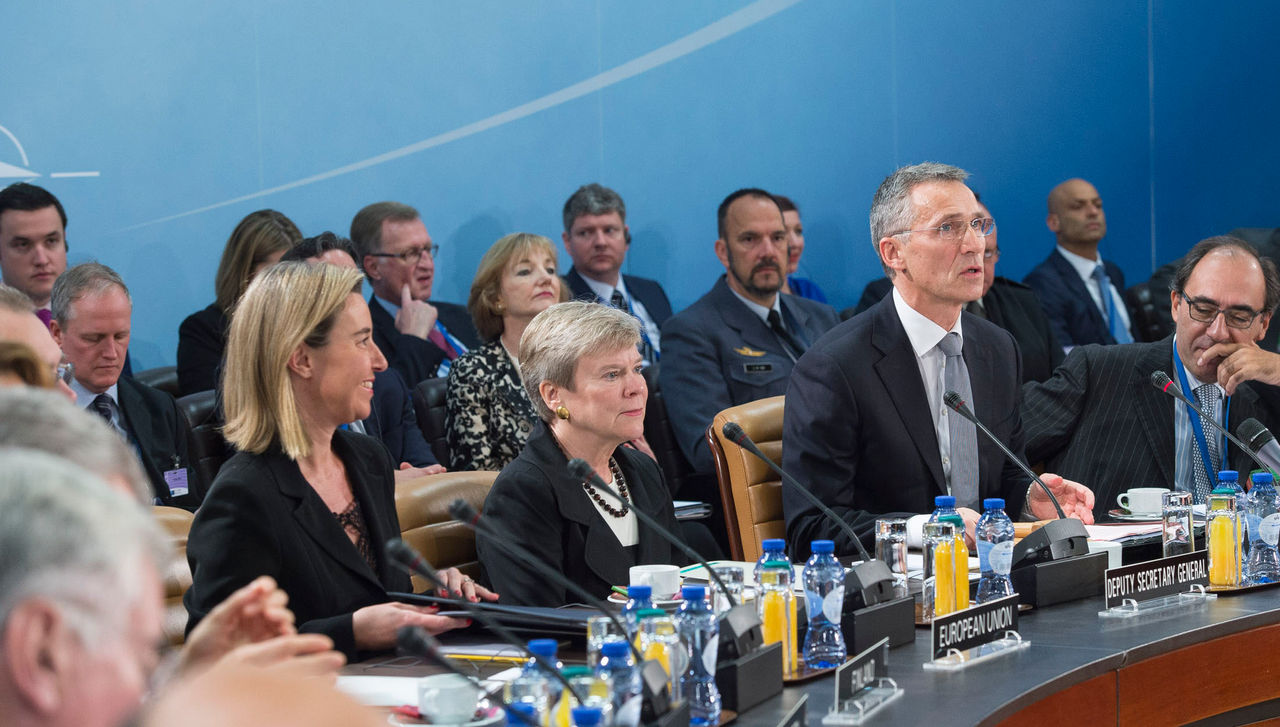
Allied Defence Ministers discussed practical steps to take forward NATO’s cooperation with the European Union on Thursday (27 October 2016). Ministers were joined by the EU High Representative Federica Mogherini, as well as the Defence Ministers of Finland and Sweden.
Briefing the media, NATO Secretary General Jens Stoltenberg highlighted the benefits of closer NATO-EU cooperation. He noted that, in the Aegean Sea, NATO’s deployment supports Greece, Turkey and the EU’s border agency Frontex in breaking the lines of human trafficking. “That is why last night we decided to continue our Aegean deployment,” said Mr. Stoltenberg.
Allies also decided last night that NATO’s new Operation Sea Guardian will support the EU’s Operation Sophia. Within two weeks, NATO ships and planes will be in the Central Mediterranean, ready to help increase the EU’s situational awareness and provide logistical support.
Today, ministers addressed ways to deepen NATO-EU cooperation in the areas of countering hybrid threats, cyber defence, coordinated exercises and supporting partners. Ministers also discussed recent initiatives to strengthen European defence. The Secretary General underlined that a strong Europe will make NATO stronger, especially by delivering more capabilities and by increasing defence spending among European Allies.