
Close
Back


From now on you can download videos from our website
If you would also like to subscribe to the newsletter and receive our latest updates, click on the button below.
Enter the email address you registered with and we will send you a code to reset your password.
The password must be at least 12 characters long, no spaces, include upper/lowercase letters, numbers and symbols.
Click the button to return to the page you were on and log in with your new password.
18 April 2016
2 MIN READ
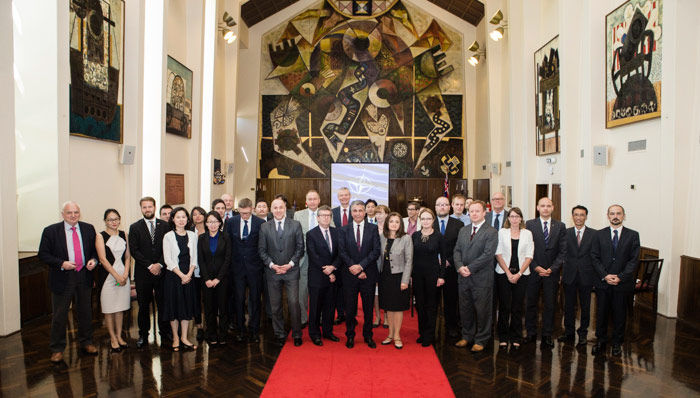
Experts presented their final results and analyses of an academic Science for Peace and Security research project aimed at tracing NATO external images among the Alliance’s Global Partners in the Asia-Pacific. The event took place on 8 March 2016 at the Canberra-based Australian National University. Participants at the conference came up with a number of proposals and recommended that, in order to be highly effective, NATO’s strategy in communication with its Global Partners in Asia-Pacific should feature a distinct degree of differentiation.
The event was attended by 40 participants, including NATO officials, representatives of Australia’s Department of Foreign Affairs and Trade and Department of Defence, members of diplomatic community, think tanks, and academia. The Conference, held under the Chatham House Rule, was moderated by the high-profile foreign affairs specialist and journalist Mr. Nik Gowing.
Project Partner Country Director, Professor Natalia Chaban, underlined the analytical complexity behind the Project’s findings and stressed the importance of research to enhance NATO’s public diplomacy efforts in the region. According to her, “systematic account of images and perceptions serves as a useful instrument to fine-tune cooperation and collaboration in international relations, while ensuring mutual respect and impact”.
The Alliance’s images in NATO’s five Global Partners in Asia-Pacific (Australia, Japan, Mongolia, New Zealand and Republic of Korea) were analysed for their visibility, local resonance, perceived capability and legitimacy as well as emotional charge. The Project’s rich empirical findings demonstrated that perceptions of NATO in the region are country-, issue- and elite cohort-specific. The highest visibility was observed in the Japanese media of all types, the lowest - in the Korean media. Analysis also indicated the highest visibility in military media. What is more, it assessed media framings of NATO in terms of perceived capability, with the highest one observed in Mongolia.
The results reported at the conference generated a discussion that highlighted how the findings of the study are of direct relevance to NATO and its global strategy. Furthermore, the findings indicated that, in order to be highly effective, NATO’s strategy in communication with its Global Partners in Asia-Pacific should feature a distinct degree of differentiation.

The SPS project has been implemented in cooperation with NATO’s Public Diplomacy Division and Tallinn University of Technology (Estonia). It has been led by a team of co-directors from Estonia, New Zealand and the United States and includes researchers from Australia, Japan, Mongolia, New Zealand and the Republic of Korea.
Australia, Japan, Mongolia, New Zealand and the Republic of Korea have all made important contributions in support of NATO’s operations and missions over the past decades, in particular in Afghanistan.