
Close
Back


From now on you can download videos from our website
If you would also like to subscribe to the newsletter and receive our latest updates, click on the button below.
Enter the email address you registered with and we will send you a code to reset your password.
The password must be at least 12 characters long, no spaces, include upper/lowercase letters, numbers and symbols.
Click the button to return to the page you were on and log in with your new password.
10 February 2016
1 MIN READ
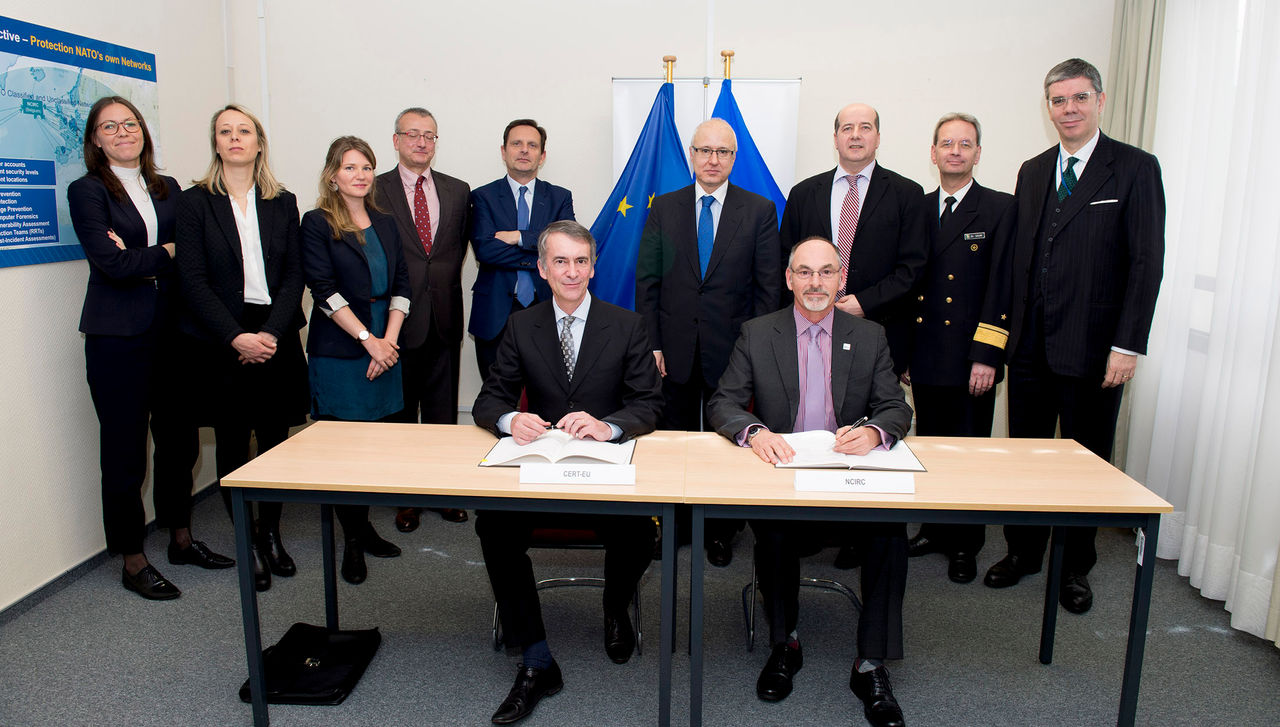
NATO and the European Union face similar challenges in protecting their networks against the growing threat of cyber attacks. To help both organisations better meet this challenge, today a Technical Arrangement on Cyber Defence was concluded between the NATO Computer Incident Response Capability (NCIRC) and the Computer Emergency Response Team of the European Union (CERT-EU). The Technical Arrangement provides a framework for exchanging information and sharing best practices between emergency response teams.
“Together, NATO and the EU are stronger in defending against cyber-attacks. Intensified cooperation under this arrangement will allow us in a tangible way to better prevent cyber-attacks, but also our ability to predict, detect and respond to them,” said Ambassador Sorin Ducaru, NATO Assistant Secretary General for Emerging Security Challenges.
"The signing of this arrangement is an important milestone in the strengthened cyber defence cooperation with NATO, which was also identified as one of the five priorities under the EU Cyber Defence Policy Framework, stated Pedro Serrano,” Deputy Secretary General of the European External Action Service. “This is a very important development in our operational cooperation in this area."
The aim of the arrangement is to enhance the cyber defences of both organisations by exchanging cyber defence-related data. “Information exchange is crucial to cyber defence,” said Koen Gijsbers, General Manager of the NATO Communications and Information (NCI) Agency, responsible for operating and defending NATO’s networks. “The Technical Arrangement covers both the exchange of information on specific cyber threats, and the sharing of best practices on technical procedures, configuration of networks, and partnership with industry.”
The Technical Arrangement is a concrete example of NATO and the EU working together to enhance shared security. It is also the latest example of long-standing cooperation on cyber defence between the two organisations. In addition, cyber defence staff from the European Union have participated for several years in NATO’s flagship annual cyber defence exercise Cyber Coalition.