
Close
Back


From now on you can download videos from our website
If you would also like to subscribe to the newsletter and receive our latest updates, click on the button below.
Enter the email address you registered with and we will send you a code to reset your password.
The password must be at least 12 characters long, no spaces, include upper/lowercase letters, numbers and symbols.
Click the button to return to the page you were on and log in with your new password.
20 September 2014
1 MIN READ
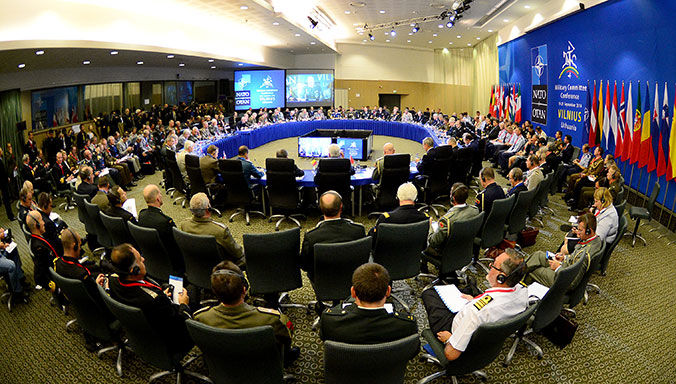
“NATO’s greatest responsibility is to protect and defend our Allies against any strategic and unconventional threat,” General Knud Bartels, Chairman of the NATO Military Committee said at the Military Committee Conference 2014 in Vilnius, Lithuania. “The Alliance must have the right forces, the right equipment in the right place, at the right time”. NATO’s response to the new threats will require a thorough analysis in order to ensure a sustainable, visible, agile and therefore credible force.
At the Wales Summit, NATO Allies agreed a Readiness Action Plan that will strengthen NATO’s collective defence and ensure the Alliance is ready to respond to any future security challenge. The Military Authorities have now taken the next step in guiding and directing the implementation of a Very High Readiness Joint Task Force (VJTF), able to deploy at short notice. “NATO’s Chiefs of Defence are the best at transforming decisions into plans and plans into actions,” the President of Lithuania, H.E. Mrs. Daria Grybauskaitė said at the Conference.
Among the key topics discussed were the security challenges in four regions – Russia/Ukraine, Africa/Sahel, Middle East/North Africa and Asia/Pacific. These areas are particularly important for Allies given the increasing instability on NATO’s borders and further abroad, which has the potential to impact the security of the Alliance both directly and asymmetrically. The Chiefs of Defence highlighted the enduring and significant nature of these current state and non-state threats and agreed that the Alliance could have a role to play to mitigate them.
The Military Committee paid tribute to the hundreds of thousands of military and civilian personnel who have served with ISAF and the Afghan National Security Forces over the past thirteen years. “Their sacrifices and efforts have made all of our nations safer and improved global security,” emphasised General Bartels. To conclude, the Chiefs of Defence elected General Pavel, Czech Army, as the next Chairman of the NATO Military Committee.