
Close
Back


From now on you can download videos from our website
If you would also like to subscribe to the newsletter and receive our latest updates, click on the button below.
Enter the email address you registered with and we will send you a code to reset your password.
The password must be at least 12 characters long, no spaces, include upper/lowercase letters, numbers and symbols.
Click the button to return to the page you were on and log in with your new password.
08 July 2014
1 MIN READ
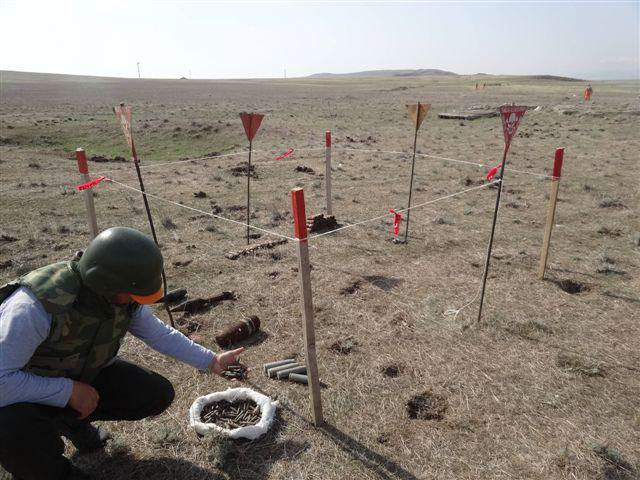
Jeyranchel, in northeastern Azerbaijan covers an area of about 62 square kilometres just along the Georgian border. From 1955 until 1991, the former Soviet Army used the site as a live-firing range. Unexploded ordnance (UXO) and mines remained, much of it hidden underground, threatening security and livelihoods.
In 2012, a NATO Trust Fund was set up to help Azerbaijan clear the area of this deadly legacy and now, two years later, Phase I is complete, with 19 square kilometres cleared. In September 2013, 132 live mines and 12,318 live UXO had been found. Phase II of the project will focus on the clearance of the central 23 square kilometres of the Jeyranchel Range over the next 24 months.
A ceremony to mark the handover of land and the opening of Phase II of the Jeyranchel Clearance Project took place in Baku on 8 July. Senior representatives from NATO, the NATO Support Agency (NSPA), the Azerbaijan National Agency for Mine Action (ANAMA) and the Azerbaijan Government, as well as staff and invited guests from the diplomatic and donor community attended the event, which included a presentation and display of equipment.
The Trust Fund project is an example of the enhanced cooperation between NATO and Azerbaijan.
"Azerbaijan has contributed a lot to NATO, in particular to NATO operations,” the NATO Secretary General's Special Representative for the Caucasus and Central Asia, James Appathurai said. “This project allows NATO to do something very concrete in return, that is to enhance the everyday safety and security of Azerbaijani citizens living near the areas that used to be contaminated with unexploded ordnance," he explained.