
Close
Back


From now on you can download videos from our website
If you would also like to subscribe to the newsletter and receive our latest updates, click on the button below.
Enter the email address you registered with and we will send you a code to reset your password.
The password must be at least 12 characters long, no spaces, include upper/lowercase letters, numbers and symbols.
Click the button to return to the page you were on and log in with your new password.
28 October 2013
1 MIN READ
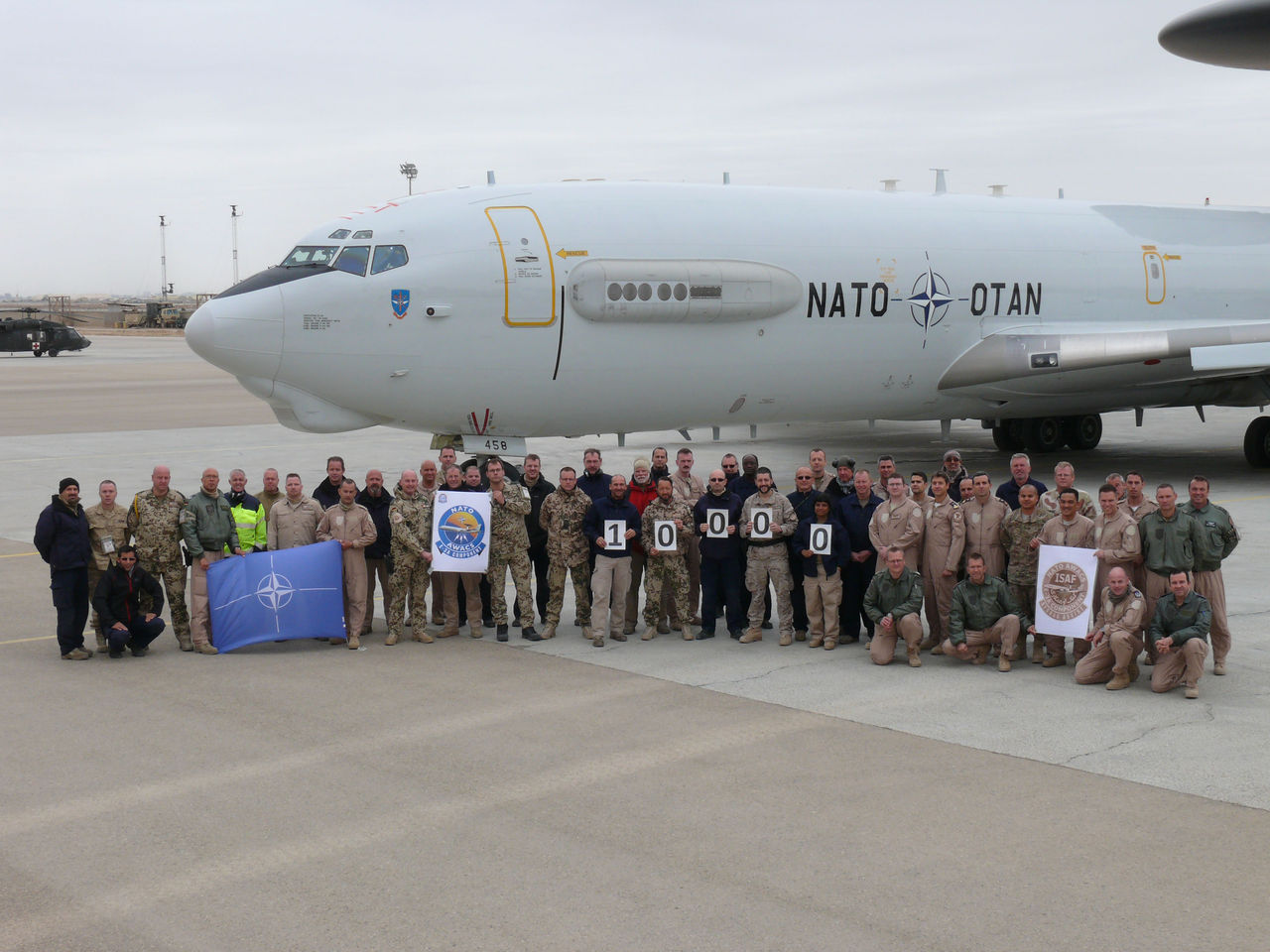
NATO’s fleet of E-3A Airborne Warning and Control System (AWACS) aircraft surpassed a significant milestone this past weekend after reaching 10,000 flight hours in support of the Alliance’s mission in Afghanistan.
The E-3A fleet, based in Geilenkirchen, Germany, passed the milestone on Saturday (26 October 2013), reflecting almost 1,000 missions flown in two and a half years. The AWACS fleet supported the International Security Assistance Force (ISAF) during this period without any serious air or ground related incidents. “The E-3A Component can be proud of a remarkable accomplishment in support of NATO’s ISAF mission in Afghanistan,” said Supreme Allied Commander Europe, General Philip M. Breedlove. “The Component’s NATO AWACS aircraft have logged more than 10,000 flying hours under Operation Afghan Assist (AOO), while operating out of Mazar-e Shariff for the past two and a half years. Their crews have flawlessly and consistently provided critical mission contributions often in direct support of land forces engaged in contact or conducting medical evacuation operations. Congratulations to the whole team for maintaining such excellence watching over the skies of Afghanistan,” he said.
The AWACS planes started support missions to ISAF in January, 2011. Their mission is to provide air command and control, communications relay and radar coverage in the Afghan airspace making sure planes using Afghan airspace fly at a safe distances between each other. The AWACS also help the smooth conduct of aerial refuelling by guiding fighter jets to their tankers. The enhanced situational awareness provided by AWACS to ISAF air and ground commanders enables better control of close air support assets, surveillance and communications support to ground operations, including medical evacuation operations.
Geilenkirchen’s support to ISAF reflects the evolution within the E-3A Component to meet the demands of NATO Commanders. What was envisioned as a force focused on territorial air defence, is now an airborne command and control capability essential to NATO operations today. Component aircrews are conducting operations in support of ground and special operation forces, a role never envisioned when the Component was started in 1982. The NATO Air Base (NAB) in Geilenkirchen, Germany, is home to 17 E-3A aircraft.