
Close
Back


From now on you can download videos from our website
If you would also like to subscribe to the newsletter and receive our latest updates, click on the button below.
Enter the email address you registered with and we will send you a code to reset your password.
The password must be at least 12 characters long, no spaces, include upper/lowercase letters, numbers and symbols.
Click the button to return to the page you were on and log in with your new password.
20 May 2010
1 MIN READ
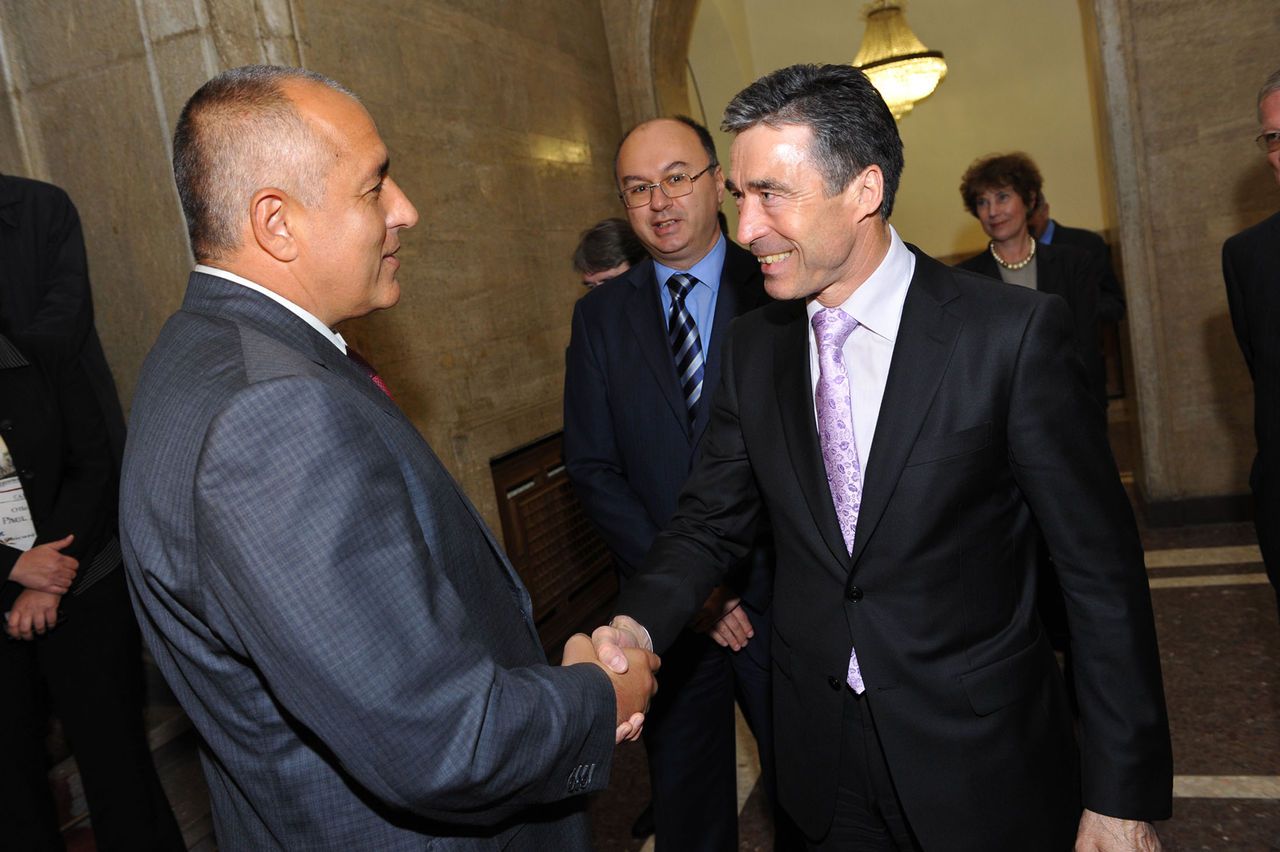
On 20 May, Anders Fogh Rasmussen paid his first visit to Bulgaria as NATO’s Secretary General. He met with President Georgi Parvanov, Prime Minister Boyko Borissov, Foreign Minister Nickolay Mladenov and Minister of Defence Anyu Angelov.
A number of issues on the agenda of NATO’s Summit in November were addressed, including the NATO-led mission in Afghanistan, NATO reform, missile defence and the process leading to a new Strategic Concept. Some key regional aspects were also discussed.
The Secretary General and his hosts discussed issues related to the Strategic Concept to be approved in Lisbon, which will be informed by the report presented by the Group of Experts on 17 May. They shared the view that the new Strategic Concept must be a forward looking document that sets out a vision not only for what the Alliance should do, but what it should be.
They also agreed that the benefits and the responsibilities of missile defence should be shared by the Allies. In a public address at the Central Military Club, the Secretary General said: “I believe that the time has come for us to move ahead and make missile defence a genuine Alliance mission. This is my target for the next NATO Summit in Lisbon.”
On Afghanistan, Mr. Fogh Rasmussen began with commending Bulgaria for its valuable contribution to the NATO-led International Security Assistance Force (ISAF). “Over 500 soldiers is substantial for a relatively small country,” he said.
He also reminded that the training of Afghan Forces is an investment in transition and encouraged all Allies, including Bulgaria, to consider offering more trainers.
Addressing developments in the Western Balkans, Mr. Fogh Rasmussen said: “I am encouraged by progress in Kosovo, and between many countries that are putting the legacy of the recent past behind them. The future of this entire region lies in the EU and in NATO.”
Talks were finally held on the situation in the strategic Black Sea region.