
Close
Back


From now on you can download videos from our website
If you would also like to subscribe to the newsletter and receive our latest updates, click on the button below.
Enter the email address you registered with and we will send you a code to reset your password.
The password must be at least 12 characters long, no spaces, include upper/lowercase letters, numbers and symbols.
Click the button to return to the page you were on and log in with your new password.
26 November 2007
1 MIN READ
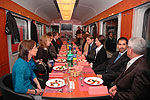
On a unique train called the “GLOBSEC Express”, young leaders from the Balkans and central Europe discussed the future of the Balkans while they travelled from Bratislava, Slovakia to Zagreb, Croatia on 26-27 November 2007.
The train car — fitted with a conference table, internet connection, a sound system and a projector screen — provided an informal space for open discussions on security issues and the future of the Balkans in the context of Euro-Atlantic integration.
Participants from Balkan countries (Albania, Bosnia and Herzegovina, Bulgaria, Croatia, Montenegro, the former Yugoslav Republic of Macedonia1, Romania and Serbia) and central European countries (Czech Republic, Slovak Republic, Hungary and Slovenia) spoke with NATO Secretary General Jaap de Hoop Scheffer via videoconference about the Euro-Atlantic future of the Balkans.
Michal Kovács, the National Program Director of Slovak Atlantic Commission, said that the principal aim of the project is to draft a common communiqué that will be sent to Mr. De Hoop Scheffer, political leaders in Balkan countries and the media.
“The message of the project is clear,” he said. “The successor generation will encourage the political leaders of their countries to work towards Euro-Atlantic integration, because there is no ‘Europe whole and free’ without the Balkans.”
The GLOBSEC Express project was organized by the Slovak Atlantic Commission and Euro Atlantic Centre with support from NATO, the Ministry of Foreign Affairs of the Slovak Republic, Representation of the European Commission in Slovakia and the Embassy of the United States of America to the Slovak Republic. The project was executed under the auspices of State Secretary of the Ministry of Foreign Affairs of the Slovak Republic, Diana Štrofová.