
Close
Back


From now on you can download videos from our website
If you would also like to subscribe to the newsletter and receive our latest updates, click on the button below.
Enter the email address you registered with and we will send you a code to reset your password.
The password must be at least 12 characters long, no spaces, include upper/lowercase letters, numbers and symbols.
Click the button to return to the page you were on and log in with your new password.
18 October 2004
2 MIN READ
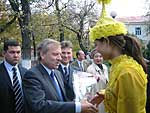
NATO and Central Asia share vital interests and the Alliance is committed to expanding cooperation with its Central Asian partners, NATO Secretary General Jaap De Hoop Scheffer said during a tour of the region, 18-21 October.
The Secretary General discussed the fight against terrorism, Afghanistan and cooperation in the area of defence reform with the Heads of State and senior officials of NATO’s five Central Asian partners: the Kyrghyz Republic, Kazakhstan, Uzbekistan, Tajikistan and Turkmenistan.
He was accompanied by NATO’s newly appointed Special Representative for Central and the Caucasus, Ambassador Robert Simmons.
“A key element of NATO’s reorientation to address new threats is to make better use of the partnership relations that we have developed over the past decade,” the Secretary General said in a speech in Kazakhstan, “The new challenges to our security know no borders. Meeting these challenges, and defeating them, requires the closest possible international cooperation.”
This is why, at the Istanbul Summit this June, NATO Heads of State and Government agreed to place a special focus on cooperation with Central Asia and the Caucasus, he said. To implement this decision, they agreed to appoint a Special Representative for the two regions and send liaison officers to the regions.
One important area for expanding cooperation was Afghanistan, and the Secretary General discussed ways in which the Central Asian partners could further assist the NATO-led ISAF mission in the country.
A stable and peaceful Afghanistan that did not export terror was of “vital interest” to both NATO and its Central Asian partners, he stressed.
He also reiterated NATO’s readiness to help its Central Asian partner countries make their defence institutions more effective in dealing with today’s new threats. This could include advice on the size, structure, funding of armed forces, the democratic control over the military and interoperability with the forces of NATO countries.
During the visit, particular appreciation was expressed for NATO’s Virtual Silk Highway computer networking project, conducted under NATO’s "Security Through Science" programme.
It links all of the countries of Central Asia and the Caucasus, plus Afghanistan, to the world-wide Internet. This major initiative is highly valued by the partner countries, whose scientific communities have experienced 'order of magnitude' increases in their connectivity to other countries.