
Close
Back


From now on you can download videos from our website
If you would also like to subscribe to the newsletter and receive our latest updates, click on the button below.
Enter the email address you registered with and we will send you a code to reset your password.
The password must be at least 12 characters long, no spaces, include upper/lowercase letters, numbers and symbols.
Click the button to return to the page you were on and log in with your new password.
07 April 2020
3 MIN READ
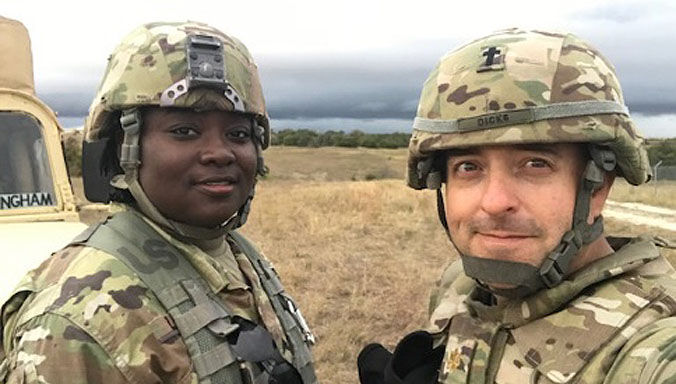
Major Stephen Dicks is 45 years old and serves in the 1st Cavalry Division Artillery of the United States Army. Based at Fort Hood, Texas, this division is one of the most decorated combat divisions of the US Army. But the major is not an artilleryman – he is a chaplain.
“My job entails ensuring the free exercise of religion for soldiers,” explains Major Dicks. “This includes performing religious services, weddings, baptisms, funerals and sermons. It also includes facilitating for the religious needs of soldiers that are different from my faith group.”
As part of the commander’s senior staff, it is his responsibility to advise the commander on matters of morale, morals, ethics and religion.
In his spare time, Dicks has been a cartoonist for many years. He has even had the privilege of drawing cartoons for two US presidents – both of whom gave him an autographed copy of his cartoon in return.
For exercise DEFENDER-Europe 20, Dicks was deployed to Germany. The country is not new to him. In the 1970s, his father was stationed in Wildflecken, Germany, together with a good friend who invited him to visit his home in the United States, where he fell in love with his friend’s daughter. They got married and went back to Germany where Major Dicks was born in the city of Würzburg in northern Bavaria.
“The very fact that I am now the soldier serving where my father once served fills me with happiness,” says Dicks.
During DEFENDER-Europe 20, NATO Allies tested their ability to move quickly across the Atlantic and Europe and to work together to protect each other from any potential threat.
From January to March 2020, the US Army moved approximately 6,000 soldiers from the United States to Europe, as well as 9,000 vehicles and pieces of equipment from Army Prepositioned Stocks, and about 3,000 pieces of equipment via sea from the United States. Moreover, in coordination with other Allies, it also completed movement of soldiers and equipment from multiple ports to training areas in Germany and Poland.
Dicks believes it is important to exercise with other NATO Allies. “The United States military has continually worked with NATO Allies for years, especially over the last two decades of conflicts around the world. Since we work together on the battlefield, it is important to train together – because we will fight like we train, therefore we must train as a multinational team of Allies.”
In response to the current outbreak of the COVID-19 virus, exercise DEFENDER-Europe 20 was modified in size and scope. On 13 March 2020, all movement of personnel and equipment from the United States to Europe ceased. Allied forces, however, continue to preserve their readiness, if needed.
“The health and well-being of all soldiers, civilians and family members is a top priority and critical to our readiness,” concludes Major Dicks.