
Close
Back


From now on you can download videos from our website
If you would also like to subscribe to the newsletter and receive our latest updates, click on the button below.
Enter the email address you registered with and we will send you a code to reset your password.
The password must be at least 12 characters long, no spaces, include upper/lowercase letters, numbers and symbols.
Click the button to return to the page you were on and log in with your new password.
18 September 2019
3 MIN READ
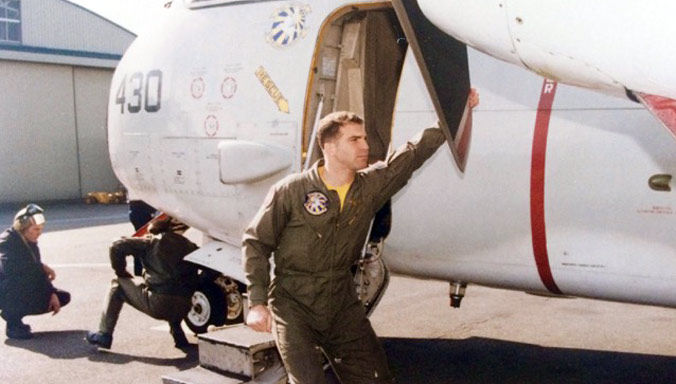
Paul Beckley preparing his aircraft to transit to USS Dwight D. Eisenhower
Paul Beckley grew up in Long Island in south-eastern New York State. When he was a young boy, he liked watching the fishing boats entering the marina. “I loved the smell of the salt air,” says Paul. “Few years after, I joined the US Naval Academy. I was 18 years old.”
“Imagine 8,000 personnel of both ships doing at the same time complex manoeuvres and sharing of resources between their naval vessels to host their respective aircraft. Everything went well. It was an amazing and humbling experience and was my first experience with NATO,” explains Paul.
Today, Paul is a maritime expert at NATO Headquarters in Brussels, Belgium. He seeks to ensure that NATO Allies have the right capabilities to deal with current maritime security challenges, such as mines, terrorist activities, smuggling or piracy.
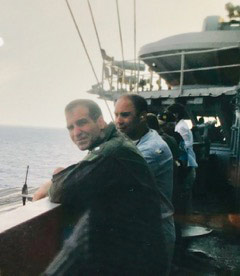
“Freedom of access to the seas is critical for our national economies, infrastructure, freedom and ways of life,” says Paul. Ninety per cent of world trade is carried by ships. The port cities that facilitate this commercial movement are generally accessed by travel through inland waterways that provide a link to the open ocean. Due to the heavy traffic and shallow water, they are an easy target for attacks aimed at disrupting the economy or military operations.
“Both mines and submarines are efficient ways of denying that freedom of access to the seas,” he explains. Recent events in the Persian Gulf and Sea of Azov have demonstrated the need for naval power and for NATO forces’ to be able to find and destroy mines.
Paul works for the NATO Naval Armaments Group, or NNAG. Made up of senior naval armaments directors from NATO member states and partner countries, this is a key body for the development of maritime capability. This year, the use of unmanned systems in naval mine warfare was the focus of a NNAG meeting co-hosted by the Bulgarian Navy and Nikola Vaptsarov Naval Academy.
“Mines have become smarter. They are designed to be as undetectable and deadly as possible and can vary greatly in terms of their designs,” explains Paul. Mines can float on top of a body of water, rest on the sea floor or be moored to the sea floor. They can also be fitted with technology detecting certain signals that allow the mine to be detonated at a more precise location or by some specific target.
NATO has two groups of mine counter-measures ships, which are tasked with keeping shipping lanes free of mines. These groups are multinational maritime forces consisting of vessels from Allied countries under NATO command. A key priority is to develop technologies that keep human operators safe during mine-hunting operations. “To achieve this, Allied navies use unmanned systems that have the ability to efficiently and effectively clear minefields while keeping the “man out of the minefield”, thus saving lives,” says Paul.
Other technologies discussed by the senior naval armaments directors include unmanned surface and underwater vehicles equipped with high-resolution sensors, such as sonars, magnetometers or optical cameras. They employ computer-aided detection and classification algorithms as well as automated target-recognition processes.
“These and other technologies for other maritime warfare areas, such as anti-surface and anti-air warfare, need to be tested in real situations,” Paul emphasises. This is why – during NEMO 19 trials in the United Kingdom this autumn – NATO’s naval forces will test their ability to operate freely and to protect shipping operations in littoral and confined waters against any threats using electromagnetic technologies. Paul is working hard to promote the smooth running of these tests.