
Close
Back


From now on you can download videos from our website
If you would also like to subscribe to the newsletter and receive our latest updates, click on the button below.
Enter the email address you registered with and we will send you a code to reset your password.
The password must be at least 12 characters long, no spaces, include upper/lowercase letters, numbers and symbols.
Click the button to return to the page you were on and log in with your new password.
26 May 2014
4 MIN READ
“Sir, hundreds of refugees are crossing the border now...” All of a sudden, the line goes dead. You switch your attention to reports coming in on terrorist activity spreading along the coast, but no coordinates are given. What do you do?
You are a NATO commander. Floods of refugees are creating a humanitarian crisis and, in a neighbouring country, terrorists are fuelling tension in a potentially explosive situation that could destabilise the region. Unidentified troops have been reported by refugees and you are concerned about their intentions. All the components of a conflict are there. And you must decide what to do. Right now.
In the heat of the action, getting the right information to the right person at the right time can be a life and death issue. But that is a complex process. It means being able to piece together information from different platforms and analysing it to give commanders the edge, in the field, to make critical decisions while protecting their troops and civilians.
Luckily, this is not a real-life situation, but it could be. It is NATO’s biggest ever trial of Joint Intelligence, Surveillance and Reconnaissance (JISR), comprising satellites, aircraft, unmanned aerial vehicles, naval vessels, ground sensors and human intelligence from 18 NATO Allies.
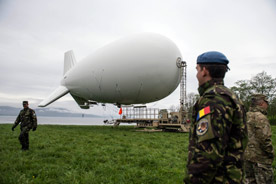
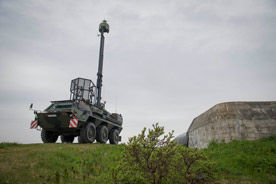
Unified Vision 2014 (UV14) is taking place in Norway from 18-28 May and aims to test NATO’s ability to gather information and fuse intelligence from multiple sources – from space, in the air, on land and at sea – at different stages of a crisis. In the scenario, the crisis is initially local and then it gradually escalates into a full-blown international conflict. All the while, very different ISR capabilities are expected to perform in testing situations, stretching their ability to function properly in complex environments.
“This is the most ambitious trial we have ever done, bringing together the largest array of surveillance technology, equipment and personnel over a 10-day period. Instead of conducting our interoperability assessment in a lab, we have created a demanding operational environment to test the ability of our sensors, architecture and procedures to deliver intelligence capable of driving operations in the field. Many of these capabilities will be resident for the 2016 NATO Response Force and will facilitate the Alliance’s ability to quickly react to contingencies”, explained U.S. Air Force Lieutenant Colonel Matt Biewer, UV14 Trial Manager.
After the shortfalls observed during the NATO-led Operation Unified Protector in Libya in 2011, improving NATO’s ability to coordinate and deploy Allied ISR capability is crucial. In February 2014, NATO Secretary General Anders Fogh Rasmussen stated: “Through our operations, including Libya and Afghanistan, we have identified the areas where our capabilities do not go far enough or too few countries have them. Libya revealed shortfalls in precision-guided munitions; intelligence, surveillance and reconnaissance assets; and experts trained to interpret the data they provide. Work has been ongoing, but the economic crisis has not made it any easier. So we need to take a long hard look at the most effective way to work together to close those gaps.”
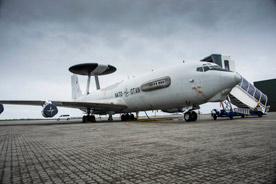
UV14 is testing doctrine, organisation, training, material, leadership, personnel, facilities and interoperability, with the aim of helping NATO to quickly process, exploit and disseminate information to commanders in action. Assets being used include equipment such as the Predator, Global Hawk, Hunter, Raven, Puma, NATO’s AWACS aircraft, a naval corvette and raccoon reconnaissance vehicles.
Techniques are also being introduced to provide even more intelligence such as identity intelligence – i.e. using special techniques to find terrorists in dense areas.
The trial will allow analysts to “fuse” ISR products derived from all of these different sources, be they imagery, communications, human or even open source, which are provided from across the 18 participating countries. Allies are also developing their ISR assets and, through UV14, are working side by side to test their equipment and their ability to work together. Rather than inundating commanders with information from different sources, the aim is to provide them with a common picture derived from multinational assets so that they can make informed decisions at any one time.
The ultimate objective of the trial is to suggest improvements that will bring NATO closer to increasing the readiness of the NATO Response Force (NRF) 2016 and to delivering a Joint ISR Initial Operational Capability, which it aims to achieve end 2016.