
Close
Back


From now on you can download videos from our website
If you would also like to subscribe to the newsletter and receive our latest updates, click on the button below.
Enter the email address you registered with and we will send you a code to reset your password.
The password must be at least 12 characters long, no spaces, include upper/lowercase letters, numbers and symbols.
Click the button to return to the page you were on and log in with your new password.
13 February 2014
3 MIN READ
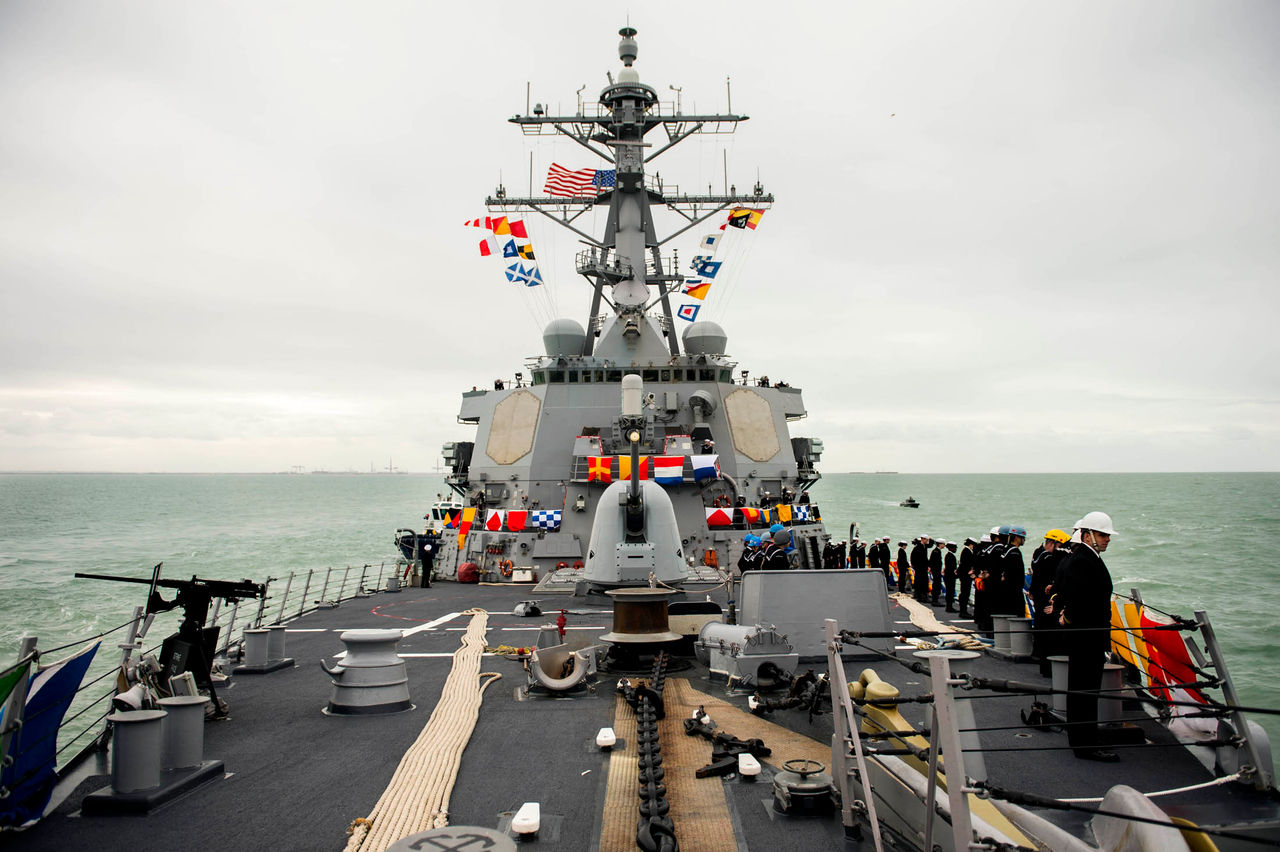
The arrival in Spain of a US guided missile destroyer marks a key stage in building up Europe’s protection against ballistic missile threats.
The USS Donald Cook, which arrived at Rota Naval Station, Spain on 11 February, is the first of four ballistic missile defence (BMD)-capable destroyers that will be stationed at the base.
The ships are capable of tracking and shooting down ballistic missiles in flight, using their Aegis radar system and SM-3 interceptor missiles. These capabilities will make the destroyers a key component of NATO’s missile defence shield for Europe.
They also are able to simultaneously track up to 200 targets at distances of more than 200 nautical miles, provide long-range surveillance and tracking of intercontinental ballistic missiles, and can work with other US BMD elements to provide advance warnings.
“With the USS Donald Cook in Rota and three other ships arriving, we have four ships and the two systems ashore permanently stationed in Europe; that is quite an impressive capability to protect European populations,” said Robert Bell, Secretary of Defense Representative, Europe and Defense Advisor at the US Mission to NATO. “With these ships stationed in Rota, we can project a missile defence capability much more immediately and responsively in this region,” he added.
The USS Donald Cook will be joined by the USS Ross, USS Porter and USS Carney over the next two years. The destroyers will patrol the Mediterranean on four-month rotations under US command and control, but can be put under NATO operational control if threat conditions warrant.
During these tours, they will also carry out a full range of maritime security operations, bilateral and multinational training and exercises, and involvement in NATO missions and deployments (including NATO missile defence), if tasked.
Spain already operates the first European ships equipped with the Aegis system, with its four F-100 Álvaro de Bazán-class Aegis frigates. This means Spanish and US ships will be able to expand joint training and exercises.
“The Spanish ships are compatible with the US ships,” said Col Juan Jose Martin, Defence Advisor at the Spanish Delegation to NATO. “We are fully interoperable with them as we use the same Aegis system.”
As well as new hardware, the US move will be bringing people to bolster the US presence in Rota. Some 1,200 sailors and 1,600 family members will move to the base at Rota over the next two years, according to a US senior defence advisor.
The USS Donald Cook’s deployment is part of a US programme known as the European Phased Adaptive Approach (EPAA) and represents a US contribution to the wider NATO Missile Defence plan that currently includes one Aegis ship, a radar system in Turkey and a command centre in Ramstein, Germany. Going forward, land-based interceptor batteries in Romania (expected in 2015) and Poland (expected in 2018) will significantly improve this capability.
“The next milestone for NATO would be to declare an initial operational capability,” said Roberto Zadra, Head of the Ballistic Missile Defence Section at NATO Headquarters. He added, “NATO BMD is moving forward.”
NATO’s missile defence system is a good example of Smart Defence, which enables NATO nations to share capabilities by pooling resources to respond better to common security challenges.
NATO’s long-term goal is to merge individual Allies’ missile defence assets into a coherent defence system, providing full protection for NATO European populations, territory and forces against ballistic missiles threats.
The system should reach full operational capability in the first half of the next decade.