NATO MULTIMEDIA ACCOUNT

Access NATO’s broadcast-quality video content free of charge

Register

Create an account

Create an account

Check your inbox and enter verification code

We have sent a verification code to your email address. . Enter the code to verify your account. This code will expire in 30 minutes.
Verification code

Didn't receive a code? Send new Code

You have successfully created your account

From now on you can download videos from our website

Subscribe to our newsletter

If you would also like to subscribe to the newsletter and receive our latest updates, click on the button below.

Reset password

Enter the email address you registered with and we will send you a code to reset your password.

Reset password
Check your inbox and enter verification code
We have sent a verification code to your email address. Enter the code to verify your account. This code will expire in 30 minutes.
Verification code

Didn't receive a code? Send new Code

Create a new password

The password must be at least 12 characters long, no spaces, include upper/lowercase letters, numbers and symbols.

Your password has been updated

Click the button to return to the page you were on and log in with your new password.
Background

  1. NATO’s 2022 Strategic Concept reaffirmed the need to enhance the Alliance’s technological edge to strengthen deterrence, defence, and collective security. At the 2025 The Hague Summit, Allied Heads of State and Government underscored the importance of emerging technologies and innovation to strengthen the Alliance’s core tasks.
  2. In this evolving strategic context, the Alliance Digital Strategy sets the strategic direction for NATO’s digital transformation underpinned by the imperatives of interoperability, security, innovation, and operational superiority. It affirms a shared commitment to interoperable digital capabilities to empower Allied leaders and warfighters for multi-domain operational dominance.
  3. The implementation of the Alliance Digital Strategy is anchored in the Digital Transformation Implementation Strategy (DTIS). As the strategic-level, overarching roadmap for NATO’s digital transformation, the scope of the DTIS covers the Alliance, encompassing Allies and the NATO Enterprise.
  4. The first version of the DTIS was approved by the North Atlantic Council in 2023 and endorsed by the Heads of State and Government at the Vilnius Summit. Since then, the Alliance has made significant progress across all areas of interest.
  5. However, the DTIS 2024 Annual Report, consultations with stakeholders, and guidance by the Digital Policy Committee (DPC) identified challenges and opportunities, underscoring the need to refine the DTIS framework and the recalibration of certain Lines of Effort. Recognising that substantial work remains and that new opportunities continue to emerge, a revision of the DTIS ensures its continued relevance and effectiveness.

Purpose

  1. Digital transformation is the end-to-end transformation of NATO’s Military and Non-Military Instruments of Power, enabled by digital technologies, to enhance the Alliance’s ability to execute its core tasks. It encompasses a coordinated change effort across three fundamental pillars: people, processes, and technology.
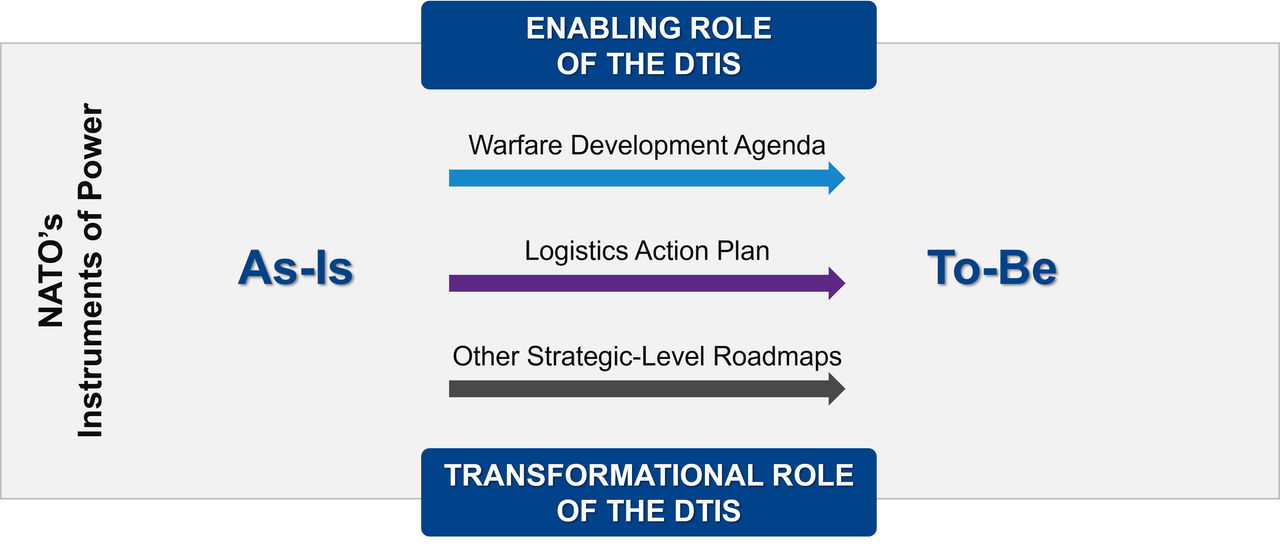
  2. The collective sum of digital transformation efforts must enable the Alliance’s core tasks, as outlined in the 2022 Strategic Concept. To this end, this Implementation Strategy fulfils a dual role (see Figure 1):
    • An enabling role. The DTIS is the digital accelerator for the implementation of other strategic-level roadmaps, each advancing meaningful transformation in complementary areas of NATO as a political-military Alliance. In particular, the DTIS serves as a catalyst for the implementation of NATO’s Warfighting Capstone Concept (NWCC) and its supporting Warfare Development Agenda (WDA)1, which drive the transition towards a Multi-Domain Operations (MDO)-enabled Alliance, strengthening the deterrence and defence of the Euro-Atlantic area.
    • A transformational role. The DTIS plays a transformational role by directly shaping how NATO operates in the digital sphere – leveraging digital technologies and new ways of working towards an agile, integrated, and data-driven Alliance. Operationalizing the Alliance Digital Strategy, the DTIS drives the development of secure, resilient, and interoperable digital capabilities that harness data-driven, human-machine collaboration.
  3. This dual role positions the DTIS as a boundary-spanning effort, emphasising the need for cross-community collaboration to ensure meaningful and synchronised progress.

Figure 1. The Dual Role of the DTIS

Key considerations

  1. The following considerations strengthen the DTIS as a strategic framework to ensure that digital efforts remain focused on operational and strategic requirements.

Consideration 1: Key concepts in NATO’s digital transformation

  1. It is imperative to establish a shared conceptual understanding to support coherence in planning and execution of NATO’s digital transformation. A common vocabulary facilitates alignment among contributors and delivery activities.
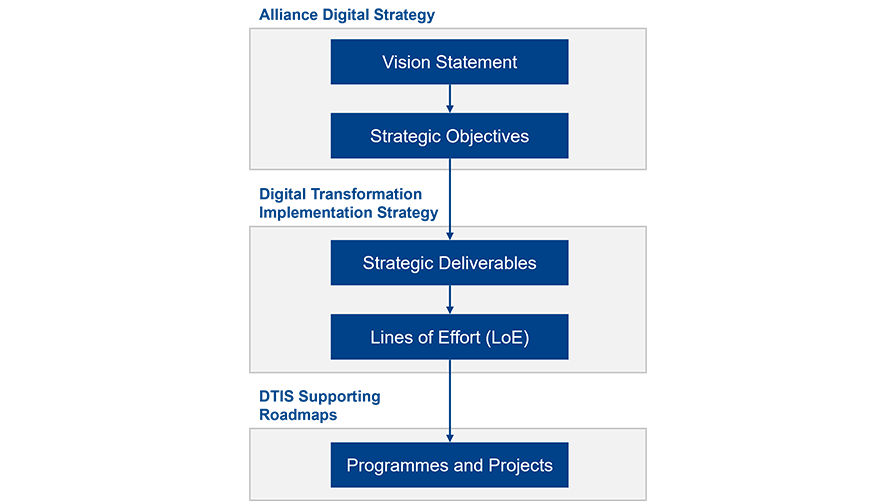
  2. Figure 2 presents the key concepts and illustrates their relationships within a structured hierarchy.
    • The Alliance Digital Strategy defines the aspirational Vision Statement that reflects NATO’s commitment to a secure, interoperable, and data-driven digital future. The Digital Strategy is underpinned by Strategic Principles that serve as enduring guardrails shaping decisions and behaviours. The Strategic Objectives foster unity of purpose and direction in the Alliance’s digital efforts.
    • The DTIS serves as the overarching roadmap for digital transformation. It transforms the way NATO operates by articulating Strategic Deliverables that are the foundational building blocks of a digitally-transformed NATO and embody a forward-looking level of ambition.
    • To facilitate tangible progress, the Strategic Deliverables are broken down into well-defined Lines of Effort (LoEs), which encompass coordinated efforts aimed at achieving a specific strategic or operational condition.
    • Lines of Effort are implemented through Programmes and Projects across different organisations, and require the mobilization of diverse resources, proportionate to the level of ambition.

Figure 2. Key Concepts in NATO’s Digital Transformation
  1. As the DTIS is the strategic-level, overarching roadmap for NATO’s digital transformation, Supporting Roadmaps complement and operationalise the Implementation Strategy by defining relevant Allied and NATO Enterprise efforts more in-depth. It is imperative that Supporting Roadmaps integrate closely with the DTIS to safeguard strategic consistency, optimise resources allocation, and minimise duplication of effort. A synchronised approach ensures convergence towards the shared Strategic Objectives.

Consideration 2: Delivery vehicles for NATO’s digital transformation

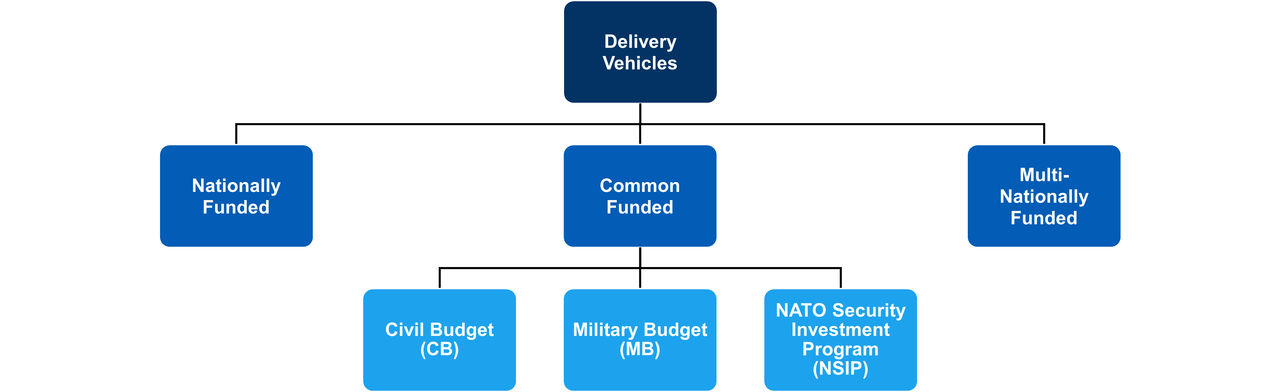
  1. The success of the DTIS is predicated on the contributions of Allies and the NATO Enterprise. As an overarching Implementation Strategy, various delivery vehicles are mobilised to enact meaningful change.
  2. Figure 3 shows that delivery vehicles include common-funded programmes and projects inside and outside the Common Funded Capability Delivery Governance Model (CFCDGM); multinational programmes and projects; and national programmes and projects2.

Figure 3. Delivery Vehicles for NATO’s Digital Transformation
  1. Although a detailed description of coordination mechanisms lies beyond the scope of this document, particular attention should be given to joint committee sessions, the use of multi-reference documents, early and consistent staff alignment, and enhanced information sharing. Strengthening inter-community collaboration and clear decision-making structures will further help streamline activities and foster coherence.
  2. Recognizing the importance of common-funded resources, the success of the DTIS hinges on a close involvement of the Resource Policy and Planning Board (RPPB) to ensure that the digital imperatives embedded in this Implementation Strategy inform resourcing decisions.
  3. Furthermore, close coordination with key delivery entities3 is required to maintain an end-to-end perspective on digital transformation, from strategic planning to implementation.

Consideration 3: A rolling-horizon approach

  1. Recognizing that NATO’s digital transformation is a longitudinal and continuously evolving endeavour, it is not feasible to predetermine all work strands upfront. The pace of change necessitates a time-boxed planning model that allows for iterative adjustment over time, in response to emerging developments and lessons learned from implementation.
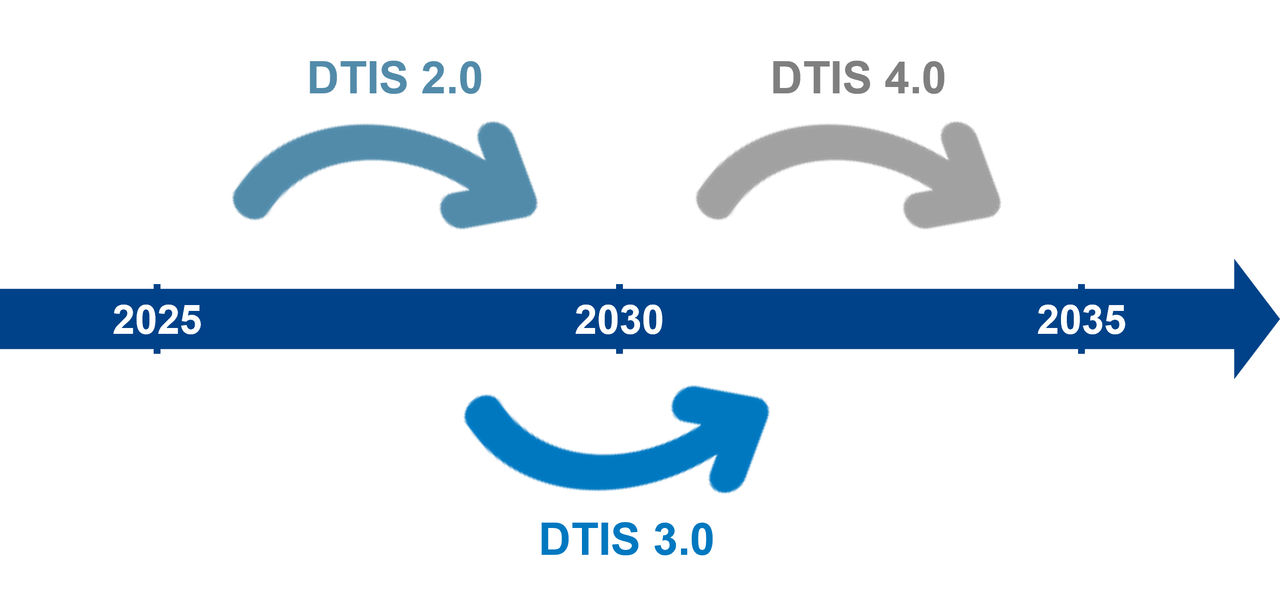
  2. To this end, the DTIS adopts a rolling-horizon approach, maintaining a focused yet extendable planning timeframe that evolves as progress is achieved. In doing so, the DTIS balances the stability required for near-term execution with the adaptability needed to integrate future advancements.
  3. Figure 4 depicts the rolling-horizon approach graphically, with timings shown for illustrative purposes only.

Figure 4. Rolling-Horizon Approach (for illustrative purposes only)
  1. The DTIS 2.0 adopts a five-year outlook, with work strands extending through 2030. Successive iterations of the DTIS will progressively broaden the planning horizon toward 2035, with a potential mid-term update introduced prior to 2030, whilst maintaining a five-year outlook to ensure continued relevance to emerging priorities.

Strategic deliverables

  1. The DTIS enacts transformative change through the definition of Strategic Deliverables, that represent the foundational building blocks of a digitally-transformed NATO.
  2. The following Strategic Deliverables are defined:
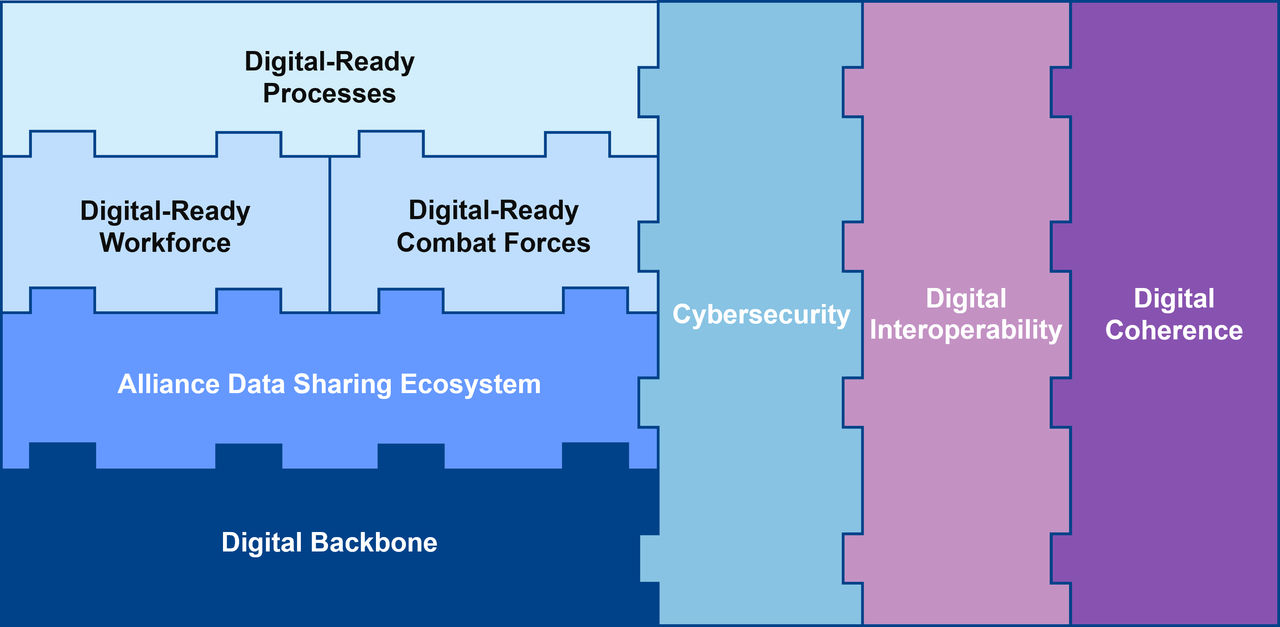
    • Digital Backbone: A federation4 of networks and systems, that provides the technical means for a resilient, scalable, and secure digital services continuum, including cloud and edge services. This federation connects sensors, decision makers, actors, and effectors across the various organisational, national, operational, and security domain boundaries, supporting the full range of political and military activities in peacetime, crisis, and conflict, including maximum level of effort.
    • Alliance Data Sharing Ecosystem: A data ecosystem for defence and security where Allies, the NATO Enterprise, and trusted actors share, label, and exploit interoperable data to accelerate mission execution, enhance operational efficiency, and improve decision-making across the Alliance. The ecosystem covers all Allied Data Domains, including, but not limited to, Geospatial, Space Operations, and Intelligence and ISR5. It is underpinned by an Alliance-wide data-centric governance framework, aligned with NATO policies, and respects data sovereignty and national regulations.
    • Digital-Ready Combat Forces: A modern and effective NATO Force Structure that is trained and equipped to operate effectively in a digitally-enabled battlespace, leveraging warfighting capabilities that are infused with advanced technologies and primed through national and collective exercises. The integration of digital capabilities enhances operational effectiveness and decision superiority in MDO scenarios, strengthening deterrence and defence.
    • Digital-Ready Workforce: A digitally-proficient workforce in the NATO Enterprise and Allies that is equipped with the required competences and tools to operate effectively in a data and technology-driven environment. It is supported by a modern HR lifecycle, that integrates adaptive Learning & Development paths, to keep pace with technological advancements. Observable behavioural change is driven through mechanisms such as performance expectations, leadership development, and organisational culture. Moreover, a culture of continuous improvement serves as the catalyst for collaborations among Allies, NATO, the private sector, and the academic community.
    • Digital-Ready Processes: A modern, streamlined processes landscape that leverages digital technologies to automate, digitise, harmonise, and transform6 relevant processes. It covers the broad spectrum of processes in NATO (conform the C3 Taxonomy) to create fit-for-purpose, agile processes. Moreover, where required and appropriate, it includes changes to relevant policies, doctrine, and ways of working.
    • Cybersecurity: A resilient cybersecurity posture that forms the security foundation of NATO’s digital transformation, ensuring that digital capabilities are secure, trusted, and mission-ready. Anchored in Zero Trust, it advances trusted identity and access management and data-centric security, while embedding assurance through fit-for-purpose security accreditation and robust asset management. Continuous monitoring and rapid incident response further strengthen resilience, enabling the Alliance to operate securely in an increasingly contested digital environment.
    • Digital Interoperability: A structured, common approach to advance digital interoperability across NATO’s digital capabilities, spanning the core processes of the interoperability key value chain. It encompasses the establishment of relevant regulatory, implementation, and technical enablers for digital interoperability. Moreover, it recognises that industry plays a critical role in shaping the standards necessary to achieve digital interoperability across the Alliance.
    • Digital Coherence: A digitally-enabled coherence function that leverages digital technologies to ensure coherence in terms of measuring progress, portfolio management, (reference) architectures and supporting methodologies. In particular, it encompasses efforts aimed at sustaining progress across the interdependent Strategic Deliverables and maintaining alignment with key strategic frameworks.
  3. Figure 5 positions the Strategic Deliverables within a logical, interdependent structure, reflecting the inherent linkages among the Deliverables.

Figure 5. DTIS Strategic Deliverables

1. For example, the integration of Space as an operational domain (advanced through the WDA) requires federated cloud & edge services to interconnect relevant capabilities (advanced through the DTIS).

2. Executed by Allies when implementing their NATO Defence Planning Process (NDPP) Capability Targets.

3. Including the NATO Communications and Information Agency (NCIA), the NATO Support and Procurement Agency (NSPA), and the Centre for Maritime Research and Experimentation (CMRE).

4. Entities that contribute to this federation include: NATO Enterprise entities, Allies’ Armed Forces and any National-led Multi-National forces, and Non-Military Entities (AC/322-D(2024)0068).

5. ISR stands for Intelligence, Surveillance, and Reconnaissance (ISR).

6. This effort draws on principles of Business Process Improvement (BPI), focusing on incremental optimisations, and Business Process Reengineering (BPR), aimed at the transformative redesign of processes.