Close
Back


From now on you can download videos from our website
If you would also like to subscribe to the newsletter and receive our latest updates, click on the button below.
Enter the email address you registered with and we will send you a code to reset your password.
The password must be at least 12 characters long, no spaces, include upper/lowercase letters, numbers and symbols.
Click the button to return to the page you were on and log in with your new password.
So, good morning. Good morning to this important meeting of NATO foreign ministers, and I indeed again want to thank Sweden for the wonderful hospitality. Also last night with the King and Queen and the Prime Minister, it was a really lovely evening, also having Andrii Sybiha there to discuss, of course, issues around Ukraine - I think that was very good. So again, Maria, thank you so much for making this possible.
We will have an important meeting ahead of us today. We will, of course, discuss the outcome of The Hague, the Summit, and how we now move into the Ankara Summit, making a success - first of all, when it comes to the spending - and we see all over NATO territory the spending rapidly ramping up. Last year it is really staggering, in Europe and Canada, equalising now over time with the United States, but that is not the only reason we spend up, we spend more. Yes, of course, we do it for that reason, because it is fair, but also because we need the money to make us capable of defending NATO territory, and it is deeply rooted, as you know, in the capability targets.
But this money only makes sense, not only when we have the men and women in uniform, of course, they are key, but also for them to have their hands on the defence industrial output, and that is a big issue all over NATO territory. So, that will be a big issue in Ankara, but also an opportunity. Because when we speak sometimes about the defence dividends, the jobs, the extra production capacity coming online to defend ourselves, there is also, of course, an economic element in the US, in Canada, in Europe, and we see more and more companies working across the Atlantic.
And then, third, Ukraine, making sure that we do everything to keep Ukraine as strong as possible in the fight. Of course, there are developments. The whole situation with Iran, the Strait of Hormuz, the freedom of navigation at this moment basically seriously being under threat - there is an issue we will no doubt also touch upon today. I know many of us are very worried about the situation. And I know that many countries have already prepositioned very important military equipment close to theatre, so to see how we collectively can help in the next phase.
And so all of that will be, no doubt, today being discussed. But hey, again, thank you for organising this, all of you for being here.


Paulo Rangel (Minister of Foreign Affairs, Portugal) and Hakan Fidan (Minister of Foreign Affairs, Türkiye)
NATO Secretary General Mark Rutte
NATO Deputy Secretary General Radmila Shekerinska with Paulo Rangel (Minister of Foreign Affairs, Portugal) and Hakan Fidan (Minister of Foreign Affairs, Türkiye)
Baiba Braže (Minister of Foreign Affairs, Latvia) and Marco Rubio (US Secretary of State)
Marco Rubio (US Secretary of State), NATO Deputy Secretary General Radmila Shekerinska, NATO Secretary General Mark Rutte and Maria Malmer Stenergard (Minister of Foreign Affairs, Sweden)
Marco Rubio (US Secretary of State)
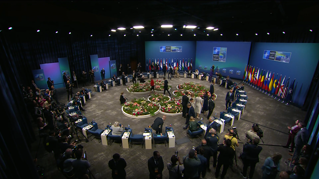
View of the room
Marco Rubio (US Secretary of State), NATO Deputy Secretary General Radmila Shekerinska, NATO Secretary General Mark Rutte and Maria Malmer Stenergard (Minister of Foreign Affairs, Sweden)
NATO Secretary General Mark Rutte and Maria Malmer Stenergard (Minister of Foreign Affairs, Sweden)
Deputy Chair of the Military Committee Lieutenant General Winston P. Brooks, Supreme Allied Commander Europe, General Alexus G. Grynkewich and Supreme Allied Commander Transformation, Admiral Pierre Vandier
Timcho Mucunski (Minister of Foreign Affairs, North Macedonia) and Maxime Prévot (Minister of Foreign Affairs, Belgium)
Ferit Hoxha (Minister of Foreign Affairs, Albania) and Maxime Prévot (Minister of Foreign Affairs, Belgium)
Velislava Petrova-Chamova (Minister of Foreign Affairs, Bulgaria) and Anita Anand (Minister of Foreign Affairs, Canada)
Anita Anand (Minister of Foreign Affairs, Canada), Gordan Grlić Radman (Minister of Foreign Affairs, Croatia) and Petr Macinka (Minister of Foreign Affairs, Czechia)
Petr Macinka (Minister of Foreign Affairs, Czechia), Lars Løkke Rasmussen (Minister of Foreign Affairs, Denmark) and Margus Tsahkna (Minister of Foreign Affairs, Estonia)
Tom Berendsen (Minister of Foreign Affairs, Netherlands)
View of the room
NATO Secretary General Mark Rutte and Maria Malmer Stenergard (Minister of Foreign Affairs, Sweden)
Lars Løkke Rasmussen (Minister of Foreign Affairs, Denmark), Margus Tsahkna (Minister of Foreign Affairs, Estonia) and Elina Valtonen (Minister of Foreign Affairs, Finland)
Jean-Noël Barrot (Minister of Foreign Affairs, France), Johann Wadephul (Minister of Foreign Affairs, Germany) and Alexandra Papadopoulou (Deputy Minister of Foreign Affairs, Greece)
Alexandra Papadopoulou (Deputy Minister of Foreign Affairs, Greece), Anita Orbán (Minister of Foreign Affairs, Hungary) and Þorgerður Katrín Gunnarsdóttir (Minister of Foreign Affairs, Iceland)
Antonio Tajani (Minister of Foreign Affairs, Italy), Baiba Braže (Minister of Foreign Affairs, Latvia), Kęstutis Budrys (Minister of Foreign Affairs, Lithuania) and Frédéric Müller (Permanent Representative, Luxembourg)
Petr Macinka (Minister of Foreign Affairs, Czechia), Lars Løkke Rasmussen (Minister of Foreign Affairs, Denmark), Margus Tsahkna (Minister of Foreign Affairs, Estonia) and Elina Valtonen (Minister of Foreign Affairs, Finland)
Gordan Grlić Radman (Minister of Foreign Affairs, Croatia), Petr Macinka (Minister of Foreign Affairs, Czechia), Lars Løkke Rasmussen (Minister of Foreign Affairs, Denmark), Margus Tsahkna (Minister of Foreign Affairs, Estonia)
Oana-Silvia Țoiu (Minister of Foreign Affairs, Romania), Juraj Blanár (Minister of Foreign Affairs, Slovak Republic), Andrej Benedejčič (Permanent Representative, Slovenia) and José Manuel Albares Bueno (Minister of Foreign Affairs, Spain)
Deputy Chair of the Military Committee Lieutenant General Winston P. Brooks, Supreme Allied Commander Europe, General Alexus G. Grynkewich and Supreme Allied Commander Transformation, Admiral Pierre Vandier
NATO Deputy Secretary General Radmila Shekerinska, NATO Secretary General Mark Rutte, Maria Malmer Stenergard (Minister of Foreign Affairs, Sweden)
View of the room
View or the room
Meeting of the North Atlantic Council in Foreign Ministers’ Session