Close
Back


From now on you can download videos from our website
If you would also like to subscribe to the newsletter and receive our latest updates, click on the button below.
Enter the email address you registered with and we will send you a code to reset your password.
The password must be at least 12 characters long, no spaces, include upper/lowercase letters, numbers and symbols.
Click the button to return to the page you were on and log in with your new password.
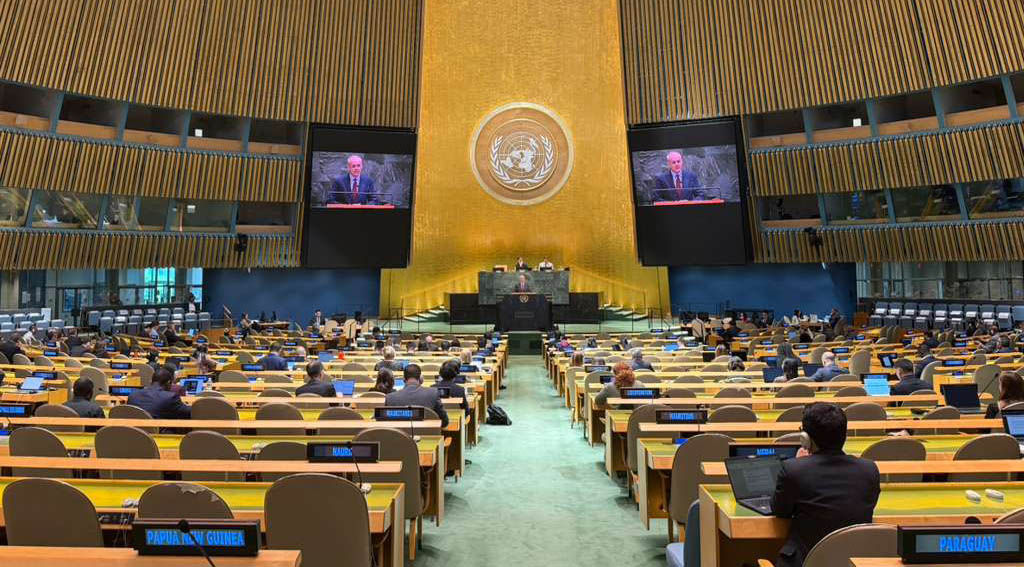
Mister President, Excellencies, Ladies and Gentlemen;
Let me start by congratulating you, Ambassador Do Hung Viet, on your election as the President of the Eleventh NPT Review Conference.
We will work with you for a successful outcome.
Today, it’s an honour to speak on behalf of the North Atlantic Treaty Organization, an Alliance of 32 nations.
We recognise the importance of this Review Conference. And we will continue to listen closely to the views put forth here, engaging with many delegations and reflecting carefully on their positions and perspectives.
Nuclear non-proliferation remains as vital today as it was when the NPT came into force in 1970.
Since then, the NPT has attracted near-universal adherence, and has cemented a norm against proliferation that remains strong today, despite the challenges we face.
It provides the only credible path to nuclear disarmament; includes the five Nuclear-Weapon States; and provides the basis for work to reduce strategic risk, encourage transparency, and tackle the challenges of verification.
Through the IAEA, the NPT plays a vital role on non-proliferation and safeguards, and establishes a trusted framework for the peaceful uses of nuclear energy.
But today, we face a gravely deteriorating security environment.
Russia’s full-scale invasion of Ukraine has caused the largest war in Europe since 1945, which has killed hundreds of thousands of people and displaced millions.
Russia has engaged in irresponsible nuclear rhetoric and coercive nuclear signalling. It has violated crucial arms control commitments. It has done all this in the context of its illegal and unprovoked aggression against Ukraine, a non-Nuclear-Weapon State.
This has fundamentally changed the security environment in the Euro-Atlantic area. NATO’s role as a defensive Alliance is to safeguard the freedom and security of all Allies and to protect our 1 billion citizens.
Faced with Russia’s aggression and its willingness to employ nuclear threats, NATO’s nuclear capability retains its fundamental purpose: to preserve peace, prevent coercion, and deter aggression.
NATO’s nuclear deterrence and nuclear sharing arrangements play an important role in fulfilling that purpose. They predate the NPT, were well-known when the Treaty was negotiated and ratified, and at its indefinite extension in 1995. They have always been fully consistent with the NPT.
From the outset, extended deterrence has made a key contribution to preventing proliferation.
For decades, arms control, non-proliferation and disarmament have been critical to preserving peace and promoting strategic stability. For NATO, they remain essential.
This remains true even as China continues to rapidly expand its nuclear arsenal. According to publicly available information, China will build eight nuclear warheads over the course of this conference. We call on China to increase transparency around its military nuclear programme.
Meanwhile, Iran’s nuclear programme poses grave challenges to the NPT’s objectives. The DPRK’s illegal nuclear weapons and ballistic missile programs also undermine the NPT.
None of these challenges take away from the NPT’s success and its critical role for the future.
The Treaty remains the essential cornerstone of the global non-proliferation and disarmament architecture, and the framework for international cooperation on the peaceful uses of nuclear energy.
We must use this Review Conference to preserve and strengthen the NPT.
On 21 April, the North Atlantic Council issued a statement underlining Allies’ strong commitment to the full implementation of the NPT.
We are resolved to contribute to the preservation, universalisation, and full implementation of the Treaty.
We continue to support all of its objectives, including Article VI, with a view towards worldwide verifiable elimination of nuclear weapons, based on the principle of undiminished security for all.
Allies have always done their part, including through reducing dramatically the number of nuclear weapons in Europe by around 90% since the height of the Cold War. Deterrence has never stood in the way of disarmament.
Notwithstanding the difficult security context, Allies remain firmly committed to taking concrete, practical, and achievable steps at this Review Conference:
· To promote transparency;
· To reduce risk;
· To declare a voluntary moratorium on the production of fissile materials for use in nuclear weapons; and
· To verifiably ensure a world without nuclear weapon test explosion.
These measures will help rebuild the trust without which we will be unable to move towards nuclear disarmament as envisioned under Article VI.
Allies strongly encourage the United States’ pursuit of multilateral strategic stability. We call on China and Russia to engage constructively.
Mr President, NATO is a defensive Alliance and a responsible actor. The partnerships we have with approximately 40 states parties from Europe, the Middle East, Africa, the Asia-Pacific, and Latin America are testament to this.
Over the next weeks, we must all reaffirm our commitment to the NPT, across all three pillars.
And together, we must work to identify common ground.
NATO Allies stand ready to play their part.
Thank you, Mr. President.