
Close
Back


From now on you can download videos from our website
If you would also like to subscribe to the newsletter and receive our latest updates, click on the button below.
Enter the email address you registered with and we will send you a code to reset your password.
The password must be at least 12 characters long, no spaces, include upper/lowercase letters, numbers and symbols.
Click the button to return to the page you were on and log in with your new password.
30 April 2026
2 MIN READ
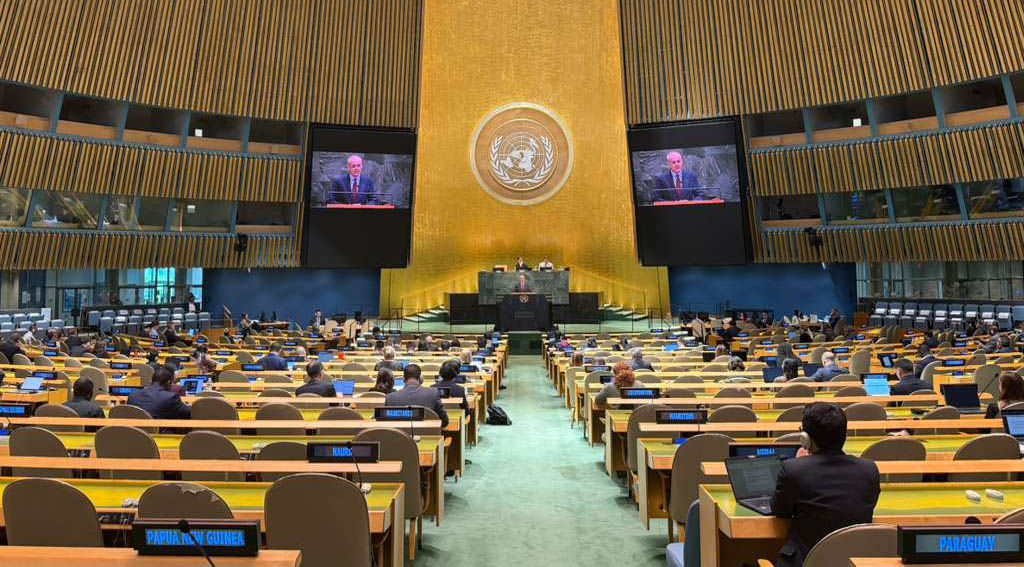
NATO reaffirmed its strong commitment to the full implementation of the Treaty on the Non-Proliferation of Nuclear Weapons (NPT) at the United Nations in New York on Thursday (30 April 2026). Addressing the 11th Review Conference of the Treaty on behalf of the Alliance, Assistant Secretary General Boris Ruge stressed that "nuclear non-proliferation remains as vital today as it was when the NPT came into force in 1970."
Ambassador Ruge set out the "gravely deteriorating security environment" – in particular Russia's full-scale invasion of Ukraine, combined with Moscow's irresponsible nuclear rhetoric and coercive nuclear signalling. "Faced with Russia’s aggression and its willingness to employ nuclear threats," he said, "NATO’s nuclear capability retains its fundamental purpose: to preserve peace, prevent coercion, and deter aggression." He underlined that NATO's nuclear deterrence and nuclear sharing arrangements pre-date the NPT, were well-known when the Treaty was negotiated and ratified, and at its indefinite extension in 1995, stressing: "they have always been fully consistent with the NPT”. He added that extended deterrence has made a key contribution to preventing proliferation.
NATO has a long-standing commitment to arms control, disarmament and non-proliferation, and Ambassador Ruge stressed that these "remain essential," even as China continues to rapidly expand its nuclear arsenal. He called on Beijing to increase transparency around its military nuclear programme, also pointing to Iran and the DPRK's grave challenges to the NPT.
"We must use this Review Conference to preserve and strengthen the NPT," said Ambassador Ruge, adding that Allies will work on concrete, practical and achievable steps, including to promote transparency and reduce risk. He said that Allies strongly encourage the United States’ pursuit of multilateral strategic stability, and call on China and Russia to engage constructively.
While in New York, Assistant Secretary General Ruge held meetings with UN Under-Secretary-General for Disarmament Affairs Izumi Nakamitsu, Review Conference President Do Hung Viet, and a range of senior national officials – including from all 32 NATO Allies, from NATO's Indo-Pacific and Western European partners, from ASEAN, and from Africa.
Ahead of the Review Conference, the North Atlantic Council agreed a statement reaffirming strong commitment to the NPT.