Close
Back


From now on you can download videos from our website
If you would also like to subscribe to the newsletter and receive our latest updates, click on the button below.
Enter the email address you registered with and we will send you a code to reset your password.
The password must be at least 12 characters long, no spaces, include upper/lowercase letters, numbers and symbols.
Click the button to return to the page you were on and log in with your new password.
Good morning. Good that you're all here. Looking forward — at least I'm looking forward, I hope you're also looking forward — to the meeting of Foreign Ministers. I really want again to thank Sweden for organising, as you know only a couple of years in NATO, and already organising such a huge event. Sweden is an important new Ally, of course, together with Finland, when they came in, Finland a bit earlier.
What we will focus on today is very much on the Ankara Summit. The main themes for the Ankara Summit.
First of all, making sure that money is there to deter and defend ourselves against any adversary. And the good news here is, of course, that the money is really coming in. Many Allies committing more and more, accelerating the path to the 5% spending commitment in The Hague. And this literally means tens, over the years, hundreds of billions of extra defence spending.
Secondly, the money is great, but then we need to spend it. And to spend it, of course, on the men and women in uniform, but also making sure that they have what they need to deter and defend. And that is the defence industrial output. And there's an intense debate going on with the defence industry, with the financial sector, to make sure that also they do what is needed to ramp up their defence production, not increasing prices, but producing more. And good news is coming in. We make progress, but still a lot needs to be done. And Ankara will also very much focus on this issue.
And thirdly, last night we had Andrii Sybiha here, the Ukrainian Foreign Minister, of course, is how can we keep Ukraine as strong as possible in the fight. They are holding the front line, and I mean I'm really impressed how they fiercely opposed the Russian attack since 2022, the full-scale invasion since 2022, but still we have to make sure that they have what they need to maintain in the fight. And that is also about money. And making sure that that money and support for Ukraine is as evenly distributed over NATO Allies as possible. And I think we can do more here so that will also be one of the themes we will discuss. Having said this, we will meet later today at the press centre but if you have a few questions now I can take two or three. And then we'll see us later.
Teri Schultz, DW
Secretary General, thank you. What do you make of the announcement overnight, our overnight, from President Trump of sending 5,000 more troops to Poland, reversing a decline. And what does this mean for the smaller deployments for the Baltic states as we understand it?
Mark Rutte, NATO Secretary General
Of course, I welcome the announcement. Our military commanders are working through all the details, but of course, I welcome it. But let's be clear, the trajectory we are on — which is a stronger Europe and a stronger NATO, making sure we will over time, step-by-step, be less reliant on one Ally only, as we have been for so long, which is United States, so that also for them, they have the possibility and the option to pivot more towards other priorities, which are also in our interest — will continue. But of course, I very much welcome the announcement yesterday.
Question
How confident are you about this contradicting messaging from the US, and what can you do to ensure the predictability for Allies and [inaudible]?
Mark Rutte, NATO Secretary General
You have seen over the years, always, that there are decisions about deployments and troop levels, etc. But there is, when you zoom out, you clearly see the trajectory. The trajectory is that European Allies are spending more. I've mentioned yesterday again the German example, but I could mention the Dutch example, the Polish example, so many examples in Europe. Sweden, where we are today, already reaching the 5%, including the 3.5 core defence spending by 2030, five years ahead of schedule. And this is necessary not only to equalise what we are spending with the United States, but also to make sure that we have what we need to deter and defend against our adversaries, including our long-term threat, which is Russia. And the US will play a key role in Europe when it comes to the nuclear, but also when it comes to the conventional. But what you will be seeing over the coming time is a step-by-step process where the Europeans step up more, which is really important. The Americans acknowledge this, and within that process, you will always have, of course, decisions and announcements, which are part of the longer term trajectory.
Christoffer Wendick, SVT
What does it matter for NATO whether this decision of Trump is a military-strategic one or purely a political one, to punish one country and to gain another?
Mark Rutte, NATO Secretary General
Hey listen, NATO is a political military alliance, so that's the big difference with China or Russia, where one person in the end takes all the decisions. We are a democratic alliance and a military alliance. And that means that decisions will always be informed by military and political considerations. That's how it works.
Question
How can you guarantee that this focus stays on Ukraine?
Mark Rutte, NATO Secretary General
Basically, it is happening already. What I'm seeing, for example, the United States, the flow of US crucial gear into Ukraine continues. This includes, of course, vital anti-ballistic missile support, including for the Patriot systems paid for the European Allies. The famous PURL programme, it is continuing. The Europeans are paying for it. What I want to achieve is that the burden is more evenly spread, that there is more burden sharing here. Because at the moment, it is only six or seven Allies who are doing the heavy lifting. The good news is that what they do is enough to make sure that Ukraine keeps having the access to this crucial US equipment. But of course it would be fairer if within NATO, and particularly the European part of NATO, we could see other Allies also stepping up, but when it comes to the support for Ukraine and political support for Ukraine particularly, there is absolutely no discussion. We all see the necessity and we see the Ukrainians doing remarkably well on the battlefield. Final question.
Question
Before he left the US last night, Mr Rubio expressed his concern that NATO not helping the US in the war in Iran, the Hormuz Strait situation. Will you talk about that [inaudible]?
Mark Rutte, NATO Secretary General
No doubt. When Foreign Ministers meet, we will discuss all relevant events, all relevant developments, including of course, the Strait of Hormuz in Iran. When I was in the United States early April, I also spoke with the President and the Secretary of State and the Secretary of War. I really sense this disappointment. Let me also say that Europeans have heard the message when it comes, for example, to European bases, and these are bilateral commitments by European countries with the United States, so that the United States can use these bilateral commitments for operations they have elsewhere in the world. When you look at Europe right now, over the last two months, massively European countries have been living up to those commitments. I was in Bucharest last week, and I saw first-hand, and you know that the Romanian government had to change even the legislation to make this possible, and they did this as I think, in one or two days. I saw the tankers on the airport of Bucharest, but the same is true for Bulgaria, Portugal. It's true for Greece, but also the bigger countries like Italy and UK and France and Germany. So they are all, when it comes to making their bases available, doing what US could expect based on bilateral commitments.
Then, when it comes to the Strait of Hormuz, next phase. What we are seeing is, and also here I think Europeans really heard the message, is many European countries making sure that they, let's say, preposition some of their key ships and other equipment close to theatre, for example demining equipment, demining ships, demining uncrewed systems, so that in that next phase we can be maximum helpful as European Allies with United States to see how we can make sure that the freedom of navigation, and this is what is at stake here. The Strait of Hormuz is at this moment choked off, and the free movement of navigation is seriously under threat here. So, of course, this is an interest also for all Allies, not for NATO maybe as an Alliance, but clearly wherever we can help, we will be there. Thank you so much.


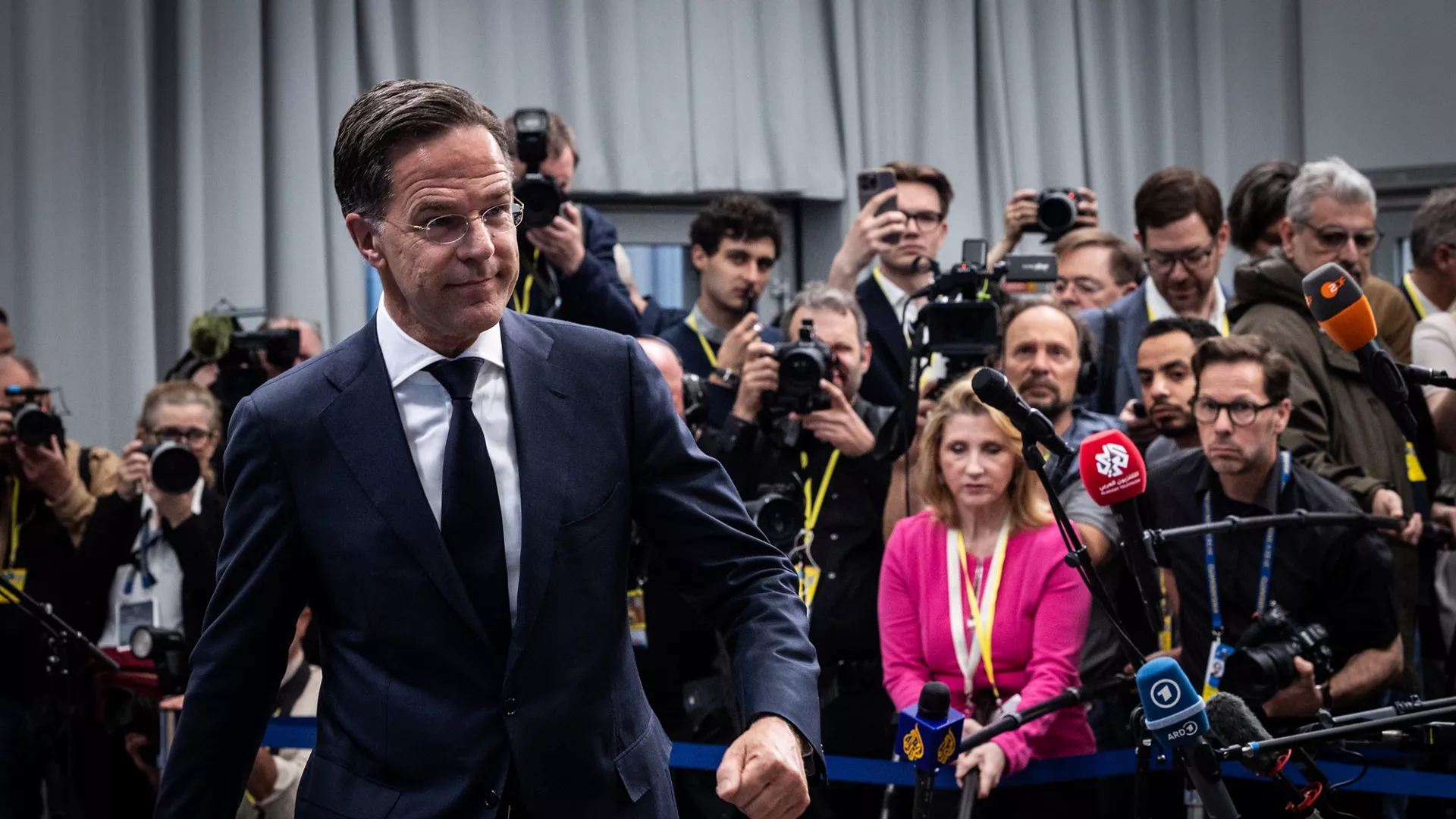
Doorstep statement by the NATO Secretary General Mark Rutte at the meeting of NATO Ministers of Foreign Affairs in Helsingborg, Sweden
Doorstep statement by the NATO Secretary General Mark Rutte at the meeting of NATO Ministers of Foreign Affairs in Helsingborg, Sweden
Doorstep statement by the NATO Secretary General Mark Rutte at the meeting of NATO Ministers of Foreign Affairs in Helsingborg, Sweden
Doorstep statement by the NATO Secretary General Mark Rutte at the meeting of NATO Ministers of Foreign Affairs in Helsingborg, Sweden
Doorstep statement by the NATO Secretary General Mark Rutte at the meeting of NATO Ministers of Foreign Affairs in Helsingborg, Sweden
Doorstep statement by the NATO Secretary General Mark Rutte at the meeting of NATO Ministers of Foreign Affairs in Helsingborg, Sweden
Doorstep statement by the NATO Secretary General