
Close
Back


From now on you can download videos from our website
If you would also like to subscribe to the newsletter and receive our latest updates, click on the button below.
Enter the email address you registered with and we will send you a code to reset your password.
The password must be at least 12 characters long, no spaces, include upper/lowercase letters, numbers and symbols.
Click the button to return to the page you were on and log in with your new password.
29 March 2018
2 MIN READ

Exactly 60 years ago, on 29 March 1958, the North Atlantic Council met in Paris where the then 15 NATO Ambassadors formally announced the establishment of a NATO Science Committee and the position of a Science Advisor to the Secretary General. Professor Norman F. Ramsey, a renowned US physicist from Harvard University who had once worked on the Manhattan Project, was appointed Science Advisor and chaired the first meeting of the NATO Science Committee, marking the foundation of the NATO Science Programme. Against the background of the launch of Sputnik1 by the Soviet Union, one of the Programme’s major goals was to promote the training of scientists within NATO countries to facilitate exchanges, build networks, and increase returns on research investments.
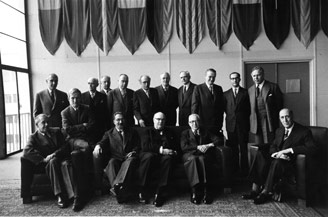
Since then, the Programme has come a long way while constantly adapting to changing demands. Known since 2006 as the Science for Peace and Security (SPS) Programme, it offers unique ways to engage NATO nations and partners in meaningful, practical cooperation with tangible results and deliverables. Today, approximately 150 ongoing SPS projects, workshops and training courses help to build capacity in partner countries, support NATO efforts in the fight against terrorism, facilitate the development of security-related advanced technologies and foster expert networks to address questions related to cyber defence or the role of women in peace and security.
As the SPS Programme celebrates its 60th anniversary, I am proudly looking back at its past achievements and impact. For instance, a constant throughout the last six decades has been the Programme’s contribution to and emphasis on innovation and scientific excellence. More than 20 scientists who had been involved in the Science Programme received a Nobel Prize. This included two gentlemen who were strongly involved in the creation of the Programme in the late 1950s: Norman Ramsey, the First NATO Science Committee Chairman, was awarded with the Nobel Prize for Physics in 1989 for the invention of a method that had crucial applications in the construction of atomic clocks. And Lester Pearson, one of the ‘Three Wise Men’ suggesting to enhance NATO cooperation in non-military areas such as science in the first place, received the Nobel Peace Prize in 1957 for contributing to a peaceful resolution of the Suez crisis.
On its 60th anniversary, SPS is far from considering retirement. I am convinced that the Programme will remain on a successful path and continue to promote NATO’s strategic objectives and partnerships and to demonstrate its flexibility in the foreseeable future.
Dr. Antonio Missiroli
NATO Assistant Secretary General for Emerging Security Challenges