
Close
Back


From now on you can download videos from our website
If you would also like to subscribe to the newsletter and receive our latest updates, click on the button below.
Enter the email address you registered with and we will send you a code to reset your password.
The password must be at least 12 characters long, no spaces, include upper/lowercase letters, numbers and symbols.
Click the button to return to the page you were on and log in with your new password.
13 March 2017
1 MIN READ
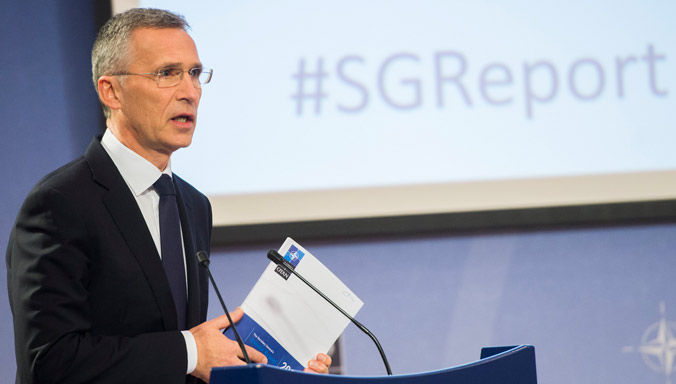
NATO Secretary General Jens Stoltenberg published his annual report today (Monday 13 March), showing how in 2016 the Alliance, “took further steps to keep our almost one billion citizens safe.”
The report highlights how NATO is adapting to the new security environment by strengthening its collective defence and projecting stability beyond its borders.
Four multinational battlegroups are being deployed to Estonia, Latvia, Lithuania and Poland. At least seventeen Allied countries will contribute troops.
While enchancing its deterrence measures in the eastern part of the Alliance, NATO has had political dialogue with Russia and held three meetings of the NATO-Russia Council last year.
The Secretary General underlined how the Alliance is doing more to project stability, such as by training local forces in Afghanistan and Iraq to fight terrorism. NATO has also sent training teams to countries including Jordan, Morocco and Tunisia.
NATO AWACS planes are supporting the Global Coalition to Counter-ISIL and a new Intelligence Division has been created by NATO to deepen its understanding of the threats it faces.
Mr Stoltenberg explained how the Alliance has turned a corner on defence spending. In 2016 twenty-three Allies increased their defence expenditure in real terms by 3.8 %, which added up to ten billion US dollars.
The Secretary General confirmed only five Allies spent 2% or more of GDP on defence in 2016. He said, “It is realistic that all Allies should reach this goal. All Allies have agreed to it at the highest level and it can be done.”
Mr Stoltenberg pointed out European Allies together spent 2% of GDP on defence as recently as the year 2000. He was encouraged that Romania plans to reach 2% this year and both Latvia and Lithuania expect to do the same in 2018.
The Secretary General encouraged Allies to redouble their efforts on defence spending and said it would be a key focus at the upcoming meeting of NATO leaders.