
Close
Back


From now on you can download videos from our website
If you would also like to subscribe to the newsletter and receive our latest updates, click on the button below.
Enter the email address you registered with and we will send you a code to reset your password.
The password must be at least 12 characters long, no spaces, include upper/lowercase letters, numbers and symbols.
Click the button to return to the page you were on and log in with your new password.
15 November 2013
2 MIN READ
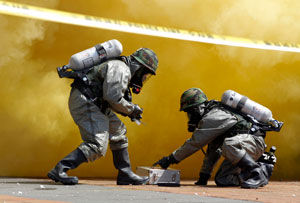
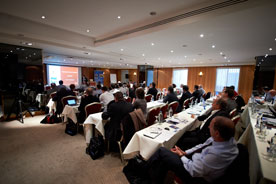
Incidents involving chemical, biological, radiological and nuclear (CBRN) agents remain a real threat to populations across the globe. In an increasingly interconnected world, effective prevention and response depends upon cooperation between international actors to identify best practices and develop the technological capabilities to meet these threats. Experts from NATO and partner countries and the NATO Weapons of Mass Destruction Centre, discussed possible areas for future practical cooperation in this field at a three-day workshop in Brussels, organised by the NATO Science for Peace and Security (SPS) Programme from 22 to 24 October.
Dr Jamie Shea, Deputy Assistant Secretary General of NATO's Emerging Security Challenges Division underlined the reality of the threat of CBRN agents: "We have recently seen the awful use of chemical weapons in Syria, which has been documented by the United Nations, and which may break a taboo on the use of these agents and increase the prospect of seeing more incidents like this in the future."
Defence against CBRN agents is a top priority for NATO's Emerging Security Challenges Division, which supports broad international cooperation to address many of today's security challenges. Dr Deniz Yüksel-Beten, Senior SPS and Partnership Cooperation Advisor, emphasised that without adequate regional and international cooperation it would be impossible to address the variety of issues relating to CBRN threats today.
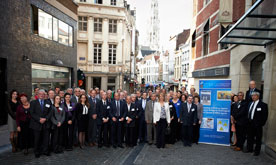
The workshop brought together leading experts addressing diverse aspects of CBRN defence. "Some work on medical countermeasures, some work on chemical aspects, while others focus on the biological side," Dr Beten pointed out. She added that the workshop provided "an excellent opportunity to build a network of distinguished experts to pool ideas and potentially develop new projects that will increase security for all."
The experts exchanged views on the critical security risks caused by CBRN agents, the most promising technological solutions, as well as the best practices to prevent and respond to them. Issues such as rapid detection, physical protection and decontamination of CRBN agents, as well as medical countermeasures were addressed.
Dr Eyüp Kuntay Turmuş, SPS Science Advisor, highlighted some of the concrete recommendations that were developed at the event: "Mobile and user-friendly detection technologies, improving coordination between civilian and military CBRN defence practitioners as well as quick and effective communication to the public in case of a CBRN incident. These expert inputs are very valuable to us in supporting the best and most relevant CBRN defence activities in the SPS Programme."
Over 70 scientists and experts took part in the workshop, including many directors of ongoing or completed SPS activities in the area of CBRN defence.